By Pauline Weston Thomas for Fashion-Era.com
Christmas Customs - The Tradition of the Holly and the Ivy
- Winter Solstice
- Easy to Make Xmas Floral Epergne Display
- Holly
- Mistletoe (Viscum album)
- Decorated Fireplace
- The Holly and the Ivy Lyrics
Winter Solstice
Living evergreen decoration is a key element in seasonal decoration for winter and Christmas festivities. Our Christian festival falls at the time of the original pagan feasts which celebrated light over darkness and was called the winter solstice. Pagan symbolism of believing that evergreens in winter kept away evil spirits merged with Christian celebrations over the years and the use of holly, mistletoe and ivy in evergreen boughs is long standing in the UK.
In the northern hemisphere the winter solstice actually takes place on December 21/22 and is the start of winter. It once celebrated the return of the Sun god when light would return. Bringing greenery into the house and decorating the interior and also the entrance is traditional in many countries. In Scandinavia, a tradition was to bring in a Yule log, light it and drink mead beside it whilst watching the flames make light now disappeared for the winter. That tradition eventually made it's way via the Vikings to Great Britain, but probably died out for many in the 1950s, although one does sometimes see Yule logs burning in great country hotel and pub fireplaces.
I like to decorate my fireplace and have door wreaths and other arrangements which add extra festive colour to a room. I also like to have some inexpensive floral arrangements around that can be topped up with fresh flowers easily and with not too much fuss. Here is a low cost example of a made-at-home decorative display of greenery and red roses. I admit the display is in an antique epergne, but there are many similar wrought iron candle holders available on the market today for around £20 or so and which hold large egg-shaped candles in plain glass containers. I'm sure you've seen them. The modern glass containers could be used the same way as used in my epergne display pictures below. Bowls of white hyacinths are also one of my favourites for their perfume at Christmas.


My epergne is art nouveau in style and is a piece my mother-in-law gave me. It belonged to her mother who was born in the late Victorian era and was married in 1915. This was a wedding gift to her and her husband. A piece such as this was often filled with dainty primroses.
But it could be loaded with trailing grapes, filled or piled high with candy sticks or sweets.
The Victorians and Edwardians loved using epergnes to decorate their dining table centre or sideboards. Some of the finest epergnes can be seen at the Victoria and Albert Museum, many with a larger central bowl so fruit and greenery can flow in abundance.
Holly
Holly leaves symbolise the crown of thorns of Christ and his drops of blood are signified by the reddest of berries. During the time of Oliver Cromwell Xmas was banned by the Puritans in Britain, but Christian country folk tied up rough bunches of 'holy' boughs of evergreens at Christmas as a symbol of Christmas. This then became the holly bough we know today. Until the start of the 1800s it was the evergreen bough that was brought indoors rather than the Xmas tree made popular by Prince Albert.
Mistletoe (Viscum Album)
The idea of a mistletoe bough soon followed the holly bough and by the 18th century it had become a mistletoe ball enhanced with extra ribbons and even ornaments, but especially with a red apple in its centre.
Mistletoe (Viscum album) was venerated even by the Romans for its magical powers. Although it is toxic, recently it has been recognised in health circles to have healing powers probably still untapped fully. Homeopathic recipes suggest it can be used to lower blood pressure and may have a role in cancers remedies, but only a fully qualified medical practitioner should ever prescribe it.
Mistletoe is a parasite that grows on other trees such as apple, poplar and oak trees. Where I live in Worcestershire, one sees mistletoe growing frequently on trees, particularly on trees formerly full of apple blossom. Worcestershire is the provider of much of the UK's mistletoe and along with supplies from Gloucester is sold annually at the famous Cattle Market, Tenbury Wells Mistletoe Auction in early December. All other UK mistletoe now comes in from Normandy or Brittany.
Hanging mistletoe in the home was originally done to ward off evil spirits and encourage the blossom of a new spring. The Victorians used it in doorways and ceilings and festive rules were relaxed enough for the odd 'socially acceptable 'mistletoe kiss' to take place. Tradition insists that the more berries there are the more possible kisses. But every kiss meant a berry plucked and once the berries had gone so the kissing stopped. The kissing custom is descended from the Celts/Druids and they believed that mistletoe was an antidote for all poisons and that when given in drink it could impart fertility to any barren animal.
Mistletoe is a very attractive plant when sat beside holly and ivy providing contrast and interest in wreaths and Xmas foliage arrangements.
Decorated Fireplace
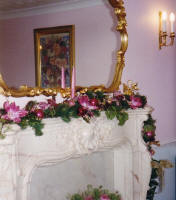
This Xmas garland is an artificial one I use sometimes to decorate my ornate fireplace.
Artificial greenery reached new heights of believability in the 1990s, but I like to add a little fresh ivy from the garden to enliven it and to color-coordinate flowers and baubles with the room.
Sometimes I adjust this idea and add Clementines, gilded walnuts, gingerbread characters and cinnamon bunches with tartan ribbons. Nothing replaces that fresh green conifer smell though and real wreaths and swags, time permitting, can easily be made using leftover side branches of a trimmed Xmas tree with some florist's thicker gauge wire.
All of this greenery can lift our spirits as it brings aromas into the home perhaps not sensed since the previous Christmas. It's so important that this famous carol says it all.
The Holly and the Ivy Lyrics
1
The holly and the ivy,
When they are both full grown
Of all the trees that are in the wood
The holly bears the crown
O the rising of the sun
And the running of the deer
The playing of the merry organ
Sweet singing of the choir
2
The holly bears a blossom
As white as lily flower
And Mary bore sweet Jesus Christ
To be our sweet Saviour
O the rising of the sun
And the running of the deer
The playing of the merry organ
Sweet singing of the choir
3
The holly bears a berry
As red as any blood
And Mary bore sweet Jesus Christ
To do poor sinners good
O the rising of the sun
And the running of the deer
The playing of the merry organ
Sweet singing of the choir
4
The holly bears a prickle
As sharp as any thorn;
And Mary bore sweet Jesus Christ
On Christmas Day in the morn.
O the rising of the sun
And the running of the deer
The playing of the merry organ
Sweet singing of the choir
5
The holly bears a bark
As bitter as any gall;
And Mary bore sweet Jesus Christ
For to redeem us all.
O the rising of the sun
And the running of the deer
The playing of the merry organ
Sweet singing of the choir
6
The holly and the ivy
Now both are full well grown,
Of all the trees that are in the wood,
The holly bears the crown.
O the rising of the sun
And the running of the deer
The playing of the merry organ
Sweet singing of the choir