By Pauline Weston Thomas for Fashion-Era.com
The fashion of the 1950s is based primarily on the New Look style set in the late 1940s by Dior. Many vintage styles of the 50's are full skirted, but some are the slim sheath dresses favoured by other designers such as Jacques Fath, the sack dress of the late fifties designed by Hubert de Givenchy and the encrusted embroidered striking jewelled evening designs of Pierre Balmain.
Other famous European designer names of the 50's era include Christobal Balenciaga, Coco Chanel, Jacques Heim, Molyneux, Paquin, Robert Piguet, Jean Patou, Jean Desses, Jacques Griffe, Nina Ricci, Fabiani, Madame Gres (earlier models called Alix) and the House of Lanvin. They are the most sought after vintage European design names to seek from 50's clothing.
Prized 50's American designer names include Claire McCardell, Mainbocher (Main Rousseau Bocher), Galanos, Pauline Trigère and the Anglo-American Charles James.
1950s Couture Gown by Mainbocher
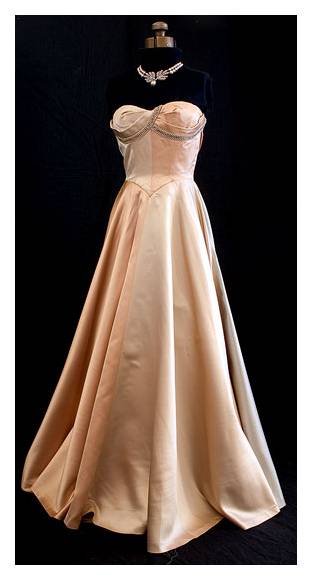
Throughout the 1940s and 1950s, Mainbocher was the most expensive custom dress designer in New York. His couture house was the only design establishment in New York that never produced ready-to-wear clothing.
This luxurious silk satin gown is divided into four sections of colour. The front bodice and skirt are alternating ivory and pastel peach; the back bodice and skirt are alternating pale dusty rose and blue.

1950s Dresses and Evening Wear
Only a minority of women could afford to wear couture designer clothes in the fifties and the majority of women wore mass produced goods. Yet fresh ideas and fashion concepts trickled down from the French salons to Madame dress shops and department stores throughout the world.
Miss and Mrs. Average were soon seen in looks that captured the essential style set by Paris. These are the clothes most vintage pickers find today. They were produced fairly rapidly by improved production methods in a post war economy boom for a society desperate for "new" goods of every description.
Clothes worn in the day were very feminine and designed to remind women they were women. Women also still craved luxury in dress after years of deprivation during the Utility period. Evening wear produced in the 50s even for the masses was often ultra glamorous. Aspects of 50's vintage clothing to collect are clothes with tiny waists, shown often as glamorous, luxurious, feminine, low necked evening dresses or boned strapless dresses in taffetas, lace, nets, tulle, chiffon and satin or even nylon.

A wide range of net and nylon hoop crinoline-style petticoats were produced to support the full bouffant skirts. Vintage underslips of the era are very collectible.
You may even find a well-designed vintage strapless bra of the era or wasp waist corset, but stiffened boned areas were often built into bodices and that forced a specific shape when on the wearer. Net and lace were both used extensively to make many mid-priced dresses.

The strapless example above from anothertimevintageapparel.com is typical of a ballerina length early fifties evening dress very suitable for the local dance. www.anothertimevintageapparel.com sells a wide range of mixed vintage items including rockabilly (RAB) goods.
You are reading an original fashion article on fifties vintage by Pauline Weston Thomas at www.fashion-era.com ©
1950s Prom Dress
A true 1950s ballerina-length vintage bouffant style party formal with extra details. This 1958 pink net tulle and lace dress was probably a prom dress and it is perfect for dancing. The skirt is frothy layers of stiffened net and lace and is extremely full. Sweet pink paper flowers accent the bust. This item also includes a matching net stole not shown.
Shorter Cocktail Dresses
Shorter cocktail dresses with higher necklines were never worn before 6pm and they were often of shot silk, brocade, lace net, grosgrain, tulle, chiffon, lustrous satin and even floral or abstract prints. The LBD or little black dress as we know it today evolved from this period.
The trapeze dress was a high busted swinging dress, whilst the waistless chemise look of 1958 was a forerunner of sixties styles and really began to catch on with a simplicity of shape welcome after the rigor of belts.
1950s Vintage Clothing


A killer little red cocktail dress far right, a Lanvin jacket with an obi sash right, and a copper evening gown left by the New York fashion house of Gothé. The latter is made of rich brown silk taffeta. The bodice is outlined with darker brown velvets embroidered with Soutache and faceted bronze beads.

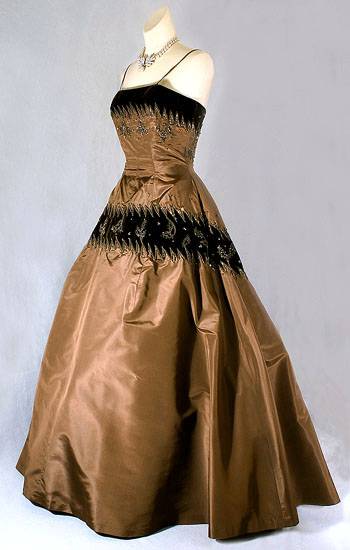
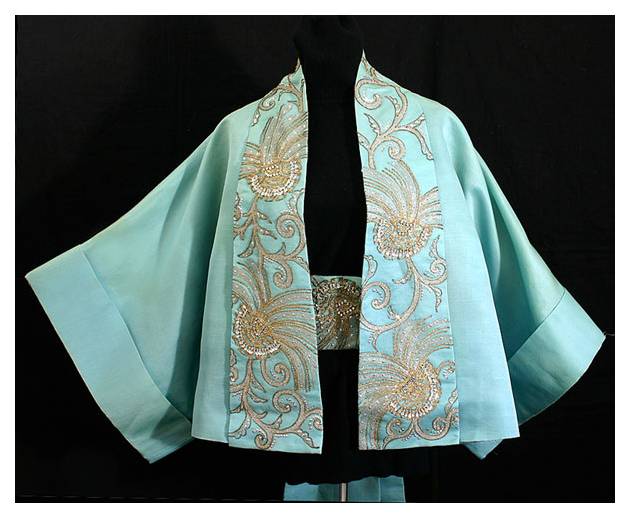
All these images of stunning vintage 1950s garments are courtesy of www.vintagetextile.com
1950s Clothing: DayWear
1950s - Full-Skirted Dresses
For the day, calf length, small waisted full skirted cotton and cotton satin or seersucker dresses with covered matching fabric belts, in glorious floral and botanical prints, such as cabbage roses were typical choices. Autumnal leaves or green ferns, cherries and acorns all looked good in lustrous cotton sateen and were used for dress and scarf fabric prints. Fresh-looking gingham checks, diamond trellis checks and spots were also popular and all make for very collectible fifties vintage now.
1950s - Straight Sheath Dresses
Also for day and in marked contrast, straight sheath dresses fitted and darted, or princess seamed, were made from satin cotton in sleeveless and cap sleeve versions. Fine wool crepe or Barathea was often used for a sleeved version. Many early fifties garments had boat or jewel necks and nearer the sixties scoop necklines were more usual.
1950s Shirtwaisters
As the 50's decade progressed shirt styles were put atop the waist of either a straight or full skirt making the shirtwaist dress a popular practical style among young and old alike. 1950s shirtwaisters often had three quarter sleeves and turn back cuffs. Many were made in striped fabrics with typical colour combinations being navy and white, emerald and white or candy pink and white as well as plain solid strong colours like turquoise or coral.
1950s Suits and Accessories
Hour glass styled suits were popular. Jackets that flared over the hip with a hint of a peplum were both worn with calf length narrow pencil skirts and gored fuller skirts, especially in the early 50s. In the mid to later fifties many of the skirts began an upward creep toward the knees. Garments had narrow rounded or sloped shoulders, scarf necklines, with wide rather than low décolleté necklines, higher waistline seams and fluid drapery.
Small Juliet caps or decorated headbands and gloves accessorised them. Another oft worn accessory was the fake flower corsage or a pin consisting of acorns and autumnal foliage with berries or a pin made from cherries or violets.
Coat with Dresses
One feature outfit of the fifties was the matching dress with either a jacket or three quarter sleeve swing duster coat, sometimes also called an opera coat when made in a glamorous evening fabric like satin or brocade. For day they were made in crisp firmer cottons in solid colours.
Dress jackets varied in silhouette from chopped off small boleros cut above the waist by a few inches having a toreador effect, or jackets could be bloused at the waist or appear as hip length jackets.
Styles
Other 1950s style aspects to look for are kimono sleeves, mandarin collars, gloves of all types, printed foulard silk or Tricel scarves and stoles or wraps in satin or fur. More casual dresses were also liked for holiday resorts and the halter neck dress was a favourite holiday style along with playsuits of shorts and bare midriff top in matching print fabrics. Unlike denim jeans strictly worn by teenagers, mid calf Capri pants made popular by the Italian film industry were worn for casual wear by women of all ages.
1950s Motifs
The 1950s motifs that were all the rage, were Venetian themes, masks, harlequins, ballet dancers, playing cards, shells and fish, cats, cherries, daisies, fruit segments, Hawaiian palm trees and pineapples. Images of Chinese, African, Mexican or similar ethnic caricatures in appropriate hats that might cause racial uproar today are often found on scarves, bags and textiles.
Poodle designs, Eiffel tower designs, hand painting and other novelty designs such as cute kittens are often seen on fifties skirts, blouses and scarves. The skirts are sometimes made of felt and often are circular in cut.
A 1950s Skirt
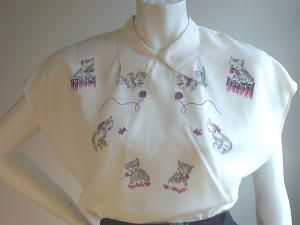
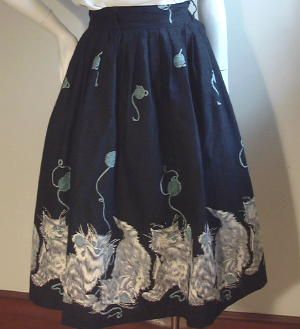


Kitten Motifs were a feature of 1950s skirts and tops of the era. Here this blouse top coordinates with this typical easy-wear skirt, perfect for rock and rolling.
Images courtesy of www.anothertimevintageapparel.com
1950s Vintage Denims - The Big E
Big E pickers look out only for vintage denim jeans by companies like Levis and Wrangler. Jeans were another fashion favored by 50's teenagers and there is some cache to wearing original 50's Levis. You can tell Levi jeans were made before 1971 if the label is totally printed in capital letters as LEVI.
In other words look for a big 'E' if seeking vintage Levis, whilst later jeans by Levi after 1971, have a label bearing a lowercase 'e' in the word Levi.
1950s Vintage Knitwear
The cardigan was a great feature of fifties fashion. Many dresses were sleeveless and the cardigan acted as a quick, often glamorous cover-up. For day, cardigans were often worn with a short-sleeved matching sweaters and were called twin sets. They could easily be dressed up with some pearls.
Twin sets of the fifties were almost always quite short waisted. Twin sets are wonderfully useful items so it is no wonder there was such a revival of them in the 1990s.
Today 50's beaded knits are very desirable collectable items, so if you have one to sell make sure you find out the going rate before parting with it, especially if it is a great example.
1950's cardigans were always fully fashioned. This method involves hand tooling, to shape and to move stitches by increasing and decreasing in a specific way to create attractive fashion marks.
Anyone who can machine or hand knit knows that if you decrease or increase a knit stitch on the very edge of a garment you get a ragged edge, but if you increase or decrease say seven stitches in from the final stitch, you move the stitch into the body of the fabric, but it creates shaping and neat contour lines about half an inch from the fabric edge.
This give a fashion mark of two stitches together becoming one on the stitch above, which is also considered attractive. 1950's knits generally all have such fashion marks.
Worn with evening wear such as cocktail dresses or long silk skirts, cashmere or lambswool and angora wool cardigans were embellished with beads, self embroidery, trapunto quilted areas, appliqués, sequins, rhinestones and lace. Much of the best beadwork and embroidery, easily matching couture cardigans, was done in Hong Kong workshops. Such cardigans are exceptionally desirable today, especially as they are a current fashion item in many stores.
But by buying a vintage 50's Hong Kong made knit you have an original and now rare quality item and are very unlikely to bump into a neighbour wearing an identical copy bought at a local shop.
1950s Knitwear by Helen Bond Carruthers
Right - Sought after vintage knits of the fifties by Helen Bond Carruthers. Images courtesy of www.vintagetextile.com
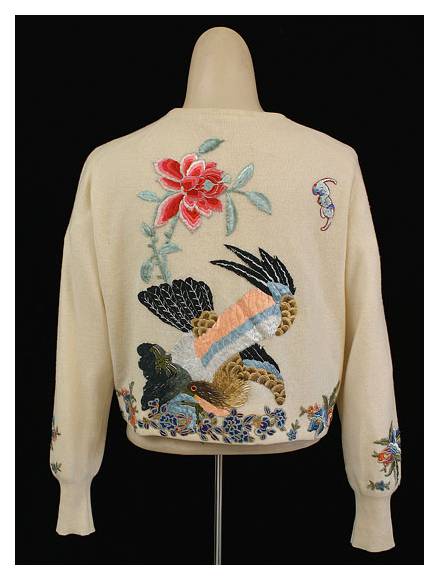
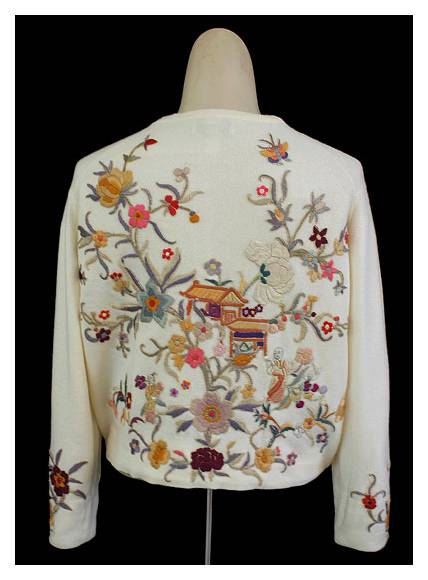


Most of these cardigans were made from delicate fibers. So sometimes new nylon finishes were applied and this is why knits occasionally state 1%nylon or perhaps 5% nylon plus 95% cashmere on a label.
The addition of nylon either as a polymer coating or as a percentage inserted into the carded yarn before twist is added, makes for a stronger knit, particularly with soft weak yarns such as cashmere or angora. Usually the nylon is added as a fine polymer coating to the fibers and at the same time it fills in the spaces between the wool hair scales.
It is these rough overlapping tile effect spaces that catch on each other and tangle as the scales lock into themselves. This is what causes shrinkage, so if the spaces made by the scales are filled in with the polymer coating of nylon, less tangling of fibres occurs and therefore less matting, felting and overall shrinkage when washed.
Other yarns were used to make knits in the late 1950s and included Orlon a brand name of acrylic fibre. Nylon was also made into cardigans, but the best examples usually have a wool or cashmere base. Such items are sometimes lined with fine light Jap silk.
One of the best things about these cardigans is that you really can get away with wearing them today.
1950s Vintage Accessories
Accessories provide the perfect finishing touch for any 1950's ensemble. These are the items women used to self-style themselves. They never used stylists as they instinctively knew what was needed to complete an outfit for the totally groomed put together look. This was achieved because they observed how studio groomed starlets were dressed and copied them. Handbags and gloves were as essential as well shod feet.
Vintage Scarves
Vintage scarves have value. Check for designer signatures on the scarf. Look carefully at the fabric, as silk was used for better scarves just like today.
A regenerated cellulosic fabric called Tricel Foulard (tri-cellulose acetate) was also used to make scarves and to the inexperienced bargain hunter it can be difficult to initially spot the difference between this and silk foulard. Go by feel and touch. The pure silk feels wonderful to the touch and airier, feeling neither warm nor cool. The Tricel has a heavier denser, cooler feel.
However a hand rolled hem on a scarf is a very good sign of being a better quality item as is evidence of hand painting. Tie and dyed scarves are post sixties.
Signatures to look for include Christian Dior and Chanel and other designers listed in the 50s vintage cloth. Specialist scarf dealers like Liberty, Pucci and Hermès also have good value. Make sure the accent is correct on Hermès and the spelling perfect for any designer signature.
Designer Scarves - A Vintage Vera Scarf and a Scarf by Lanvin

Left Lanvin scarf. Right - The scarf with Vera's signature is clearly printed on the scarf corner as is that of Lanvin, making both items just the type collectors seek.

Designer signature scarf images courtesy of www.anothertimevintageapparel.com
Americans may access a lot more Vera Neumann scarves than UK vintage hunters. Vera's scarves started when she was allowed to use surplus parachute silk in 1947 in America. She used a wide range of design sources to make interesting lively patterned designs and Vera scarves are much sought after today.
If you are buying or selling scarves consider doing it in lots of 10 or more at an auction site like eBay. That way beauty must emerge for some purchasers seeking a certain style, print, name or color of scarf. This really is an area where there are finds in charity shops and in Grandma's old chest.
Vintage Bags
Many collectors love 50's bags. You don't have to worry about fit or shrinkage and the variety of materials range from quality leathers, suedes, straw raffia, embroidered, canvas tapestry, mother of pearl, sequins to Bakelite and Perspex.
Fun bags follow the same decorative effects as fun skirts. Day bags were trimmed with pictorial motifs from poodles to French street scenes and many of the themes mentioned above were regularly used.
Bakelite and Lucite Bags
Many of the bags had a slightly crazy quality and were truly eccentric in design. At one point Bakelite and Lucite box bags were a rather expensive craze in America, with box bags selling for about $55. I recently saw one of these at an antique fair in UK and it was priced at about £220.
Fashion stylists and fashion fanatics love these quirky bags, so if you see one at a good price be aware you have a bargain, but check out the plastic really is Bakelite using the test and cleaning method for vintage clothing.
Bag names to look out for are those made by Couture designers and also specialist firms like Hermès, Whiting and Davis.
Bags by Enid Collins
One other important name with regard to innovative funky bag styles is that of Enid Collins of Texas who opened her first shop in 1959. She sold fun bags either made as a wooden box purse or as a canvas bucket style bag with whimsical decorative ideas.
The bags were always well made and trimmed with leather, painted areas, mirrors, sequins and crystals in themes such as birds facing each other. They have a great feel of the design motifs of the era, but in her individual way.
Many of the designs remind me of embroidery motifs and symbols of the era found in decorative needlework and embroidery design books of the 50s to 70s. Her bags from the 50s and 60s are very sought after, but by the 1970s she had sold her company.
1950s Vintage Chanel and Kelly Bags
Handbags of note from the 50's include the Chanel quilted bag and the famous Kelly bag made for Grace Kelly by Hermès.
Although the original design based on a saddlebag existed in the 1930s, it was Grace Kelly who made the bag famous in 1956 when she used it to cover her pregnant tummy bulge. In the 50's, women were reserved about showing the world their pregnancy.
The Kelly bag is a beautiful hand stitched bag of the best quality and is usually made of calfskin, but can be made of crocodile, lizard or ostrich. Today new Kelly bags demand a six month wait from Hermès or the purchase of a vintage bag at equally great cost.
The Chanel quilted bag is actually the '2.55' bag conceived on February 2, 1955, and the style was quietly worn by fans of Chanel clothes. In the logo-obsessed 1980s, fake or real chain twisted Chanel diamond quilted shoulder bags flooded the market. It became the bag to be seen wearing.
Fakes are everywhere.
Vintage Nylons or Stockings
If you have never worn the stocking of the 1950s you will experience a sensuous moment when you slide them onto your legs.
Stocking in the 1950s felt different. They were fine and cool and silky to the touch. They felt like the height of luxury as if you were about to give your legs a beauty treatment just by wearing them.
Pictures of Vintage Fully Fashioned Stockings

Right - Fully fashioned boxed stockings from anothertimevintageapparel.com who sell a wide range of mixed fifties vintage goods as well as goods from as far back as circa 1900. Stockings on the left by Schiaparelli.

Both images are by arrangement with www.anothertimevintageapparel.com
Unlike pantyhose tights which are sized small, medium, large, extra large etc., 50's stockings came in foot sizes. To find your size to wear flat fully fashioned seamed stockings measure the length of your foot. If it measures 9 inches long, a size 9 would suit you, but if you have fatter legs a larger size may be better.
I recall though that the largest stocking size you could buy was an 11. This was all very well if you had slender legs, but for those poor souls with larger legs the width of the stocking was taken up by the fatter leg and so the stocking did not go so far up the leg as it might on a tall slim leggy woman. This was never much trouble for most people, but lumps of fat could hang over stocking tops and often did.
It was not necessary to have a much fatter leg to develop the thigh bulge.
But the main problem for most people occurred when skirts gradually shortened in the 1960s and stocking tops were seen as ugly and giving an overall poorly groomed fashion look. That is when tights really developed for the masses.
Stocking sizes ranged from size 8 to size 11 going up in half sizes. The fit varied from brand to brand, but fully fashioned seamed stocking were well shaped on the foot and heel although the yarn used was not stretchy and sometimes a little bagging could happen so that fine wrinkles appeared.
It was essential to either check your seams were straight using a back mirror or get a sister or friend to tell you nothing was crooked.
Better brands made longer stocking lengths and by the end of the decade more people wore the newer seamless stockings first introduced in 1952, but slow to capture the public's affection. Once yarns with better cling were introduced they were seen more and more.
1950s Costume Jewelry
Costume jewelry from the 50s is very collectible.
Names to look out for are Trifari, Dior, Schiaparelli, Chanel and Miriam Haskell. Costume jewelry is sold in abundance on the web and I suggest you key in keyword phrases such as vintage Trifari costume jewelry into Google and see what sites come up. You will have the chance to browse through some wonderful pictures of Parures, bracelets, novelty brooches, pins, earrings in designs that will stun you.
To develop an eye for vintage costume jewelry you will need to study typical pieces and read about it in the same way you need to read about costume to have an understanding of seeking out vintage fashion. You can see examples of costume jewelry on the fashion-era site.
In Conclusion: 1950s Vintage Clothing
The 1950s is an era full of rich choices for the vintage collector and unlike some later 20th-century periods can be classed as true vintage fashion. Collect what appeals to you most, only selecting the highest quality items in favor of larger quantities of less desirable clothes and accessories.
Quality 50s items can only become more desirable and valuable vintage items as time passes.
www.contentmentfarmantiques.com featured on this site provided the image of the vintage striped swimsuit in the page header.