By Pauline Weston Thomas for Fashion-Era.com
- Egyptian Cosmetics of 4000 Years Ago
- Eyes - Egyptian Makeup - Eyepaint
- Research into Ancient Egyptian Cosmetics
- Other Grooming
- Body Perfumes
Egyptian Makeup of 4000 Years Ago
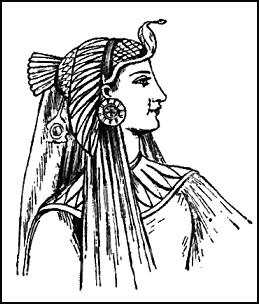
Egyptian burial furniture of c2000 B.C. has enabled researchers to learn a great deal about the grooming habits of the Egyptians of 4000 years ago.
The ancient Egyptians were like any other civilisation; both men and women liked to make themselves look better according to their standards of beauty.
The result was that both genders wore makeup when the occasion demanded it and they practised a standard of Egyptian hygiene based on sound medicinal, therapeutic and spiritual reasons.
The contents of the funerary furniture have revealed that like us, they attended to personal grooming. Egyptians used combs, hairpins, polished copper mirrors, makeup holders, tubes of eye paint, eyeliners and other toilet accessories.
The containers they used were made from alabaster, wood, marble, stone or reed. Although the Egyptians manufactured glass, it was reserved primarily for decorative jewellery, not for objects like mirrors or windows.
Some of the Egyptian cosmetics involved preparation that used animal waste products such as fly dung, and which we would probably decline to use.
So I shan't be suggesting them on this page! However, as with recipes for home made natural cosmetic products today, many of the most basic constituents of the cosmetics were oils, beeswax or other fatty matter.
Powdered ores and finely ground gems such as lapis lazuli formed the basis of colour, dependant on the amount used with a base carrier.
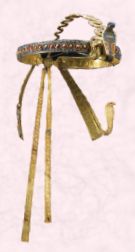
To get the Egyptian look for dramatic or party costumes, try to capture the elements such as eye makeup, collars, amulets and headdresses such as this one below right of King Tutankhamen's Diadem.
It was first seen when Howard Carter opened the royal tomb 1922, he found the Egyptian king's diadem around the 19 year old King Tutankhamen's head. A rearing cobra and vulture act as protective icons and the piece is set in gold with semi precious gems, carnelian, obsidian and glass.
Egyptian Eye Makeup
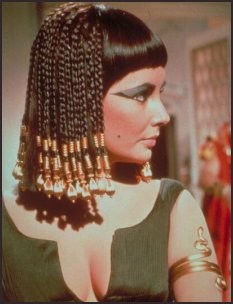
Eye makeup is probably one of the makeup techniques that first spring to mind when we think of Egyptian faces.
Two images flood my brain when I visualise this; that of the King Tutankhamun (right), and more recently of Elizabeth Taylor (left) as Cleopatra in the 1963 film of the same name.
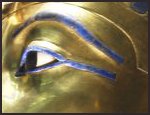
Both images illustrate use of extended egyptian eyeliner, as does the image of the golden Goddess Selket shown below right.
In ancient Egypt, Black kohl, lapis lazuli or green malachite were used for this eye decoration. To copy this for theatrical costume or fancy dress purpose, we can use modern safe cosmetics like waterproof eyeliner.
If you prefer you can use traditional kohl or a modern kohl based pencil. A steady hand and a few attempts, should enable you to soon master your Egyptian makeup look.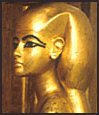
The Egyptians either used a simple palette of raw eye powders, or used ready mixed eye paint. Raw powder could be added to water, or animal fat product to make an unguent (creamy paste) before application to the eye area.
They then applied that with a special wood, bone, or ivory stick for the purpose.
Rich and poor owned the eye cosmetic powders. But like today, the quality of the tools they used to apply it, or the containers in which they stored it, emphasised differences in their wealth. Spiritually, once applied, eye decoration acted as personal magical amulet against the evil eye whatever the wealth.
If you do choose to use kohl you will find you can buy a modern pencil version, or instead you can select the traditional kohl with a small stick eyeliner applicator.
To use it, dampen the stick and dip it in the kohl powder until it picks up residue. Flick it to rid the excess. Next with the eyelid almost closed, pass the kohl stick from the inner corner to outer corner, ending with an upward flick. Residue will transfer to upper and lower lids.
You may need to try this out several times, but be warned kohl stains the eyelids with repeated use. Immediate right - The eye of Elizabeth Taylor when made up as Queen Cleopatra.
Research into Ancient Egyptian Makeup
Cosmetics giant L'Oreal with the Musées de France Recent have been involved in the past decade with scientific research on the archaeologist's findings. That research published in the world renowned magazine NATURE, revealed that 400 years ago Egyptian cosmetics were based on the metal lead.
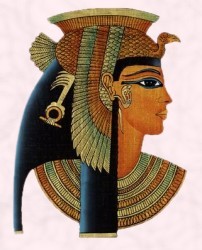
 Modern painting of Cleopatra on papyrus.
The techniques the Egyptians used to prepare cosmetics involved crushing and sieving products for varying times according to the required end result.
New modern techniques made a fresh approach to analysis possible. In total the team analysed the contents of 49 bottles kept at the Department of Egyptian Antiquities at the Louvre Museum. Researchers employed scanning electron microscopy for morphology, elementary chemical composition and X-ray diffraction for mineralogical identification.
Under modern forensic style investigations, the structure of the exact lead Egyptians used in cosmetics was revealed. Laboratory investigations showed that the basis of the ancient Egyptian cosmetics were often grey lead sulphide/galena*, or white lead carbonate/cerussite**. Black galena has traditionally been used by many peoples as a kohl product.
Lead sulphide has a cubic crystal structure and lead carbonate an orthorhombic crystal structure. The two structures used in ancient Egypt's makeup were frequently combined in varying amounts. It basically means that products using the two lead types can be either shiny or dull.
How dull or shiny depends on the crystal, the quantity used in any one mixture, the light refraction and the reflection picked up by the onlooker. The duller powders have small crystals and the shiner powders have larger crystals, meaning that the shiny powders were not as processed (ground up) as the duller cosmetics.
This means the ancient Egyptians had enough knowledge to create different mixtures of the two crystal types to generate nuances between shades.
Two other white products found in the Egyptian makeup analysed were laurionite and phosgenite. The scientists concluded these latter products were deliberately mined to make cosmetics. At the same time, the constituents acted as a bactericide protection against eye diseases in the hot dry Egyptian climate.
Egyptian Rouge
Archaeologists also found a red ochre product that with the addition of a fatty carrier could have been used to colour the cheeks.
Other Grooming
Egyptian Perfume
Perfumes were expensive in ancient Egypt, but were of good quality and made famous throughout the Mediterranean area. Only the wealthy would have had access to them.
Liquid perfume was made using oils derived from almonds and other vegetable oils. To such a base, various plants, flowers, woods, leaves and spices were added. Perfumed lotions and unguents were made by adding wax or purified fats.
The perfumes were long lasting and Pliny recorded one perfume in his possessions being just as good at 8 years. Typical fragrances used local and imported products including rose, lily, iris, cinnamon, orange, myrrh, frankincense, lime, sandalwood.
Men and women wore wigs on special occasions. In some dynasties the head was shaved to keep it fresh and lice free in the hot Egyptian climate. But many looked after their own hair with beauty cosmetic products that kept it clean and healthy.
Henna was used to add colour over the grey hair show. Bear in mind too that most Egyptians lived only until about their 40th year, so white haired Egyptians were less likely to be portrayed in artefacts.
From evidence found in mummies, it appears the Egyptians had little decay to their teeth, but they did suffer from abraded teeth caused by stone grit particles in bread wearing away at their teeth from using coarse stone-ground flours.
Refined sugar was unknown to them, although honey was their main source of sweetener and was used on the face too. For fresh breath they chewed parsley or similar herbs.
Modern Research into Ancient Egyptian Makeup
On 11 February 1999, a Parisian press release told how the scientific magazine Nature had published new information about the cosmetics of ancient Egypt.
The joint study was carried out by a team from the Musées de France research laboratory and L’Oréal-Recherche, in collaboration with the European Synchrotron Radiation Facility in Grenoble. They were able to pool their methods of analysis and knowledge in the fields of chemistry, archaeology, pharmacology and cosmetics and apply them to Egyptian makeup.
* - Black galena is found near the Red Sea and Aswan. It is the basic constituent of many kohls.
** - Cerussite is used for grey to white makeup base products.
*** - Malachite is found in Sinai and the Eastern Desert and is used for colouring Egyptian eye makeup, as a paint and also as a gem.
Page Added 15 Nov 2007. Ref:-P663
You have been reading an original article on Ancient Egyptian make-up and cosmetics by Pauline Weston Thomas at www.fashion-era.com ©