
By Pauline Weston Thomas for Fashion-Era.com
- Collars with Ancient Egyptian Decorative Ornament
- Egyptian Collar for Tutankhamun Fancy Dress Costume
- Tutankhamun and the Golden Age of the Pharaohs Exhibition
Ancient Egyptian Decoration
Styles of Egyptian robe with free pattern guides were discussed on the detailed pages of Egyptian Costumes. However, decorative elements were mostly confined to the removable collars on garments and other removable accessories such as headwear, girdles (striking wrap sash belts) and deep arm cuffs.
To complete your Egyptian costume add a collar, typical jewellery and Egyptian make-up. To be fair there are plenty of King Tut collars available at fancy dress party costume outlets online. But part of the fun of going to an Egyptian fancy dress event is making your own Egyptian-inspired costume and most importantly achieving something that fits you proportion-wise rather than being made as one size fits all. Think how much more hygienic your own costume would be too!
Decorative Elements in the Land of the Pharaohs - Collars with Ancient Egyptian Costume Pattern
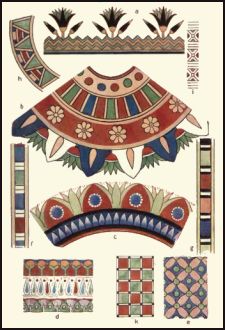
Once you have a base under garment, the next stage of making an ancient Egyptian tunic style costume, is making the collar. The Egyptian collar was highly ornamental.
The colours in the decorative ornament plate used reference points found at the British Museum. These colours and patterns are similar to those found in dyes used in wall paintings illustrating ancient Egyptian beads, wool and fabrics.
Decoration in Egyptian dress was chiefly confined to the collar. But if you just want to add a few Egyptian touches consider wearing simple decorative armband amulets.
The costume patterns used were made with either beads, jewels, embroidery or painted leather pieces. But they also used coloured glass so don't be afraid to incorporate fake gems from broken costume jewellery.
Patterns were also stamped and painted directly onto the materials. My favourite Egyptian motifs were the Lotus flower. Look out for craft stamps or stencils, from shopping channels such as QVC or make your own simple potato print stamps.
Ancient Egyptian art and design are characterized by distinct patterns, symbols, and motifs that have a deep cultural and religious significance. If you're interested in Egyptian patterns, here are some of the most commonly recognized motifs and their basic interpretations:
- Lotus Flower: Representing the sun and rebirth, the lotus flower frequently appears in Egyptian art and jewelry.
- Papyrus Plant: Often paired with the lotus, papyrus symbolized lower Egypt and was a significant motif in various artworks.
- Scarab Beetle: This insect was associated with the divine manifestation of the early morning sun and symbolized rebirth and regeneration.
- Ankh: The symbol of life, the ankh resembles a cross with a loop at the top.
- Eye of Horus (Wedjat Eye): This is a symbol of protection, health, and rejuvenation.
- Horus Falcon: Representing the sky god Horus, this falcon is often seen perched or spread-winged.
- Hieroglyphs: Egyptian writing consisted of a rich system of symbols. These hieroglyphs were not just letters but held deeper symbolic meanings.
- Feathers: Often depicted in art, they were symbols of the goddess Ma'at and represented truth, balance, and order.
- Columns: Inspired by the lotus and papyrus plants, the pillars in Egyptian architecture were ornately decorated and had unique capitals.
- Grid Patterns: Many Egyptian artworks, especially wall paintings, followed a grid system that determined the proportion of the figures.
- Geometric Patterns: Repeating geometric patterns can be seen in Egyptian textiles, borders, and architectural designs.
- Cobra: A symbol of royalty and divine authority, often depicted on crowns or headdresses.
- Vultures: Representing protection, especially of the Pharaoh.
- Nekhbet and Wadjet: Vulture and cobra goddesses respectively, representing Upper and Lower Egypt.

This simple paper stencil I made right was made using the computer. It is based on the motif at the top of the decorative ornament plate left.
Fast Fancy Dress Tip Timesaver - If you want fast patterned fabric use such a stencil as a basis for a pattern foundation of colour. Add extra complex detail with a paintbrush of fabric paint felt pens.
Egyptian Collar for Tutankhamun's Fancy Dress Costume - Free Egyptian Collar Pattern

The Decorative ornament plate shown left has typical Egyptian style patterns.
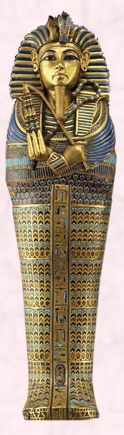
The vulture, scarab beetle, fanned wings and lotus flowers are seen as often as the cobra featured on the coffin lower down the page.
The pattern shape for this collar shown right is very simple and is based on removing about 1/5th of a circle and using the larger portion.
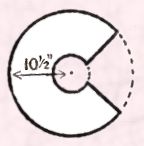
Female adult collar sizes are frequently between 14 and 16 inches, but make the hole in the centre of your collar pattern to an approximation of your neck size.
Fancy Dress Tip - To make an easy circle attach a pencil, biro or piece of blackboard chalk to some string and draw your outer circle whilst holding the string taut.
Fast-Fancy Egyptian Dress Tip - Use Vilene iron-on or similar interfacing on the back of your fabric to give your collar some stiffness and stability.
Fast Fancy Dress Egyptian Costume Tip - Dispense with fabric altogether and use Vilene, Pellon pelmet interfacing or a similar commercial product for the collar. This will be firm, but softer to wear than cardboard.
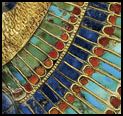
Paint, bond coloured fabric with Bondaweb, or stick cut coloured paper onto the collar to achieve a base colour. Add pieces of painted leather, metallic sweet wrappers, beads, gems, braids or scrap fabric to ornament the collar base.
Consider using products like Vilene Bondaweb or easy fusible products to speed your task and aid creativity in other ways. Bondaweb can also be used to apply textured wools and braids. Trim the collar at neck and edges by gluing a suitable gold braid or other trim.
Need more inspiration - Typical Egyptian decoration patterns could follow this pattern left and part of King Tutankhamen's pectoral decoration.
If you have lots of time - perhaps a weekend or even better a week - then make a *Papier-Mâché collar, using one of the many recipes already available on the internet. With care and attention plus a well researched recipe, you can achieve an almost porcelain like finish to the end product.
Create areas of surface interest with the Papier-Mâché by building and moulding gem like texture using a teaspoon and melon ball tool. Nuts, washers, plastic water bottle tops, lentils, pasta stuck onto such a collar all add fascinating richness when sprayed gold.
WARNING - Avoid adding metal bits with sharp edges, or grooves such as beer tops.

When the Papier-Mâché collar is thoroughly dry, quick spray with gold paint spray. Work outside and wear a mask when using spray paint. Next paint collar sections with coloured metallic, pearlized paints and other craft materials. Varnish the collar to make it shine with brilliance.
Tip - If you have no varnish, use egg white or egg yolk for a golden glow and let it dry hard. If you have some body dust you could add that to the egg mix for a shimmering effect, but avoid getting a fairydust or angelic look.
It really would be worthwhile investing in some varnish and a small tin of lustrous gold enamel paint.
The Decorative ornament plate shown left has typical Egyptian style patterns found on male sash girdles. See the other pattern plate further up.
Remember winged and fanned decoration was a universal feature of Egyptian pattern on dress. Typical characteristic Egyptian elements included the hawk, the beetle, the lotus flower and geometric patterns that were cleverly entwined.
In many ways, these all-over intertwined repeat patterns are similar to motifs found in other civilisations including Aztec and Celtic forms.
The patterns were also used to make beaded networks worn over garments. This meant pattern could be transferred easily to a freshly laundered plain garment.
Above right we have one of the coffin layers of the boy King Tutankhamun. Note that rich intense pattern could be incorporated into your own collar designs.
Glass and enamel were favourite techniques for decoration in the Land of the Pharaohs. The famous vulture collar laid on the mummy chest of Tutankhamun was primarily inlaid with blue and coral red coloured glass. The glass was possibly of high value as a product in itself in Egyptian eyes and was inlaid into the same solid gold as any other item encrusted with true precious gems. The birth of costume jewellery may have occurred in Egypt.
This travelling exhibition will run in UK until August 31 2008 and then it moves to the USA and to the Dallas Museum of Art for October 2008.
Page Added 14 Nov 2007. Ref:-P662
You have been reading an original costume history article by Pauline Weston Thomas at www.fashion-era.com ©