By Pauline Weston Thomas for Fashion-Era.com
- The Costume of 'Old Rome'
- Dress in the Roman British Period About 78 to 500 AD
- The Tunica or Tunic
- The Roman Soldier In Britain
- The Roman Toga
- Roman Toga Fancy Dress Tip
- Free Roman Toga Patterns
- Toga Candida
- How to Make a Roman Toga
- Romanised British Men
- The Costume of 'New Rome'
- Byzantine Dress
- Justinian - The Last 'Great' Emperor
The Costume of 'Old Rome'
Dress in the Roman British Period About 78 to 500 AD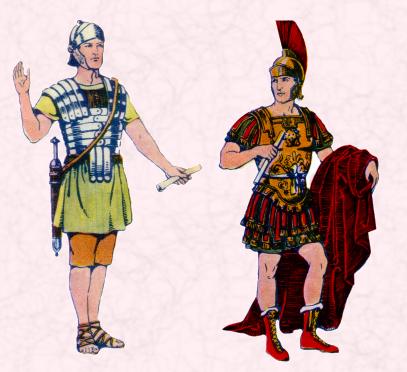
Our impression of an ancient Roman, is either that of the soldier in his tunic and with an overlay of heavy metal armour, or of the Roman senator dressed in a toga. See extra line drawing pictures of Roman Battle dress and Roman dignitaries.
Britain was invaded by Julius Caesar in 55 and 54 BC. One hundred years later Britain became part of the Roman Empire. Then for some 400 years after that many Britons wore Roman styled dress.
The Roman Tunic or Tunica
The tunica was the dress of soldiers and workmen. dignitaries wore tunica under their toga.
Men wore a leather belt over a tunica which was made from two pieces of cloth, to which separate short sleeves were added. In Latin, nouns end in either 'a' or 'um', thus the word tunic is an Anglo-Saxon derivation of tunica.
When British Romans wore two tunics, the one next to the skin, which we would call an undergarment, the Romans called a Subacula. The outer garment was called the Tunica exteriodum and was knee length.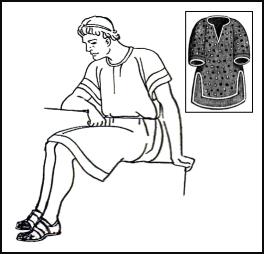
Perhaps it was the colder northern climates, or perhaps Romans had fashion fads too, either way the tunica exteriodum reached the ankles by 100 AD. Furthermore this Roman Tunic gained a new name, the Caracalla. From 200 AD almost everyone wore the caracalla.
The line drawing shown right shows a Roman slave in a short tunic perfect for working easily. The dark tunic in the corner was to become the foundation garment of basic clothing for hundreds of years.
After a slow start the hardy Roman soldiers adapted to Britain's harsher climate. One example was the way they adopted trews from Scotland, or started wearing the longer trousers that Barbarian tribes wore. One feature of conquering armies is that they are almost exclusively male, however, soon or later they inter-marry with local women, thus in time-honoured manner, women may influence male garments.
This page is an original Roman Costume History and Fancy Dress Tips article by Pauline Weston Thomas 2008 © - Copyright www.fashion-era.com
The Roman Soldier In Britain
These two men are a coloured illustration of soldier dress from costume drawings from an old fashion booklet of the 1920s. Above right - To the near right is a depiction of a Roman soldier in Britain. On the far right is a Romanised Briton in the dress of a Roman General.
In colder countries like Britain, a thick woollen floor length cloak with a hole at the neckline was a necessity.
The Roman Toga
For socialising in town, or at meetings, Roman men of higher status might add a toga over the tunica. The early Roman Toga was very voluminous, required huge skill in draping it and made really active pursuits difficult. Essentially this made it a garment mostly of the upper classes such as senators.
Roman Toga Candida
Any Roman man who wanted to be elected as a magistrate had to don a spotless white toga - The Toga Candida. Indeed, the modern word candidate comes from the Roman Toga Candida.
Even 2000 years ago a political candidate running for office had to look spick and span. Clothes matter when someone wants to be taken seriously and respected.
How to Make a Roman Toga
Roman Toga Patterns 1 & 2
The Roman toga was made from fine wool and was worn by placing it over the left shoulder with part of it hanging in the front. This was then passed round the back from the shoulder and under the right arm and finally thrown over the left shoulder. Hats were not normally worn with the Roman toga. Togas could be made from several shapes as shown in my illustration above right.
Dignitaries had the privilege of wearing a Roman toga with a stripe creating a purple border band that flowed around the body with the draping.
Roman Toga Fancy Dress Tip
My illustration should give you an idea how important the contrast band is in wear.
For modesty purposes, and to achieve the correct look, wear a simple tunic or white plain T-shirt underneath. Naturally, white or flesh tone underwear is best with a Roman Toga. Use a clasp or brooch for extra security to hold the wrapping firmly in position.
As with some of the Egyptian styles, the art of wearing a toga lies in the wrapping and dressing of the fabric. Alternatively, you could buy a stylish professional toga online.
Roman Toga Pattern 3
The approximate dimensions of these early togas seem enormous, but to cover and wrap the body well you will need a large piece of cloth.
This authentic Roman toga pattern right should measure 18 feet from A to B, and from C to D should measure 7 feet.
Around 100 AD the toga began to diminish in size, firstly to a pallium and then to a stole.
This page is an original Roman Costume History and Fancy Dress Tips article by Pauline Weston Thomas 2008 © - Copyright www.fashion-era.com
More Fancy Dress Tips for Making a Roman Toga
Anyone going to a fancy dress party for Halloween or New Year may be thinking the easiest solution to making a Roman toga would be to wrap a sheet around them and go as an ancient Roman. But you can improve your toga if you pay a little attention to these couture versions shown above!<
The dimensions of these two toga patterns shown further above would be similar to the half circle above and probably measure some 18 feet across. Note this almost double the measurement of C to D above. Clearly in pattern 1 and 2, there is at least 4 feet of fabric above the man's head before the fabric is folded over for arrangement.
For fancy dress purposes trial and error is essential and these patterns are only toga shape guides.
You could experiment with fabric lengths to create best effects. Trialling the shape with a single sheet or two and on a smaller person such as a child, might also be useful.
For an adult two large king size bed sheets sewn together might be a good start and might provide sufficient fabric for a superior fancy dress Roman toga
Consider stencilling along one long edge, or sew deep coloured ribbon or braid to see see how effective a contrast border might look.
As always, getting the hair and feet correct can make or break the end result in terms of authenticity.
This page is an original Roman Costume History and Fancy Dress Tips article by Pauline Weston Thomas 2008 © - Copyright www.fashion-era.com
The image above is of a man robed in a classical Roman toga, next to him is a woman who is also wearing a Roman robe. See Roman hair images and robes for Roman women on the Roman ladies page.
Romanised British Men
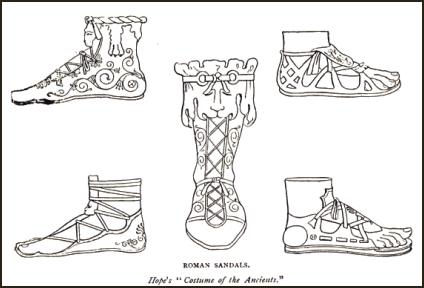
The image below is of Roman footwear. Reference for both images is Hope's 'Costume of the Ancients.'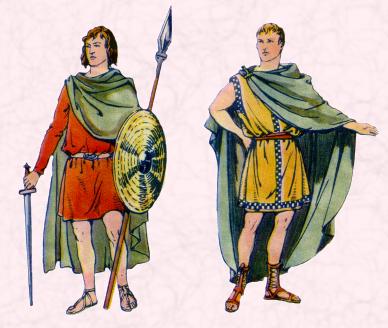
The dress of the Romanised British aristocrat was similar to that of the Romanised British Man, but his tunica was more likely to be of better quality woven cloth and edged with decorative braids.
Right - Costume illustration of a Romanised British man and a Romanised British aristocrat.
They each wear leather Gladiator sandals one pair having a thong fitting and the aristocrat having sandals with many straps.
Roman Footwear
The men wore leather boots for marching or sandals for summer and comfort wear. Interestingly, Roman boots found with Roman archaeological remains, show iron nails holding the boots together.
The Costume of 'New Rome'
Byzantine Dress
476 AD saw the end of the Western Roman Empire. Great Romans include Gaius Marius, Gaius Julius Caesar, Mark Anthony, Maximus, Augustus - The first Emperor, Nero - The Madman of Rome, Trajan, Constantine the Great, and Justinian - The last 'Great' Emperor.
Justinian - The last 'Great' Emperor.
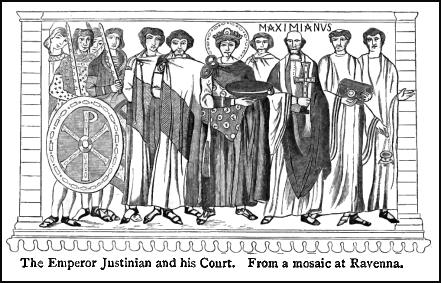
The Emperor Justinian and his Court is shown in this image above which was taken from a mosaic at Ravenna. This later dress is more typical of clothing of the Byzantine era also shown below right. As the Roman empire had expanded so the seat of government had also moved.
The Costume of 'New Rome'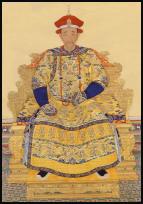
The new Roman capital on the Bosphorus (present day Istanbul strait of Turkey), founded in AD 330, was called Byzantium. But when the western (Roman) empire fell in AD 476 the new government capital became cut off. Slowly the people of Byzantium adopted more elaborate dress suffused with oriental influences from China (image right) and later from Assyria and Persia.
As the centuries progressed Byzantine costume became more and more orientalised. Brilliant fringes, brighter colours, richly patterned brocades, embroidery, gold tissue fabrics and tassels soon adorned the most simple robe shapes.
The coloured image below of a Byzantine Empress and princess shows this ornate Byzantine look very clearly.
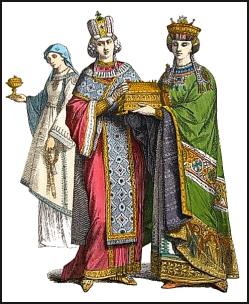 Look carefully at all the Byzantine images and immediately notice the ecclesiastical appearance of these robes.
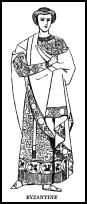 The Emperor of the day by this time acted as a priest-king and called councils of church and whilst he did not serve mass, he did waft incense at the alter. He was totally involved in the formal procedures of daily ecclesiastical reverence.
The dress the Emperor and his attendant individuals wore, was strictly laid down as hierarchical. The rank and function of individuals became more important than either utility or the principle of seduction in dress. The robes were regulated by liturgical specifications all heavily imbued with meaning and ritual.
Byzantine dress left a strong legacy and many churches today still wear vestments based on robes and elements of dress from the costume of this era. Byzantine dress is now the basis of dress used in many religions.
Many examples of icon art triptychs or Byzantine mosaics showing costume worn in this period can easily be found in art books and museums. Numerous illustrations of Byzantine dress such as this image above left and from the Braun and Schneider Victorian magazine provide a rich source of costume information.
After the fall of the Roman Empire Britain went into the period known as the Dark Ages and dress from the sixth century is shown here.
Simple Celtic costume from the period 600BC to 100 AD and before the Roman British fashion era is illustrated on the Celtic Costume page.
Dress after the Roman British Period and of the Sixth Century to 1066 is shown on its own page too.
This page is an original Roman Costume History and how to make a Roman Toga article by Pauline Weston Thomas 2008 © - Copyright www.fashion-era.com
Page added 12 October 2008 Ref: P703. Updated 5 Nov 2008.

