 This costume history information consists of Pages 81-91 of the chapter on late 13th century and early 14th century dress in the Middle Ages era of Edward The First 1272-1307 and taken from English Costume by Dion Clayton Calthrop.
MEN AND WOMEN
Until the performance of the Sherborne Pageant, I had never had the opportunity of seeing a mass of people, under proper, open-air conditions, dressed in the peasant costume of Early England.For once traditional stage notions of costume were cast aside, and an attempt was made, which was perfectly successful, to dress people in the colours of their time.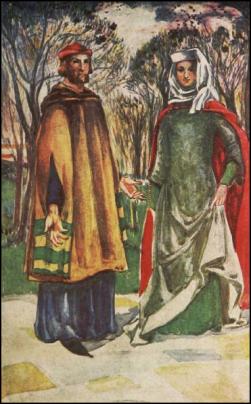
Jewel Colours
It was interesting to see the difference made to this crowd by the advent of a number of monks in uniform black or brown, and to see the setting in which these jewel-like peasants shone - the play of brilliant hues amid the more sombre browns and blacks, the shifting of the blues and reds, the strong notes of emerald green - all, like the symmetrical accidents of the kaleidoscope, settling into their places in perfect harmony. The entire scene bore the impress of the spirit of historical truth, and it is by such pageants that we can imagine coloured pictures of an England of the past. Again, we could observe the effect of the light-reflecting armour, cold, shimmering steel, coming in a play of colour against the background of peasants, and thereby one could note the exact appearance of an ordinary English day of such a date as this of which I now write, the end of the thirteenth century. The mournful procession bearing the body of Queen Eleanor of Castille, resting at Waltham, would show a picture in the same colours as the early part of the Sherborne Pageant. Colour in England changed very little from the Conquest to the end of the reign of Edward I.; the predominant steel and leather, the gay, simple colours of the crowds, the groups of one colour, as of monks and men-at-arms, gave an effect of constantly changing but ever uniform colours and designs of colour, exactly, as I said before, like the shifting patterns of the kaleidoscope.Pied Colours
It was not until the reign of Edward II, that the effect of colour changed and became pied, and later, with the advent of stamped velvets, heavily designed brocades, and the shining of satins, we get that general effect best recalled to us by memories of Italian pictures; we get, as it were, a varnish of golden-brown over the crude beauties of the earlier times. It is intensely important to a knowledge of costume to remember the larger changes in the aspect of crowds from the colour point of view. A knowledge of history - by which I do not mean a parrot-like acquirement of dates and Acts of Parliament, but an insight into history as a living thing - is largely transmitted to us by pictures; and, as pictures practically begin for us with the Tudors, we must judge of coloured England from illuminated books. In these you will go from white, green, red, and purple, to such colours as I have just described: more vivid blues, reds, and greens, varied with brown, black, and the colour of steel, into the chequered pages of pied people and striped dresses, into rich-coloured people, people in black; and as you close the book and arrive at the wall-picture, back to the rich-coloured people again.Mens Armour & Comfort Of Loose Gowns
The men of this time, it must be remembered, were more adapted to the arts of war than to those of peace; and the knight who was up betimes and into his armour, and to bed early, was not a man of so much leisure that he could stroll about in gay clothes of an inconvenient make. His principal care was to relieve himself of his steel burden and get into a loose gown, belted at the waist, over which, if the weather was inclement, he would wear a loose coat. This coat was made with a hood attached to it, very loose and easy about the neck and very wide about the body; its length was a matter of choice, but it was usual to wear it not much below the knees. The sleeves were also wide and long, having at a convenient place a hole cut, through which the arms could be placed.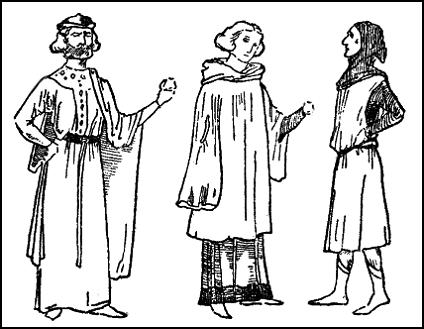
Mens Hair
The men wore their hair long and brushed out about the ears - long, that is, to the nape of the neck. They also were most commonly bearded, with or without a moustache. Upon their heads they wore soft, small hats, with a slight projection at the top, the brim of the hat turned up, and scooped away in front. Fillets of metal were worn about the hair with some gold-work upon them to represent flowers; or they wore, now and again, real chaplets of flowers.Late C14th Mens Surcoats
There was an increase of heraldic ornament in this age, and the surcoats were often covered with a large device. These surcoats, as in the previous reign, were split from shoulder to bottom hem, or were sewn up below the waist; for these, thin silk, thick silk (called samite), and sendal, or thick stuff, was used, as also for the gowns.The shoes were peaked, and had long toes, but nothing extravagant, and they were laced on the outside of the foot. The boots came in a peak up to the knee.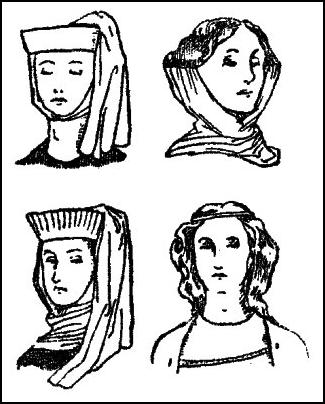
A Woman's Gown
The woman also followed in the lines of comfort: her under-gown was full and slack at the waist, the sleeves were tight, and were made to unbutton from wrist to elbow; they stopped short at the wrist with a cuff. Her upper gown had short, wide sleeves, was fastened at the back, and was cut but roughly to the figure. The train of this gown was very long.Womens Headwear
The Throat Gorget
They sought for comfort in every particular but one: for though I think the gorget very becoming, I think that it must have been most distressing to wear. This gorget was a piece of white linen wrapped about the throat, and pinned into its place; the ends were brought up to meet a wad of hair over the ears and there fastened, in this way half framing the face. The hair was parted in the middle, and rolled over pads by the ears, so as to make a cushion on which to pin the gorget. This was the general fashion.Women's Medieval Chin Bands
Now, the earlier form of head-dress gave rise to another fashion. The band which had been tied round the head to keep the wimple in place was enlarged and stiffened with more material, and so became a round linen cap, wider at the top than at the bottom. Sometimes this cap was hollow-crowned, so that it was possible to bring the wimple under the chin, fasten it into place with the cap, and allow it to fall over the top of the cap in folds; sometimes the cap was solidly crowned, and was pleated; sometimes the cap met the gorget, and no hair showed between them.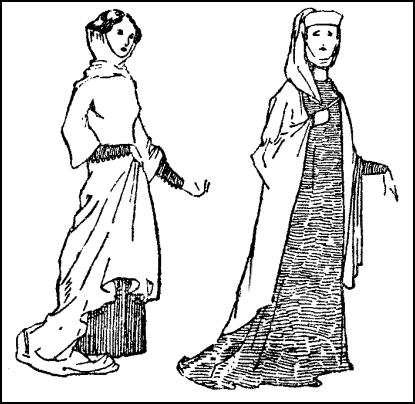
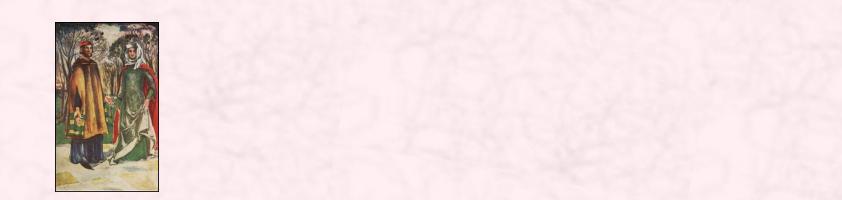
A MAN AND WOMAN OF THE TIME OF EDWARD I - 1272-1307
Below Right - The sleeves of the man's overcoat through which he has thrust his arms are complete sleeves, and could be worn in the ordinary manner but that they are too long to be convenient; hence the opening.
Effigy of Queen Eleanor
You may know the effigy of Queen Eleanor in Westminster Abbey, and if you do, you will see an example of the very plainest dress of the time. She has a shaped mantle over her shoulders, which she is holding together by a strap; the long mantle or robe is over a plain, loosely-pleated gown, which fits only at the shoulders; her hair is unbound, and she wears a trefoil crown upon her head. The changes in England can best be seen by such monuments as Edward caused to be erected in memory of his beloved wife. The arts of peace were indeed magnificent, and though the knight was the man of war, he knew how to choose his servant in the great arts.§
Craftsmen Artisans
Picture such a man as Alexander de Abyngdon, 'le Imaginator,' who with William de Ireland carved the statues of the Queen for five marks each - such a man, with his gown hitched up into his belt, his hood back on his shoulders, watching his statue put into place on the cross at Charing. He is standing by Roger de Crundale, the architect of that cross, and he is directing the workmen who are fixing the statue.... A little apart you may picture Master William Tousell, goldsmith, of London, a very important person, who is making a metal statue of the Queen and one of her father-in-law, Henry III, for Westminster Abbey. At the back men and women in hoods and wimples, in short tunics and loose gowns. A very brightly-coloured picture, though the dyes of the dresses be faded by rain and sun - they are the finer colours for that: Master Tousell, no doubt, in a short tunic for riding, with his loose coat on him, the heavy hood back, a little cap on his head; the workmen with their tunics off, a twist of coloured stuff about their waists, their heads bare. It is a beautiful love-story this, of fierce Edward, the terror of Scotland, for Eleanor, whom he 'cherished tenderly,' and 'whom dead we do not cease to love.'The Round Table of Kenilworth.
The same man, who could love so tenderly and well, who found a fantastic order of chivalry in the Round Table of Kenilworth, could there swear on the body of a swan the death of Comyn, Regent of Scotland, and could place the Countess of Buchan, who set the crown upon the head of Bruce, in a cage outside one of the towers of Berwick. Despite the plain cut of the garments of this time, and the absence of superficial trimmings, it must have been a fine sight to witness one hundred lords and ladies, all clothed in silk, seated about the Round Table of Kenilworth.This costume history information consists of Pages 81-91 of the chapter on late 13th century and early 14th century dress in the Middle Ages era of Edward The First 1272-1307 and taken from English Costume by Dion Clayton Calthrop.
Sitemap
- Costume History Home
- Introduction to English Costume by Calthrop
- 1066-1216 Norman
- 1272-1485 Plantagenet
- 1216-1272 Henry III
- 1066-1272 Peasants' Costume - End of the Fourteenth Century
- 1272-1307 Edward I
- 1307-1327 Edward II
- 1327-1377 Edward III
- 1377-1399 Richard II
- 1399-1413 Henry IV
- 1400 Chaucer's Medieval Dress
- 1413-1422 Henry V
- 1422-1461 Henry VI
- 1461-1483 Edward IV
- 1483-1485 Richard III
- 1485-1603 Tudor
- 1603-1714 Stuart
- 1603-1830 Hanover
- Chambre Syndicale
- Theories of Fashion