By Pauline Weston Thomas for Fashion-Era.com
- THE MEN
- A KING'S RETINUE
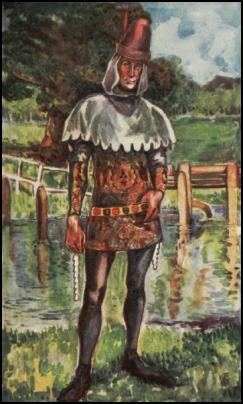
- A MAN OF THE TIME OF EDWARD III -1327-1377
- A WOMAN OF THE TIME OF EDWARD III - 1327-1377
EDWARD THE THIRD
Reigned fifty years: 1327-1377.
Born 1312. Married, 1328, Philippa of Hainault.
 This costume history information consists of Pages 102-121 of the chapter on the 14th century dress in the 50 YEAR REIGN era of Edward The Third 1327-1377 and taken from English Costume by Dion Clayton Calthrop.
The 36 page section consists of a text copy of the book ENGLISH COSTUME PAINTED & DESCRIBED BY DION CLAYTON CALTHROP. Visuals, drawings and painted fashion plates in the book have a charm of their own and are shown amid the text. The book covers both male and female dress history of over 700 years spanning the era 1066-1830.
This page is about dress in the 50 year reign of King Edward The Third 1327-1377. The images and details are a good resource for how-to costume designs for Shakespeare's stage plays of the Plantagenet era.
For the Introduction to this book see this introduction written by Dion Clayton Calthrop. I have adjusted the images so they are mostly 400 pixels high and can be used for colouring worksheets where pupils add some costume/society facts.
My comments are in italics.
THE MEN - 1327-1377
Kings were Kings in those days; they managed England as a nobleman managed his estates.
Edward I, during the year 1299, changed his abode on an average three times a fortnight, visiting in one year seventy-five towns and castles.
Edward II increased his travelling retinue until, in the fourth year of the reign of Edward III, the crowd who accompanied that King had grown to such proportions that he was forced to introduce a law forbidding knights and soldiers to bring their wives and families with them.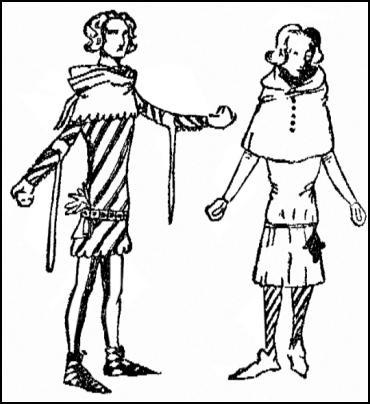
Edward III, with his gay company, would not be stopped as he rode out of one of the gates of London to pay toll of a penny a cart and a farthing a horse, nor would any of his train.
This toll, which included threepence a week on gravel and sand carts going in or out of the City, was raised to help pay for street repairs, the streets and roads of that time being in a continual state of slush, mud, and pits of water.
A KING'S RETINUE The Cavalcade
Let us imagine Edward III and his retinue passing over Wakefield Bridge before he reduced his enormous company.
The two priests, William Kaye and William Bull, stand waiting for the King outside the new Saint Mary's Chapel. First come the guard of four-and-twenty archers in the King's livery; then a Marshal and his servants (the other King's Marshal has ridden by some twenty-four hours ago); then comes the Chancellor and his clerks, and with them a good horse carrying the Rolls (this was stopped in the fourth year of Edward's reign); then they see the Chamberlain, who will look to it that the King's rooms are decent and in order, furnished with benches and carpets; next comes the Wardrobe Master, who keeps the King's accounts; and, riding beside the King, the first personal officer of the kingdom, the Seneschal;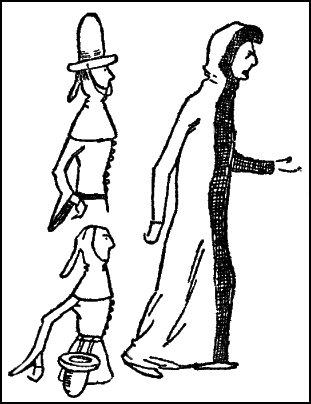 after that a gay company of knights and their ladies, merchants, monks dressed as ordinary laymen for travelling, soldiers of fortune, women, beggars, minstrels - a motley gang of brightly-clothed people, splashed with the mud and dust of the cavalcade.
Remembering the condition of the day, the rough travelling, the estates far apart, the dirty inns, one must not imagine this company spick and span.
The ladies are riding astride, the gentlemen are in civil garments or half armour.
Let us suppose that it is summer, and but an hour or so after a heavy shower. The heat is oppressive: the men have slung their hats at their belts, and have pushed their hoods from their heads; their heavy cloaks, which they donned hastily against the rain, are off now, and hanging across their saddles.
Cloaks
These cloaks vary considerably in shape. Here we may see a circular cloak, split down the right side from the neck, it buttons on the shoulder. Here is another circular cloak, jagged at the edge; this buttons at the neck. One man is riding in a cloak, parti-coloured, which is more like a gown, as it has a hood attached to it, and reaches down to his feet.
Clean Shaven Men
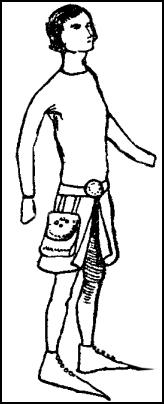
Nearly every man is alike in one respect - clean-shaven, with long hair to his neck, curled at the ears and on the forehead.
Cotehardie
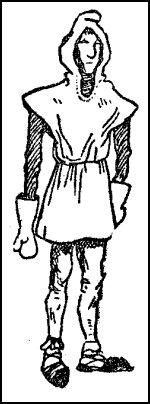
Most men wear the cotehardie, the well-fitting garment buttoned down the front, and ending over the hips. There is every variety of cotehardie - the long one, coming nearly to the knees; the short one, half-way up the thigh. Some are buttoned all the way down the front, and others only with two or three buttons at the neck.
Purses
Round the hips of every man is a leather belt, from which hangs a pouch or purse.
Some of these purses are beautiful with stitched arabesque designs; some have silver and enamel clasps; some are plain black cloth or natural-coloured leather; nearly all, however, are black.
Hoods, Hats & Caps
The hoods over the men's heads vary in a number of ways: some are very full in the cape, which is jagged at the hem; some are close about the neck and are plain; some have long liripipes falling from the peak of the hood, and others have a liripipe of medium length.
There are two or three kinds of hat worn, and felt and fur caps of the usual shape - round, with a rolled-up brim and a little peak on the top. 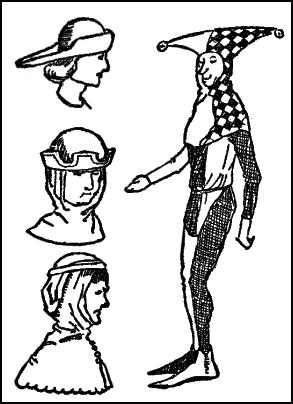
Some of the hats are tall-crowned, round hats with a close, thick brim - these have strings through the brim so that the hat may be strung on the belt when it is not in use; other hats are of the long, peaked shape, and now and again one may see a feather stuck into them; a third variety shows the brim of a high-crowned hat, castellated.
Parti-Colours, Material, Stuff or Cloth
Among the knights you will notice the general tendency to parti-coloured clothes, not only divided completely into halves of two colours, but striped diagonally, vertically, and horizontally, so giving a very diverse appearance to the mass of colour.
Here and there a man is riding in his silk surcoat, which is embroidered with his coat of arms or powdered with his badge.
Here are cloth, velvet, silk, and woollen stuffs, all of fine dyes, and here is some fine silk cotehardie with patterns upon it gilt in gold leaf, and there is a magnificent piece of stuff, rich in design, from the looms of Palermo.
Merchants
Among the merchants we shall see some more sober colours and quieter cut of clothes; the archers in front are in leather tunics, and these quiet colours in front, and the respectable merchants behind, enclose the brilliant blaze of colour round the King.
Peasants & Entertainers
Behind all come the peasants, minstrels, mummers, and wandering troupes of acrobats; here is a bearward in worn leather cloak and hood, his legs strapped at the ankle, his shoes tied on with thongs; here is a woman in a hood, open at the neck and short at the back: she wears a smocked apron; here is a beggar with a hood of black stuff over his head - a hood with two peaks, one on either side of his head; and again, here is a minstrel with a patched round cloak, and a mummer with a two-peaked hood, the peaks stuffed out stiff, with bells jangling on the points of them.
Again, among this last group, we must notice the old-fashioned loose tunics, the coif over the head, tied under the chin, wooden-soled shoes and pouch-gloves.
England The Great C14th Wool Producing Country
There are some Norfolk merchants and some merchants from Flanders among the crowd, and they talk as best they can in a sort of French-Latin-English jargon among themselves; they speak of England as the great wool-producing country, the tax on which produced £30,000 in one year; they talk of the tax, its uses and abuses, and how Norfolk was proved the richest county in wool by the tax of 1341.
The people of England little thought to hear artillery used in a field of battle so soon as 1346, when on August 26 it was used for the first time, nor did they realize the horrors that were to come in 1349, when the Great Plague was to sweep over England and kill half the population.
A Courtier & A Knight
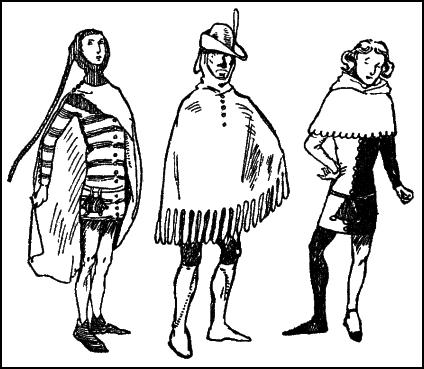
There is one man in this crowd who has been marked by everybody. He is a courtier, dressed in the height of fashion. His cotehardie fits him very well: the sleeves are tight from elbow to wrist, as are the sleeves of most of his fellows - some, however, still wear the hanging sleeve and show an under-sleeve - and his sleeve is buttoned from wrist to elbow. He wears the newest fashion upon his arm, the tippet, a piece of silk which is made like a detachable cuff with a long streamer hanging from it; his cotehardie is of medium length, jagged at the bottom, and it is of the finest Sicilian silk, figured with a fine pattern; round his hips he wears a jewelled belt.
His hood is parti-coloured and jagged at the edge and round his face, and his liripipe is very long. His tights are parti-coloured, and his shoes, buttoned up the front, are long-toed and are made of red-and-white chequered leather.
A Knight
By him rides a knight, also in the height of fashion, but less noticeable: he has his cotehardie skirt split up in front and turned back; he has not any buttons on his sleeves, and his belt about his waist holds a large square pouch; his shoes are a little above his ankles, and are buckled over the instep. His hair is shorter than is usual, and it is not curled.
As we observe these knights, a party of armed knights come riding down the road towards the cavalcade; they have come to greet the King.
These men have ridden through the rain, and now, as they come closer, one can see that their armour is already red with rust.
The King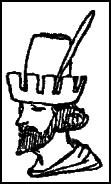
So the picture should remain on your mind, as I have imagined it for you: the knights in armour and surcoats covered with their heraldic device; the archers; the gay crowd of knights in parti-coloured clothes; the King, in his cotehardie of plain black velvet and his black beaver hat, just as he looked after Calais in later years; the merchants; the servants in parti-coloured liveries of their masters' colours; the tattered crowd behind; and, with the aid of the drawings, you should be able to visualize the picture.
Meanwhile Edward will arrive at his destination, and to soothe him before sleep, he will read out of the book of romances, illustrated by Isabella, the nun of Aumbresbury, for which he had paid £66 13s. 4d., which sum was heavy for those days, when £6 would buy twenty-four swans. £66 13s. 4d. is about £800 of our money to-day. (Book version 1907).
THE WOMEN 1327-1377
Piers the Plowman
'I looked on my left half as the lady taught me,
And was aware of a woman worthily clothed,
Trimmed with fur, the finest on earth,
Crowned with a crown, the King had none better.
Handsomely her fingers were fretted with gold wire,
And thereon red rubies, as red as any hot coal,
And diamonds of dearest price, and double manner of sapphires,
Orientals and green beryls....
Her robe was full rich, of red scarlet fast dyed,
With bands of red gold and of rich stones;
Her array ravished me, such richness saw I never.'
Piers the Plowman.
A MAN OF THE TIME OF EDWARD III -1327-1377
Like the coloured plate of the woman further below the man in this costume plate also wears the sleeve tippet around his arms and you can just see the tips of the jagged ends of which hang down. The tippet at this time was simply the last remains of the former pendant sleeves. His shoes are buttoned in front.
Illuminated Manuscripts
Loutrell Psalter
There are two manuscripts in existence the illuminations in which give the most wonderfully pictorial idea of this time; they are the manuscript marked MS. Bodl., Misc. 264, in the Bodleian Library at Oxford, and the Loutrell Psalter in the British Museum.
The Loutrell Psalter is, indeed, one of the most notable books in the world; it is an example of illumination at the height of that art; it has for illustrator a person, not only of a high order of intelligence, but a person possessed of the very spirit of Gothic humour, who saw rural England, not only with the eyes of an artist, but with the eyes of a gossiping philosopher.
Chaucer's Influence
Both this book and the book in the Bodleian Library were illustrated by persons who were charged to the brim with the spirit of their age; they were Chaucerian in their gay good-humour and in their quaint observation, and they have that moral knowledge and outspoken manner which characterize William Langland, whose 'Piers the Plowman' I have quoted above.
With Chaucer, Langland, and these illuminators we have a complete exhibition of English life of these times. The pulse of rural England is felt by them in a most remarkable way; the religion, language, thought, politics, the whole trend of rural, provincial, and Court life may be gathered from their books.
The drawings in the Loutrell Psalter were completed before the year 1340, and they give us all that wonderful charm, that intimate knowledge, which we enjoy in the 'Canterbury Pilgrims' and the 'Vision of Piers Plowman.'
There seems to be something in road-travelling which levels all humanity; there is no road in England which does not throb with history; there is no poem or story written about roads in England which does not in some way move the Englishness in us. Chaucer and Langland make comrades of us as they move along the highway, and with them we meet, on terms of intimacy, all the characters of the fourteenth century. With these illuminators of the Loutrell Psalter and the Bodleian MS. we see actually the stream of English life along a crowded thoroughfare.
In these books we may see drawings of every form of agricultural life and manorial existence: we see the country sports, the bear-baiting, and the cock-fighting; we see the harvesters with straw hats, scythes, and reaping-hooks; we see carters, carriers, and great carriages, all depicted in a manner which we can only compare, in later years, to the broad humour of Hogarth; and, as we turn the priceless pages over, the whole fourteenth-century world passes before our eyes - japers and jugglers; disours and jesters; monk, priest, pilgrim, and pardoner; spendthrift and wench; hermits, good and evil; lords, ladies, and Kings.
I have written of the men and their dress - how they were often - very often - dirty, dusty, and travel-stained - of the red-rusted armour and the striped and chequered clothes, and now I must write of the women and the manner of their dress.
A Round Table of Knights at Windsor, Founded in 1345
Of the time, you must remember that it was the time of chivalry, when there was a Round Table of Knights at Windsor, founded in 1345; when the Order of the Garter was founded; when tiltings and all manner of tournaments were at their height; and you listen to the minstrels of King Edward's household playing upon the trumpet, the cytole, the pipe, the taberet, the clarion, and the fiddle.
St. George
St. George, the Primate of Egypt in the fourth century, had now risen to public esteem and notice, so that he became in this time not only the patron saint of chivalry, but the tutelar saint of England.
Boys & Squires
Boys were taken from the care of the ladies of the household at the age of seven, when they became pages to knights, and were sworn to devote themselves to the graces and favours of some girl. At fourteen the boy became a squire, and at twenty-one, if he were possessed of a rental of £20 a year in land, he made his fast and vigil, and was afterward dubbed knight and given his spurs.
C14th Women's Hair
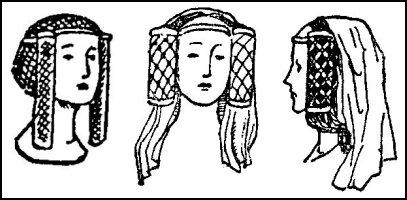
The noteworthy point about a woman of this reign was her hair. The Queen herself wore an elaborate mode of coiffure for that time; she wore a metal fillet round her head, to which was attached two cases, circular in shape, of gold fretwork, ornamented with precious stones. She wore her hair unplaited, and brought in two parts from the back of her head, and as far as one can see, pushed into the jewelled cases.
The most general form of hair-dressing was an excess on the mode of the previous reign, a richness of jewel-work, an abundance of gold wire. It was usual to divide the hair into two plaits, and arrange these on either side of the face, holding them in their place by means of a fillet; they might be worn folded straight up by the face, or at an angle, but they were never left hanging; if hair was left loose it was not plaited, but flowing. See more on women's hair in this era.
The Gorget
The gorget, or throat cloth, was still in general use, and it was attached to the hair by very elaborate-headed pins. Sometimes the hair, dressed with the gorget, was divided into four plaits, two on either side of the face, and fastened horizontally.
The Wimple
The wimple of silk or linen was very generally worn. A caul of gold net came into fashion, but not until the end of the reign. The ladies were great upon hunting and hawking, and this must have been a convenient fashion to keep the hair in order. Some wore a white silk or linen cap, so shaped as to include and cover the two side-plaits and combine a gorget and wimple in one. Pointed frontals of pearls were worn across the forehead, and fillets of silk or linen were so tied that long ends hung down the back.
Yellow hair was much esteemed, and ladies who were not favoured by Nature, brought saffron to their aid, and by such efforts brought Nature into line with Art.
Ladies Surcoats
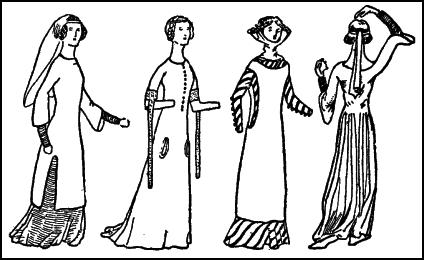
 There was the general custom of wearing the surcoat in imitation of the men, a garment I have described frequently - a slightly-fitting garment without sleeves - you will see how this grew later into a gorgeous affair. These surcoats were sometimes of fine cloth of gold covered with an intricate, delicate pattern in which beasts, birds, and foliage mingled in arabesque.
Under this surcoat was a plainer, better-fitting garment, made sometimes of the barred and rayed material so common to the men, or of velvet, cloth, or silk, in plain colours, green and red being then very favourite; ermines and many other furs were used to border these gowns.
Sleeves & Tippet
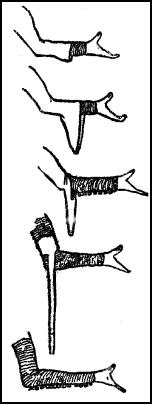
Sometimes you may see that this gown had sleeves short at the elbow, exposing a different coloured under-sleeve, buttoned from elbow to wrist; at other times - in fact, among all fashionable persons - the curious fashion of the tippet, or long streamer, was worn. I have carefully described this fashion in the previous chapter - (Edward the Second).
Gowns
The plain gown with tight sleeves was most in use, and the skirts of this gown were very voluminous, and had either pockets or holes in the front of them; the holes enabled the wearer to reach the purse hanging from a girdle which encircled the waist of the under-dress. These gowns were generally buttoned in front, from neck to waist, or they were laced.
They also wore a heavier gown which reached just below the knee, showing the skirts of the under-gown; the heavy gowns were often fur-lined, and had loose wide sleeves to the elbow.
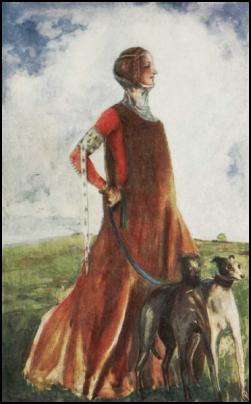 A WOMAN OF THE TIME OF EDWARD III - 1327-1377
Note the tippet (fourth sleeve down) shown above in the line drawing. The woman in the coloured plate also wears the tippet on her arm. Her throat neck gorget is set very high and totally encases her neck. Her gorget is held in shape by attaching it with pins to her plaited hair. This sleeve tippet is different from the scarf like boa tippet of the 1800s.
Scalloped Capes
There was at this time a curious fur or cloth cape in use, longer behind than in front - in fact, it varied with the taste of the owner. It was cut in even scallops all round; I say even to show that they were sewn-edged, not jagged and rough-edged. Any pair of these scallops might be longer than any other pair. Ladies wore these capes for hunting, and ornamented the ends with bells.
Women's Shoes
The shoes of the women were not very exaggerated in length, but, as a rule, fitted well to the foot and came out in a slight point. You may use for this reign shoes buckled across the instep, laced at the side, or buttoned up the front.
The Countrywoman
For riding and sport the ladies wore the hood, and sometimes a broad round hat over it, or the peaked hat. The countrywoman wore an ill-fitting gown with tight sleeves, an apron, and an open hood.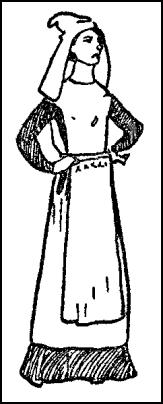
Black Death - The Plague - The Third Great Pestilence, 1369
Imagine London in the year of the third great pestilence, 1369. It is October, and the worst of the pestilence is over; John Chichester, the Mayor, is riding through the streets about some great affairs; many knights and ladies pass by. It is raining hard after the long drought of the summer, but, despite the rain, many citizens are abroad to see the doings in the City, and one may see the bright parti-coloured clothes of the lords and ladies, and here and there, as a cloak is blown back, a glimpse of rich-patterned cloth of gold.
Perhaps Will Langland - Long Will - a gaunt man of thirty-seven, is brushing past a young man of twenty-nine, Chaucer, going to his work.
Silk dresses and frieze gowns, velvet and homespun, hurry along as the rain falls more heavily, and after a while the street becomes quite deserted. Then nothing but the dreary monotony of the rain falling from the gables will come to the room of the knight's lady as she lies sick of small-pox. John de Gaddesden, the King's doctor, has prescribed for her that she must lie clothed in scarlet red in a room of that colour, with bed-hangings of that same colour, and so she must lie, without much comfort, while the raindrops, falling down the wide chimney, drip on the logs in the fire and make them hiss.
This costume history information consists of Pages 102-121 of the chapter on the 14th century dress in the 50 YEAR REIGN era of Edward The Third 1327-1377 and taken from English Costume by Dion Clayton Calthrop.
The 36 page section consists of a text copy of the book ENGLISH COSTUME PAINTED & DESCRIBED BY DION CLAYTON CALTHROP. Visuals, drawings and painted fashion plates in the book have a charm of their own and are shown amid the text. The book covers both male and female dress history of over 700 years spanning the era 1066-1830.
This page is about dress in the 50 year reign of King Edward The Third 1327-1377. The images and details are a good resource for how-to costume designs for Shakespearean stage plays of the Plantagenet era.
For the Introduction to this book see this introduction written by Dion Clayton Calthrop. I have adjusted the images so they are mostly 400 pixels high and can be used for colouring worksheets where pupils add some costume/society facts.
My comments are in italics.
You have been reading English Costume History at www.fashion-era.com © from the chapter Edward The Third 1327-1377, from Dion Clayton Calthrop's book English Costume.
Page Added 5 August 2010. Ref:-P794.