By Pauline Weston Thomas for Fashion-Era.com
- A MAN OF THE TIME OF QUEEN MARY - 1553-1558
- A WOMAN OF THE TIME OF QUEEN MARY - 1553-1558
This Tudor costume history information consists of Pages 283-290 of the chapter on the mid-16th century Tudor dress in the 5 YEAR REIGN of Mary - 1553-1558, and taken from English Costume by Dion Clayton Calthrop. Roman Catholic Mary Tudor the Queen Mary I was also known as Bloody Mary because of all the blood on her hands after the executions of many individuals of the Protestant religion.
The 36 page section consists of a text copy of the book ENGLISH COSTUME PAINTED & DESCRIBED BY DION CLAYTON CALTHROP. Visuals, drawings and painted fashion plates in the book have a charm of their own and are shown amid the text. The book covers both male and female dress history of over 700 years spanning the era 1066-1830.
This page is about Tudor dress in the reign of Queen Mary I - 1553-1558.
For the Introduction to this book see this introduction written by Dion Clayton Calthrop. I have adjusted the images so they can be used for colouring worksheets where pupils add some costume/society facts.
My comments are in italics.
MARY
Reigned five years: 1553-1558.
Born, 1516. Married, 1554, Philip of Spain.
THE MEN AND WOMEN
I cannot do better than commence this chapter by taking you back to the evening of August 3, 1553. Mary, with her half-sister Elizabeth, entered London on this date. At Aldgate she was met by the Mayor of London, who gave her the City sword.
From the Antiquarian Repertory comes this account:
'First, the citizens' children walked before her magnificently dressed; after followed gentlemen habited in velvets of all sorts, some black, others in white, yellow, violet, and carnation; others wore satins or taffety, and some damasks of all colours, having plenty of gold buttons; afterwards followed the Mayor, with the City Companies, and the chiefs or masters of the several trades; after them, the Lords, richly habited, and the most considerable knights; next came the ladies, married and single, in the midst of whom was the Queen herself, mounted on a small white ambling nag, the housings of which were fringed with gold thread; about her were six lacqueys, habited in vests of gold.
'The Queen herself was dressed in violet velvet, and was then about forty years of age, and rather fresh coloured.
'Before her were six lords bareheaded, each carrying in his hand a yellow mace, and some others bearing the arms and crown. Behind her followed the archers, as well of the first as the second guard.
'She was followed by her sister, named Madame Elizabeth, in truth a beautiful Princess, who was also accompanied by ladies both married and single.'
In the crowds about the city waiting to stare at the new Queen as she passed by, one could recognise the various professions by their colours. The trained bands in white doublets with the City arms before and behind; lawyers in black; sheriffs and aldermen in furred gowns with satin sleeves; citizens in brown cloaks and workers in cloth or leather doublets; citizens' servants in blue liveries; gentlemen's servants in very gorgeous liveries of their masters' colours.
Here is a description of a gentleman's page and his clothes:
'One doublet of yelow million fustian, th'one halfe buttoned with peche-colour buttons, and the other half laced downwards; one payer of peche-colour, laced with smale tawnye lace; a graye hat with a copper edge rounde about it, with a band p'cell of the same hatt; a payer of watchet (blue) stockings.
Likewise he hath twoe clokes, th'one of vessey colour, garded with twoe yards of black clothe and twisted lace of carnacion colour, and lyned with crymsone bayes; and th'other is a red shipp russet colour, striped about th'cape and down the fore face, twisted with two rows of twisted lace, russet and gold buttons afore and uppon the shoulder, being of the clothe itself, set with the said twisted lace and the buttons of russet silk and gold.'
This will give some notion of the elaborate liveries worn, and also it will show how, having understood the forms of the garments and the material which may be used, the rest, ornament and fancy, depend on the sense of the reader.
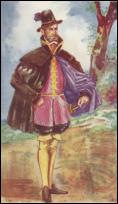
A MAN OF THE TIME OF MARY - 1553-1558
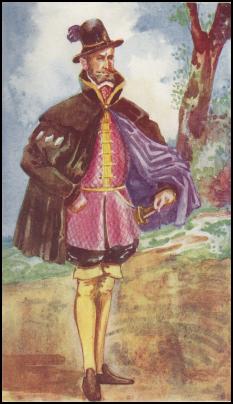 This costume plate shows dress during the transition era of 1530 and 1560 with an illustration of a man wearing a Spanish-influenced cloak very much of the period. He wears a tunic that is evolving into the Elizabethan doublet.
The Spanish Influence on Mid C16Th English Dress
A change has come over the streets, the town is full of Spaniards come over with Philip, and these bring with them many innovations in dress.
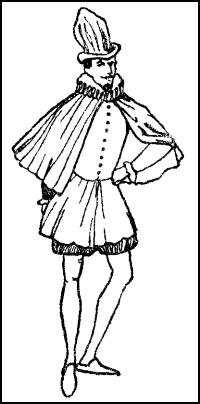
The most noticeable is the high-peaked Spanish hat, a velvet bag with a narrow brim, worn on one side of the head.
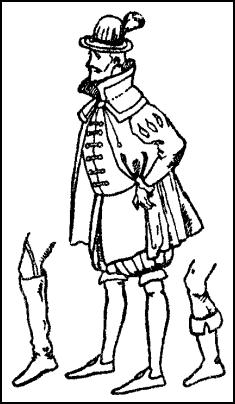
There is, also, a hard-crowned hat, round the crown-base of which is a gold cord clasped by a jewel; a feather is stuck into this hat.
Yet the mass of citizens wear the flat cap, some of them, the older men, have a coif tied under their chins, and over this the flat cap. Again, older men wear black velvet skull caps.
The Ruff
With these Spaniards comes, also, the first appearance of the ruff, very neat and small.
The Short Spanish Cloak 1550s
Although the overcoats of Henry's and Edward's reigns still form the principal wear, the short Spanish cloak has come in, cut in full folds, and reaching not far below the waist. They also brought in the cloak with a turned up high collar; and some had sleeves to their cloaks.
Beards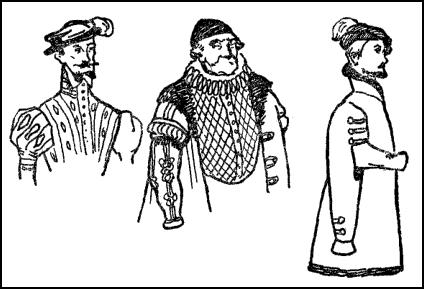
One sees more beards and moustaches, short clipped beards, and beards with two points.
Shoes, Boots, Hose
Shoes are now more to the shape of the foot, and high boots strapped up over the knee, also half-boots with the tops turned over to be seen. Often, where the hose meet the trunks, these are turned down.
The Shaped Doublet & Partlet Strip
The doublets become shaped more closely to the body, all showing the gradual change towards the Elizabethan costume, but still retaining the characteristics of earlier times, as the long skirt to the doublet, and the opening to show the collar of the shirt, or partlet strip.
THE WOMEN
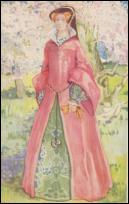
A WOMAN OF THE TIME OF QUEEN MARY - 1553-1558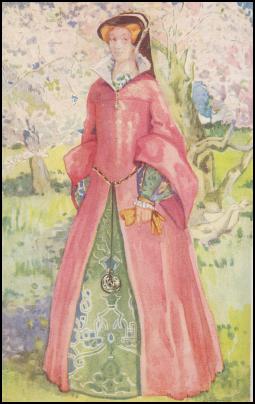
Wearing flowers in the opening of the dress was a frequent habit at this time. The fashion was begun in this reign. This dress lays the silhouette and styling of the later Elizabethan fashion which were an exaggeration of gowns such as this example.
The Hair
Ladies now show more hair, parted, as before, in the centre, but now puffed out at the sides.
The New 'Mary Style' Headdress
The new shape of head-dress becomes popular, and the upstanding collar to the gown is almost universal.
The Split Gown With Contrast Yoke
The gowns themselves, though retaining the same appearance as before, full skirts, no trains, big sleeves, and split to show the under-gown, have the top part of the gown covering the bosom made of a separate material, as, for instance, a gown of fine cloth will have collar and yoke of velvet.
The Neat Linen Caps
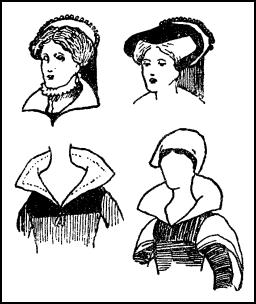 Women wear neat linen caps, made very plain and close to the head, with small ear-pieces.
On the shoulders there is a fashion of wearing kerchiefs of linen or silk, white as a rule; white, in fact, is frequently used for dresses, both for men and women.
A Fashion For Small Posies
The custom of carrying small posies of flowers comes in, and it is interesting to see the Queen, in her portrait by Antonio More, carrying a bunch of violets arranged exactly as the penny bunches sold now in our streets.
Gold Buttons & Gold Girdles
There was, in most dresses, a great profusion of gold buttons, and the wearing of gold chains was common - in fact, a gold chain about the neck for a man, and a gold chain girdle for a woman, were part of the ordinary everyday dress.
Towards Elizabethan Dress
You will realize that to one born in the reign of Henry VIII the appearance of people now was very different, and, to anyone as far away as we are now, the intervening reigns of Edward and Mary are interesting as showing the wonderful quiet change that could take place in those few years, and alter man's exterior from the appearance of a playing-card, stiff, square, blob-footed, to the doublet and hose person with a cart-wheel of a ruff, which recalls to us Elizabethan dress.
MARY
Reigned five years: 1553-1558.
Born, 1516. Married, 1554, Philip of Spain.
This Tudor costume history information consists of Pages 283-290 of the chapter on the mid 16th century dress in the 5 YEAR REIGN of Mary - 1553-1558, and taken from English Costume by Dion Clayton Calthrop. Roman Catholic Mary Tudor the Queen Mary I was also known as Bloody Mary because of all the blood on her hands after the executions of many individuals of the Protestant religion.
The 36 page section consists of a text copy of the book ENGLISH COSTUME PAINTED & DESCRIBED BY DION CLAYTON CALTHROP. Visuals, drawings and painted fashion plates in the book have a charm of their own and are shown amid the text. The book covers both male and female dress history of over 700 years spanning the era 1066-1830.
This page is about Tudor dress in the reign of Queen Mary I - 1553-1558.
For the Introduction to this book see this introduction written by Dion Clayton Calthrop. I have adjusted the images so they can be used for colouring worksheets where pupils add some costume/society facts.
My comments are in italics.
You have been reading English Costume History at www.fashion-era.com © from the chapter Queen Mary I - 1553-1558, from Dion Clayton Calthrop's book English Costume.
Page Added 16 August 2010. Ref:-805.
