
THE CROMWELLS 1649-1660
by Dion Clayton Calthrop
By Pauline Weston Thomas for Fashion-Era.com
THE CROMWELLS 1649-1660
English Costume History by Dion Clayton Calthrop
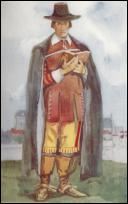
- A CROMWELLIAN MAN - 1649-1660
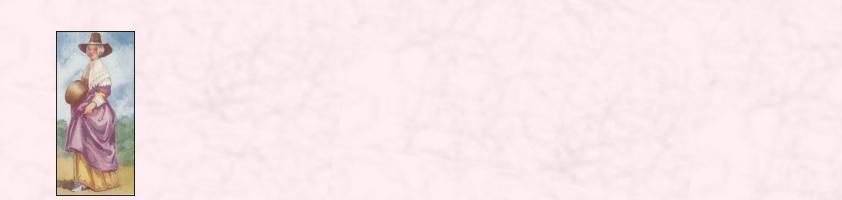
- A WOMAN OF THE TIME OF THE CROMWELLS - 1649-1660
- WOMAN OF THE TIME OF THE CROMWELLS - 1649-1660
 This costume history information consists of Pages 359-365 of the chapter on mid 17th century dress in the Civil War Cromwell Era 1649-1660 and taken from English Costume by Dion Clayton Calthrop.
The 36 page section consists of a text copy of the book ENGLISH COSTUME PAINTED & DESCRIBED BY DION CLAYTON CALTHROP. Visuals, drawings and painted fashion plates in the book have a charm of their own and are shown amid the text. The book covers both male and female dress history of over 700 years spanning the era 1066-1830.
This page is about dress in the English Civil War Cromwellian Era 1649-1660.
For the Introduction to this book see this introduction written by Dion Clayton Calthrop. I have adjusted the images so they can be used for colouring worksheets where pupils add some costume/society facts.
My comments are in italics.
THE CROMWELLS 1649-1660.
THE MEN AND WOMEN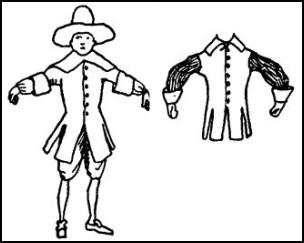
'I left my pure mistress for a space,
And to a snip-snap barber straight went I;
I cut my hair, and did my corps uncase
Of parel's pride that did offend the eye;
My high crowned hat, my little beard also,
My pecked band, my shoes were sharp at toe'.
'Gone was my sword, my belt was laid aside,
And I transformed both in looks and speech;
My parel plain, my cloak was void of pride,
My little skirts, my metamorphosed breech,
My stockings black, my garters were tied shorter,
My gloves no scent; thus marched I to her porter'.
It is a question, in this time of restraint, of formalism, where anything could be made plain, cut in a cumbrous fashion, rendered inelegant, it was done.
Severe Jackets
The little jackets were denuded of all forms of frippery, the breeches were cut straight, and the ornaments, if any, were of the most severe order.
Hats
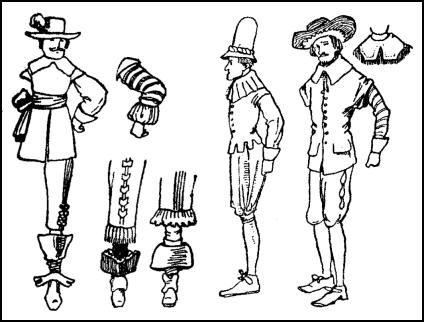
Hats became broader in the brim, boots wider in the tops, in fact, big boots seemed almost a sign of heavy religious feeling.
Plain Cropped Hair
The nice hair, love-locks, ordered negligence all vanished, and plain crops or straight hair, not over long, marked these extraordinary people. It was a natural revolt against extravagance, and in some more sensible minds it was not carried to excess; points and bows were allowable, though of sombre colours.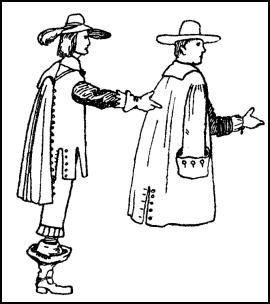
Sashes
Sashes still held good, but of larger size, ruffs at the wrists were worn, but of plain linen. The bands or collars varied in size according to the religious enthusiasm of the wearers, but all were plain without lace edgings, and were tied with plain strings.
Colours
Black, dark brown, and dull gray were the common colours, relieved sometimes, if the man was wearing a sleeveless coat, by the yellow and red-barred sleeves of the under-jacket, or possibly by coloured sleeves sewn into the coat under the shoulder-wings.
Overcoats
Overcoats were cut as simply as possible, though they did not skimp the material but made them wide and loose.
A CROMWELLIAN MAN - 1649-1660 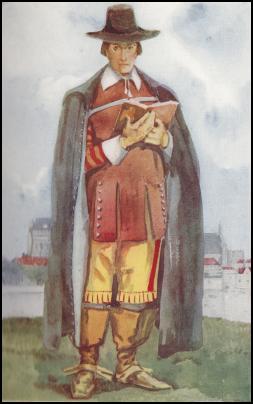
Notice the careful plainness of his dress, and his very wide-topped boots.
The women dressed their hair more plainly, the less serious retained the little bunches of side curls, but the others smoothed their hair away under linen caps or black hoods tied under their chins.
Another thing the women did was to cut from their bodices all the little strips but the one in the middle of the back, and this they left, like a tail, behind.
Some, of course, dressed as before with the difference in colour and in ornament that made for severity. It had an effect on the country insomuch as the country people ceased to be extravagant in the materials for garments and in many like ways, and so lay by good fortunes for their families - these families coming later into the gay court of Charles II had all the more to lavish on the follies of his fashions.
The Puritan is as well-known a figure as any in history; an intelligent child could draw you a picture or describe you a Puritan as well as he could describe the Noah of Noah's Ark.
He has become part of the stock for an Academy humourist, a thousand anecdote pictures have been painted of him; very often his nose is red, generally he has a book in his hand, laughing maids bring him jacks of ale, jeering Cavaliers swagger past him: his black cloak, board shoes, wide Geneva bands are as much part of our national picture as Punch or Harlequin.
WOMEN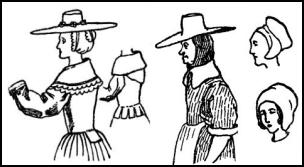
Puritan Dress
The Puritaness is also known. She is generally represented as a sly bird in sombre clothes; her town garments, full skirts, black hood, deep linen collar are shown to hide a merry-eyed lady, her country clothes, apron, striped petticoat, bunched up skirt, linen cap, her little flaunt of curls show her still mischievous.
The pair of them, in reality religious fanatics, prepared a harvest that they little dreamt of - a harvest of extravagant clothes and extravagant manners, when the country broke loose from its false bondage of texts, scriptural shirts, and religious petticoats, and launched into a bondage, equally false, of low cut dresses and enormous periwigs.
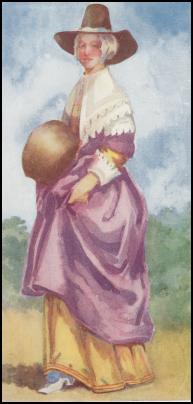 A WOMAN OF THE TIME OF THE CROMWELLS - 1649-1660
This is not one of the most Puritanical dresses, but shows how the richness of the reign of Charles I was toned down. She carries a muff in her hand, wears a good wide collar and cuffs, and neat roses on her shoes.
In the next reign you will see an entirely new era of clothes - the doublet and jerkin, the trunks and ruffs have their last eccentric fling, they become caricatures of themselves, they do all the foolish things garments can do, and then, all of a sudden, they vanish - never to be taken up again.
Hair, long-neglected, is to have its full sway, wigs are the note for two centuries, so utterly different did the man become in the short space of thirty-five years, that the buck of the Restoration and the beau of the Jacobean order would stare helplessly at each other, wondering each to himself what manner of fool this was standing before him.
WOMAN OF THE TIME OF THE CROMWELLS - 1649-1660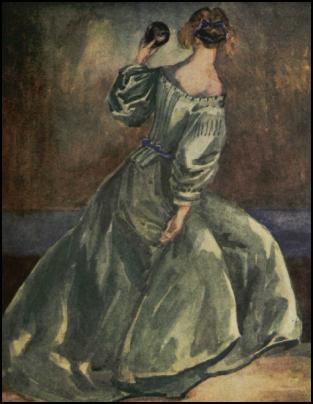
This shows the modification of the dress of the time of Charles I.
Not an extreme change, but an endeavour towards simplicity.
THE CROMWELLS 1649-1660
English Costume by Dion Clayton Calthrop
- A CROMWELLIAN MAN - 1649-1660
- A WOMAN OF THE TIME OF THE CROMWELLS - 1649-1660
- WOMAN OF THE TIME OF THE CROMWELLS - 1649-1660
This costume history information consists of Pages 359-365 of the chapter on mid 17th century dress in the Civil War Cromwell Era 1649-1660 and taken from English Costume by Dion Clayton Calthrop.
The 36 page section consists of a text copy of the book ENGLISH COSTUME PAINTED & DESCRIBED BY DION CLAYTON CALTHROP. Visuals, drawings and painted fashion plates in the book have a charm of their own and are shown amid the text. The book covers both male and female dress history of over 700 years spanning the era 1066-1830.
This page is about dress in the English Civil War Cromwellian Era 1649-1660.
For the Introduction to this book see this introduction written by Dion Clayton Calthrop. I have adjusted the images so they can be used for colouring worksheets where pupils add some costume/society facts.
My comments are in italics.
You have been reading English Costume History at www.Fashion-Era.com © from the chapter The Cromwells - 1649-1660, from Dion Clayton Calthrop's book English Costume.
Page Added 18 August 2010. Ref:-809.
Sitemap
For more information about English Costume By Dion Clayton Calthrop
see these pages:
- Costume History Home
- Introduction to English Costume by Calthrop
- 1066-1216 Norman
- 1272-1485 Plantagenet
- 1485-1603 Tudor
- 1603-1714 Stuart
- 1603-1625 - James I - Jacobean Stuarts
- 1625-1649 - Charles I - Jacobean Stuarts
- 1649-1660 - Cromwell Years - Civil War - Roundheads
- 1660-1685 - Charles II - Restoration Of Monarchy
- 1685-1689 - James II
- 1689-1702 William and Mary
- 1702-1714 - Anne
- 1603-1830 Hanover
- Hollar Drawings Index
- Hollar English Costume Plates Page 1
- Hollar English Costume Plates Page 2
- Hollar English Costume Plates Page 3
- Hollar English Costume Plates Page 4
- Hollar English Costume Plates Page 5