By Pauline Weston Thomas for Fashion-Era.com
What is La Belle Époque?
Aspects of Edwardian fashion history are examined in the sections on the Society Hostess, The Edwardian Seamstress and Edwardian Corsetry. Here we give a general overview of the main popular styles in the period 1890-1914 by which time fashion moved in a yearly cycle.
The French called the era from 1895 to 1914 La Belle Époque. It was an epoch of beautiful clothes and the peak of luxury living for a select few - the very rich and the very privileged through birth.
In retrospect we can see it is an era very separate from the 20th century despite belonging at its start. The attitudes and lifestyles of two decades were swept away by war and because the war was so atrocious a new socialism and sense of personal identity was born. The masses started to reject the concept of privilege as the reason for a better life.
Clothes worn after 1915 could probably be worn today in certain circumstances, but clothes before then are more in tune with the elaborate clothes of 1770 and would only be seen today at a costumed event or as bridal wear.
The Silhouette after 1890

The bustle disappeared from day dresses and the new day skirt style was flared smoothly over the hips from a handspan waist and then gradually widened at the hemline.
By 1895 the leg of mutton sleeves swelled to gigantic proportions and were also used on décolleté evening dresses.
The size of the sleeves was highlighted by the comparison of the tiny sashed or belted waist against the simple gored skirt that flared out all round to balance the massive sleeve heads.
Tailor Made Ready to Wear Costumes
The tailor made was called a costume or a suit and made of wool or serge. Middle and upper-class women wore them with shirtwaist blouses. Looser less fitted versions of a simple suit had been available for informal wear since 1850.
But the tailored suit as we know it was first introduced in the 1880s by the Houses of Redfern and Creed. Initially only the jacket was tailored and it was worn with a draped bustle skirt.
By the 1890s and until 1910 the gored skirt also looked more tailored and matched the jacket style which followed the changing silhouette of the time.
In the 1890s the tailored suit was thought both masculine and unladylike, a description usually used for a fairly plain garment. Describing female clothes as masculine was intended to be derogatory.

Edwardian Tailored Suits Ideal for Travel.
The pink tailor-made shown left here has a short bolero effect jacket.
The second green jacket is a longer-line jacket that continued in popularity but became straighter and less waisted toward the end of the Edwardian era.

Tailor mades were always described as ideal for traveling. Within a decade they became much more versatile with a distinction being made between the clothes used.
Lighter cloths were used in tailor-made outfits suitable for weddings and heavier tweeds and rougher serge used for everyday or country wear suits.
Fashion history clearly shows that by 1900 tailored suits were firmly established. Women entering a changing, more commercial workplace found it a useful all purpose outfit.
Men objected to the tailor made female suit as they saw it representing a challenge to their authority. Women seemed to be making a clear statement that they deserved and wanted more independence in the future.
The Gibson Girl
This particular image was a cartoon character drawn by the American artist Charles Dana Gibson. For twenty years between 1890 and 1910 he satirized society with his image of 'The New Woman' who was competitive, sporty and emancipated as well as beautiful.

Her clothes were fashionable in both America and Britain and set a fashion for skirts worn with embroidered blouses.
Another Gibson look was a shirt collar worn with either a tie, floppy artist bow, tie neck cravat with stick pin bar brooch or crosscut ruffle jabot.
Beautiful embellished ornate blouses took on a new importance and were worn by every class. Home dressmakers did their best to emulate the fussy couture blouses and they used fine pin tucks, fine embroidery, appliqué, insertions of lace, faggoting, pleats and lace trim to get good effects.
Blouses are detailed in the section on the 1912 Lower Class Fashion.
The Edwardian Silhouette 1900-1907

The fashionable hour glass silhouette belonged to the mature woman of ample curves and full bosom. The S-bend health corset described fully in the section on Edwardian Corsetry set the line for fashion-conscious women until 1905. The corset was too tightly laced at the waist and so forced the hips back and the drooping monobosom was thrust forward in a pouter pigeon effect creating an S shape.


The S-Bend corset and pouter pigeon effect.
If you were wealthy like an Edwardian society hostess, cascades of lace and ultra feminine clothes were available as labour was plentiful and sweated.
During this time it was still usual to make dresses in two pieces. The bodice was heavily boned and was almost like a mini corset itself worn over the S-bend corset.
A top bodice was usually mounted onto a lightly boned under bodice lining which fastened up with hooks and eyes very snugly. It acted as a stay garment giving extra stability, contour and directional shape beneath the delicate top fabric.
By 1905 press fasteners were used in Britain to hold the bodice or blouse to a skirt, but America had dress fasteners as early as 1901.
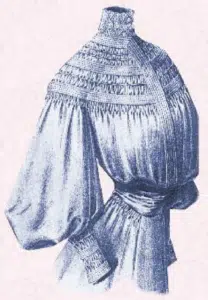
At the front of the bodice, pouches of cascading lace or gathered fabric gave emphasis to the low bust line. The straight sleeves of the late 1890s developed into bloused effects gathered into wristbands.
Very deep high lace fabric collars that reached right under the chin elongated the neck. They were often kept in place with wire covered in silk that was twisted into a series of hooks and eyes from one piece of wire.
Little wire or boning supports covered with buttonhole silk were sometimes dispersed every few inches of the collar to maintain the rigid effect.
High neck blouse 1906
High necks were usual by day, but by night exceptionally low sweetheart, square and round décolleté necklines allowed women to wear quantities of fine jewellery. No cleavage was visible as the bust was suppressed into a monobosom.
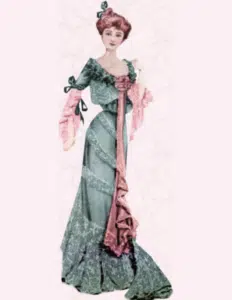
The skirts were often gored and created an elongated trumpet bell shape like the gently opening head of a longiflorum lily. Modified versions were less extreme over the hips, simply flowing to more width at the hemline.
The high collar, S-bend corset, trained skirt and lavish hat all had an effect on the posture of an Edwardian lady and it gave her a certain swaying grandeur.
Between 1906 and 1909 the silhouette began to show gradual changes and skirts lost fullness and the silhouette straightened. Feet showed again.
The Edwardian Silhouette 1908-1913
The waistline was raised until it was a column-like empire line or Directoire after the styles designed by fashion designer Paul Poiret.
So after 1907 fashion history looked toward a new fresh direction when a longer line corset became fashionable.
The corset almost reaching the knees was intended to make the figure look slimmer.

Poiret's ideas were controversial and were directed at younger women. To read more about the era of Orientalism and Paul Poiret's artist friends who put a stamp on the era go to Asian Influence In 1910s. One of THE social events of 1908 was the London Olympic Games.
The new late Edwardian silhouette.
Paletots, Casaques and Mantelets
Women wore the shawl for many years, but gradually it was replaced by other outdoor items such as capes, wraps and jackets.
The Casaque was a deep close fitting basque jacket that buttoned to the neck. A Paletot was a short jacket with set in sleeves and the Mantelet was a kind of half shawl. All the items had allowed for the cut of the bustles and pads of the era and the garments ranged from high hip to three-quarter length.
Edwardian Small Accessories
Incredible Edwardian Hats

After the slimmer silhouette arrived, hats developed much wider brims.
Lavish trims such as feathers often stuck out well beyond the brim.
The hats were named Merry Widow hats after the popular operetta of the era.
Feathers

Feathers were used excessively as decoration on hats and as boas.
The fur skin of whole animals such as foxes and even two foxes were used as wraps about the shoulders.
Aesthetes objected to the use of animal products.
Martial and Armand Creation depicting the perfectly groomed directoire-styled woman of 1912.
Note the incredible feather hat and lavish gold metal embroidery, velvet and fur trim on the oversized muff.
Gloves
Washable kid gloves were always worn with outdoor garments both winter and summer. Fancy gloves were also made in suede and silk and covered with fine embroidery.
Parasols
Parasols were still used as decorative accessories and in summer they dripped with lace and added to the overall fussy prettiness.
Bags
Handbags were not fashionable in the era, but small decorative delicate bags with a dainty strap that hung from the wrist were sometimes used. Ladies carried little money as goods were charged to accounts and only minimal make up was usual so none was carried.
Edwardian Motoring Outfits
Open cars still created dusty dirty atmospheres and country roads were often unmade.
Loose topcoats in leather or special motoring coats from Burberry or Aquascutum acted as protection from weather and cold. Oil smuts could be a problem so women wore thick face veils with their hats and even goggles.
Georgian Fashion Plates
Every generation loves dressing up in the outfits they imagine their ancestors wore decades, or even centuries, before the age we live in now. Then of course there are those who prefer to dress in fantasy costumes of unknown times such as, Star Trek, Doctor Who, Lord of the Rings or other Sci-fi designs.
Re-enactment is big business in many countries. Fancy Dress is even bigger. In some part of the world, in any week, there is probably an important festival day occurring and this always gives rise to a need for appropriate costumes. Amazingly, the costumes that people always envision themselves wearing are always exotic and lavish.
Generally, these costumes are similar to those once worn by the aristocratic, the rich, the famous, the magical or the simply beautiful. In reality, if we were transported more than 100 years back in time, most of us would probably have worked 'below stairs', in some dark dirty mill, or more recently in an office.
Belle of the Ball
Yet in real life when dressing up, we prefer to be the princess, the duchess, the cavalier or pop star, rather than the chambermaid, blacksmith, factory worker, land girl or street busker. The belle of the ball invariably wants to be Marie Antoinette, Cinderella (in full ball dress rather than kitchen tatters), or Marilyn Monroe.
The hero wants to be heroic in the eyes of the onlooker so Elvis Presley, Tarzan, Superman, Henry VIII, Mark Anthony or 007 all live again.
Elvis was sighted... It's as if the wearer hopes to achieve glamour by imitation and indeed they may well do so.
For if 'manners maketh the man', so then clothes 'as costly as thy purse can afford', make the wearer.
Ask any actor what helps them take on the character of a role and he, or she will tell you the clothes do half the work as posture and persona become a performance.
Disguise by clothing helps us to more easily become another character. For this reason masked balls have been popular for centuries. Royalty appears to have embraced masked balls too, as it enables the masked person to be off guard.
Royalty has also enjoyed dressing up as characters from earlier royal courts. The more lavish and recognizable the dress of a character, the more popular the costume choice. In some ways the modern wedding has become an excuse for all the elements of lavish over-dressing long gone from daily clothing.
Now even weddings with medieval themes are very popular. Real life becomes a costume drama.
You are reading an original costume history article by Pauline Weston Thomas at www.fashion-era.com © The above two costume plates are from my antique costume book find discussed below.
A Fashion Plate Find - My Discovery
Regular readers of my website will know that I collect fashion plates. I never pay a great deal for them, but collect carefully just for my own amusement. Often when I have scanned and finished with a plate for site purposes I pass it on to a relative or friend.
Recently for £18 I purchased an incomplete book of costume designs for fancy dress set in the Georgian era. I bought them because they looked suitable to put on this website. The sketches are by Onwhyn. On further research, imagine my surprise to discover that a COMPLETE original copy of this c1830-1845 book sells for prices between £700 and £1000 in rare bookshops.
Costumes of the Reign of George II in Designed for Her Majesty's State Ball by J. & J ONWHYN
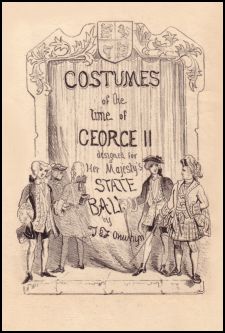
The book in question is an exceptionally slim book called Costumes of the Reign of Geo. II Adapted for Her Majesty's State Ball by J. & J ONWHYN.
George II reigned from 1727-60, thus I presume this was an early case of re-enactment. While the theme was 'Costumes of the time of George II', the ball was for Queen Victoria who was of course only in her twenties in the 1840s.
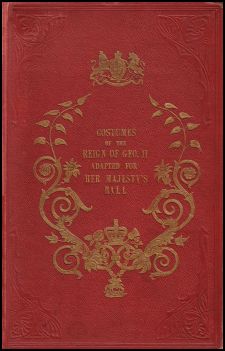
According to rare book shop websites, the book normally has 11 hand-coloured lithograph plates. These 11 plates are loose in a cover of red cloth stamped with gilt. My book was a little bit different, and at some point in its life had been spilt. The pages in my book were all loose, and the contents had been changed a little.
Within the red gilded cover I found:- a cut off title sheet (shown left): five loose Georgian costume sketches, which appear to be hand coloured/painted; one long etching I believe to be a rare Tho. McLean reproduction 1830s copy of an 1827 satirical 'Monstrosities' George Cruickshank hat cartoon; two Heloise Leloir original numbered fashion plates; three more plates from the Victorian crinoline era.
A good buy! The 5 loose Georgian-look sketches have a pencil sketch quality in the working, and I was very pleased with my purchase. Further below are the 5 detailed sketches of lavish Georgian-inspired costumes from the book. These images have been cleaned as the originals have foxing marks. Each image is titled for a particular character. The dresses probably belong in the timeframe c1725-60.
I imagine the books were reproduced either for an inner royal circle or as souvenirs after the ball was over.
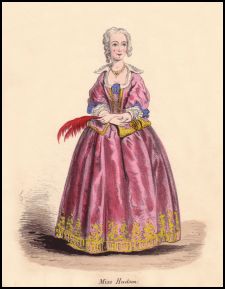
Miss Hudson
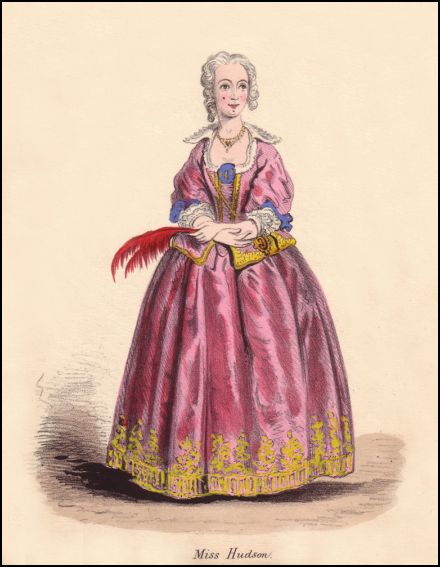
This first Georgian-style plate was of Miss Hudson, a young Georgian girl. The luster of her silk dress has been captured perfectly.
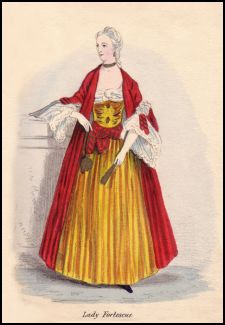
Lady Fortescue
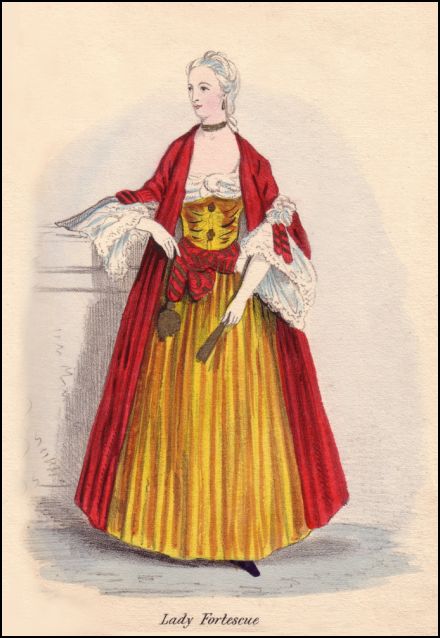
Below - This Onwhyn costume is based on Georgian Lady Fortescue. I really like the gold gown and red robe below; also the woman in this costume plate has such a beautiful face. The red robe probably had a Watteau pleat at the back. Importantly, the painter has ensured that all the hairstyles match the costume era. Notice how the hair of Lady Fortescue is much closer to the scalp and in keeping with the earlier dress period.
Princess Carolina
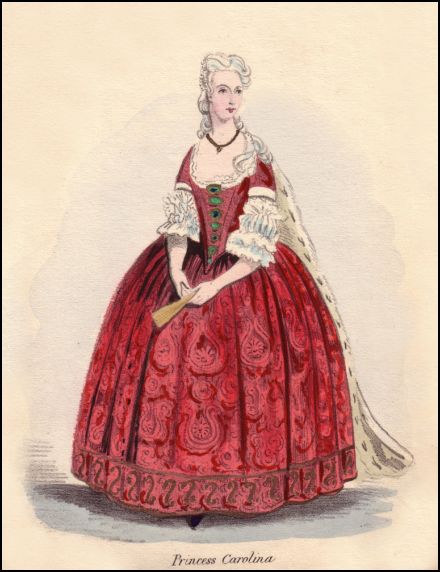
Below - This Onwhyn costume plate depicting Princess Carolina shows a gown of richly patterned damask with an ermine train. Her long face is delicately colored.
Princess Ann
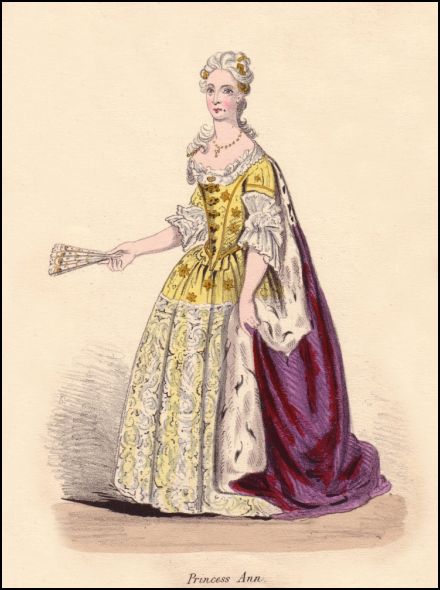
This Onwhyn costume based on Georgian Princess Ann, is highlighted with gold paint. What beautiful pattern detail in the skirt. The lushness of the velvet train edged in ermine is quite obvious. Clearly when royals dress in a fancy dress no expense was spared.
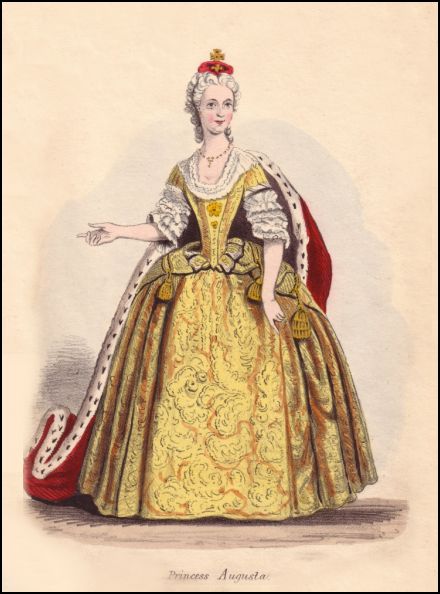
Princess Augusta
This regal gown below, taken from the Onwhyn costume book, is based on Princess Augusta. Again gold paint has been used to touch highlight the trims. See how tiny that basque encased waist looks, so minute and narrow giving the dress an Elizabethan feel, but for the sleeves.