By Pauline Weston Thomas for Fashion-Era.com
- The Peak of the Romantic Era 1825-1835
- Beret Sleeve Styles
- Anglomania
- The Romantic Era Fashion Silhouette
- The Romantic Skirt Silhouette
- Beret Sleeves
- Pelerine Collars 1830
- Fichu Pelerine
- The Wider Skirt Hemline 1820-1835
- After 1836 a New Slim Sleeve
- The Pelisse Robe and Pelisse Mantle 1818-1845
- The Underwear
- Hair
- Hats of the Romantic Period
- Dating Dresses in the Romantic Era
The Peak of the Romantic Era 1825-1835
The neo-Gothic influence in fashion history dress fashions was at its peak during the Romantic Era between 1825 and 1835. The romantic spirit in fashionable dress lasted until the late 1840s.
Anglomania
After the Napoleonic wars became a memory, French fashion was dominated by a new wave of Anglomania.

The British writings of Sir Walter Scott and Lord Byron helped popularise a thirst for a more romantic image. There was a snobbish attraction on the continent for all things English, cultivated and refined.
Many of the attitudes toward the 'Art Of Dress' had been codified by Beau Brummell in his relationship with the Prince Regent.
The rules and refinements of manners set at that time were built on and developed by the middle classes of Europe who sought to gentrify themselves.
The 1820s Fashion Silhouette
The Romantic Era Skirt Silhouette
Until 1820 dress waists had been round, but in 1828 the bodice waistline took on a V-pointed form. Even so it was the late 1830s before every lady sported the fashion for long pointed bodices. Evidence in museums suggests that real women were still wearing and making dresses with a slightly raised waistlines well into the 1830s despite the low waist illustrations of fashion plates.
Beret Sleeves

Beret sleeves were cut from a circle. There was an opening in the centre for the arm and this was gathered and bound into a band. The outer circle was gathered and set into the armhole.
Sometimes a sheer oversleeve of silk embroidered shimmering gauze covered the beret puff. Generally the beret sleeve was worn for evening.
The arms and décolletage along with the highly desirable and visible sloped shoulders left some women feeling quite undressed and exposed.
So gauze sleeves became very fashionable by the mid-1820s and were worn until the sleeves subsided to new styles.
The Gigot or Gigot De Mouton Sleeve 1825-1833
The sleeves of the Romantic Era are the main feature and were built on an inverted triangle bodice. The bodice décolletage was so exposed by the pull of the wide sleeves that it really showed off the chest, throat and the sloping shoulders.
The full-length gigot or leg of lamb sleeve or the gigot de mouton known as the leg of mutton sleeve, was first seen in 1824. The long sleeve pattern was cut on the true cross of the fabric. It was rounded at the top, increasing to greater size.

After 1825 the decade saw sleeves billow to huge proportions by 1833. They came to typify the look we now associate with the costume of the Romantic Era.
By the mid-1830s the enlarged top cap was sagging with its own enormity. There was so much material that the fullness initially held up with inner stiff buckram support or 'crin' horsehair fabric began to flop.
The buckram was replaced with either whalebone hoops in a cotton cover or feather-filled pads.
When by 1835 the supports stopped being effective the sagged fabric volume collapsed down the arm and merged into a new sleeve fashion.
After 1836 a New Slim Sleeve
Over a few years after 1836, the Romantic sleeve fullness inevitably worked its way down the sleeve giving a much tighter top arm and more fullness at the elbow. Next the elbow fullness dropped to the wrist and excess material was gathered into a rouleau or band creating a new sleeve shape.
By 1840 early Victorian day sleeves could be quite slim fitting.
By 1845 the shoulder line of dresses showed that a new fashion era was in the making. Tight sleeves were set into a low small armscye restricting women's arm movements and increasing the demure mannerisms we associate with Victorian women.
Hats
Large romantic wide hats, ornately trimmed with feathers, loops of ribbons and bows complemented the wide shoulder lines of the 1830s. For evening many married ladies liked to wear gauzy silk, satin and velvet exotic turbans or berets, especially on one side of the head. The turbans they twisted up from scarves, but as a fashion they were dead by the 1840s.

Bonnets were virtually interchangeable with hats, so little difference was seen between the types.
Loose uncut ribbon ties were a feature of the bonnets and by 1828 both bonnets and hats were quite vast affairs. Coal scuttle bonnet styles with deep crowns accommodated the high Apollo knot coiffure and were a great feature of the Romantic Era.
Pelerine Collars 1830
Pelerine collars came in several variations. Their similarity was that each covered very wide shoulders and could aid modesty. The first style was a fine white collar embroidered or lace trimmed and which looked like a cape.
The pelerine grew wider as it spread over the increasing shoulder line of gigot sleeves. It accentuated the shoulder width and made the waist of the 1830s look very small and was a popular feature of dress in the Romantic period.
The width of the lace pelerine reached about 31 inches when at its widest fashion and the pelerines were sometimes attached to a chemisette which was a sleeveless side-opened blouse fastened at the waist. Another name for this item was a tulle canezou.
Fichu Pelerine
In the second version if the lace pelerine had long front ends, it was called a fichu-pelerine. These ends could be crossed at the front waist and tied at the back waist.
Another later mid 19th century variation was a fashionable long-fronted little shoulder short backed cape mostly made of velvet or wool, trimmed with fur and worn as an outdoor garment.
The Wider Skirt Hemline 1820-1835
Skirts were a source of endless variation. Skirts were gored into panels between 1820 an 1828, so that width could be added to hemlines whilst keeping the waist clear of bulk. They were first stiffened with horsehair about 1815 and gradually padding adding was added. The padding backed the lower six inches of the skirt.

Decoration of stuffed rouleau tubes, Italian quilting and flounces and frills were added to push out the skirt hem width in an architectural way. It also shortened the dress to reveal the ankle at the same time. Women's fashions took on a pert cheeky air.
When all forms of decoration had been exhausted just the padded hems remained by about 1828.
Gores disappeared at the same time and from then on skirts were made from straight panels of dress material pleated and gathered to waistbands. The silhouette changed and lost its overall puffiness by 1835. The skirts began to get rounder and more bell like, setting the scene for the Victorian Era.
The 1820s Underwear
With the return of the waist, women had to wear stays. Once again they returned to tight lacing to make the waist look narrow and pinched in to balance the wide skirts and wide shoulder line.
Stays were made from cloth layers that had whalebone inserted in channels. Corsets were intended to emphasise the natural curves rather than create a false silhouette.
Little gussets at the hips allowed for roundness rather than trying to flatten the line. Small shoulder straps were made detachable and the wearer could wear the stays with more revealing necklines.
Over the stays women wore a chemise and a waist petticoat. As the skirt expanded the robust linen or cotton petticoats increased in number. They supported crisp firm silk or woollen materials and in summer or indoors cotton chintzes and muslins.
The Pelisse Robe and Pelisse Mantle 1818-1845
By 1831 the pelisse robe fashionable since 1818 was worn almost as a house dress. After 1848 this day coat-dress was called a redingote as fashion writers had called it for many years.
As a dress the pelisse robe was supplanted by the pelisse mantle in the 1830s. Sleeves on the pelisse robe were too big to wear under coats so shawls and cloaks were more practical. The pelisse mantle was the ideal answer during the Romantic Era. It was an interlined warm deep cloak and was the most used outer garment in chilly weather remaining fashionable until 1845.

1820s Hair
Women's hair between 1825 an 1845 was elaborate and ingenious. The most modish hair fashion was the 'Apollo Knot', a striking style tending to lean to one side.
Another lesser style was the 'Madonna' coiffure with the centre parted and built up with ringlets at crown and sides. Some even thought this style too elaborate, even when it was mostly worn for evening.

Apollo Knot Hairstyle so typical of the Romantic period.
There are many fashion plates and paintings that show both these styles because they were so typical of the age.
Dating Dresses in the 1820s Romantic Era
Compared to eras where the dating of dresses can be confusing the Romantic Era has quite definite periods of style variations that make it fairly easy to date garments to within a few years.
Occasionally students confuse the period 1892-1896 fashions because of the similar fashion for leg of mutton sleeves. They are similar, but if you look really closely you will see they are not at all alike. As I have suggested elsewhere on the Fashion-Era.com site always look at the hairstyles and headwear of the wearer of the garment. Hairstyles and hair ornamentation give a very definite feel of an era.
The frizzed and curled hairstyles of the Naughty Nineties are quite different from the demure centre hair partings, coiled Apollo top knots and ringlet loops of the Romantic Era.
Petit Courier
1820 + Le Petit Courrier des Dames Fashion History
- Le Petit Courrier des Dames
- Townsend's Selection of Parisian Costumes
- Le Journal des Dames et Des Modes
As so often happened in American, English and other European publications, many early plates were crude copies from French magazines. Only when publishers paid to use the imported quality engraved plates from French magazines did the magazines really win the hearts of subscribers.
Le Petit Courrier des Dames (French)
Many new C19th long-lived fashion magazines began life in the 1820s and old favourites died too. For one year the now very collectable Le Petit Courrier des Dames had begun life as Nouveau Journal des Dames in 1821.
This was an important French fashion magazine and it produced a weekly issue uninterrupted until 1865. Each issue had one or two fashion plates and many are considered the finest in the C19th. Artists who made some of the finest plates were Madame Florensa de Closmenil, A. Pauquet, Hervy, Laure Noel, A. de Taverne and E. Preval. Another good French Fashion Plate magazine was Le Journal des Dames et Des Modes - Costumes Parisiens. You can see 2 of my favourite plates from this further down.
Le Petit Courrier des Dames
1850 dresses below. Day dress and evening dress in tulle and grenadine, trimmed with ribbons. Shawl of white lace.


Above - The artist signature of A.Pauquet .
Townsend's Selection of Parisian Costumes (English) In 1823 Townsend's Selection of Parisian Costumes an English publication, used imported plates from both Le Petit Courrier des Dames and Le Journal des Dames et Des Modes Costumes Parisiens.
The latter word is often spelt many ways on various plates. Both these last two publications produced very fine engravings and Townsend found that when it economised and used badly made plates, sales went down. Fortunes were regained once they used French plates again.
Le Journal des Dames et Des Modes Costumes Parisiens 1826
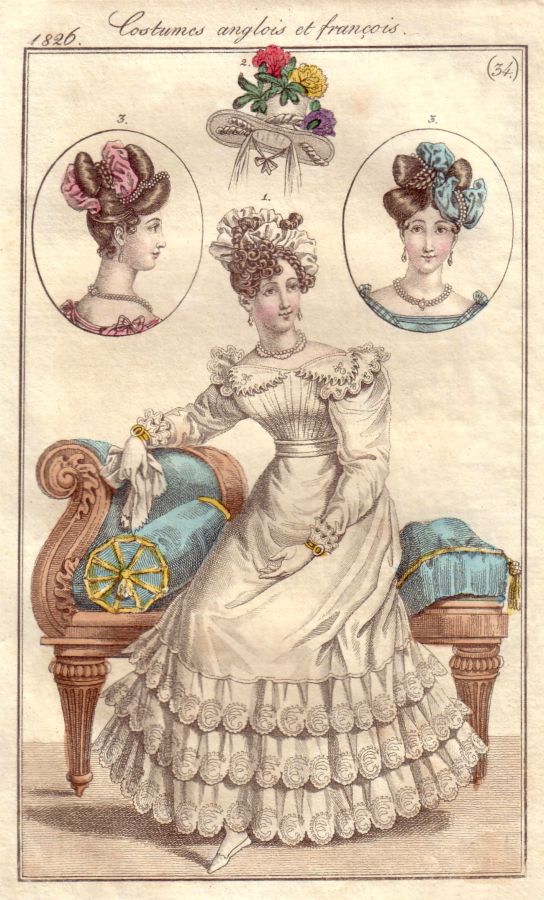
This is a hand-coloured fashion engraving from an 1826 Le Journal des Dames et Des Modes Costumes Parisiens. With vibrant colours and extraordinary detail it is an exquisite work of art in its own right.
The Apollo knot hairstyle details are magnificent. Bought from Cabrio4 at eBay. Below is another of my fashion plates from the Le Journal des Dames et des Modes magazine of the year 1826. These engravings are particularly good with fine and pretty detail. The headings usually state Costumes Parisians, sometimes I even think it reads Parisions.
Le Journal des Dames et des Modes Costumes Parisians - 1826
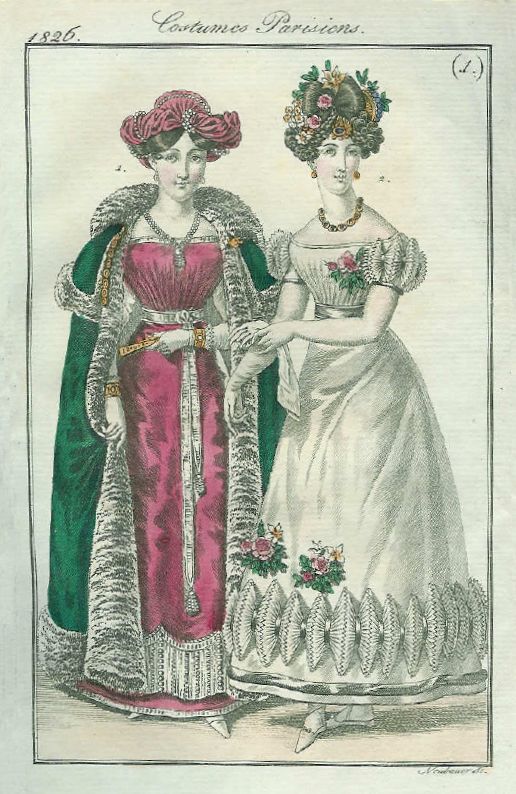
This hand-tinted image was bought from eBay fashion plate. What a wonderful pelerine mantle so perfectly accommodating for the newly developing fuller sleeves. Yes eBay can become an expensive habit............ and can you tell I like this era?
