King Edward VI Costume - 1547-1553 English History by Dion Clayton Calthrop
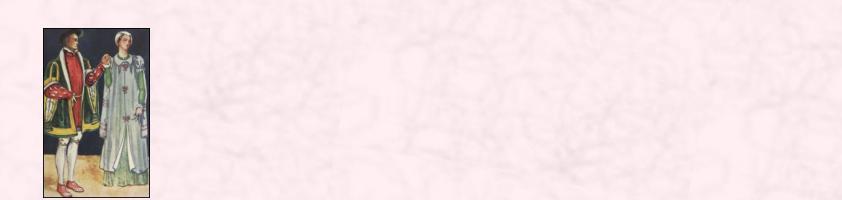
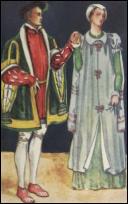
- A MAN AND WOMAN OF THE TIME OF King EDWARD VI - 1547-1553
- Beefeater Fashion Style!
- The Doublet & The Partlet
 This Tudor costume history information consists of Pages 274-282 of the chapter on the mid 16th century dress in the 6 YEAR REIGN era of boy-king Edward The Sixth 1547-1553 and taken from English Costume by Dion Clayton Calthrop.
King Edward The Sixth Reigned six years: 1547-1553. Born, 1537
THE MEN AND WOMEN
 Here we have a reign which, from its very shortness, can hardly be expected to yield us much in the way of change, yet it shows, by very slight movements, that form of growth which preludes the great changes to come.
Tunic to Doublet
I think I may call a halt here, and proceed to tell you why this volume is commenced with Henry VII, called the Tudor and Stuart volume, and ends with the Cromwells. It is because, between these reigns, the tunic achieves maturity, becomes a doublet, and dies, practically just in the middle of the reign of Charles II of pungent memory. The peculiar garment, or rather, this garment peculiar to a certain time, runs through its various degrees of cut. It is, at first, a loose body garment with skirts; the skirts become arranged in precise folds, the folds on the skirt are shortened, the shorter they become the tighter becomes the coat; then we run through with this coat in its periods of puffings, slashings, this, that, and the other sleeve, all coats retaining the small piece of skirt or basque, and so to the straight, severe Cromwellian jerkin with the piece of skirt cut into tabs, until the volume ends, and hey presto! there marches into history a Persian business - a frock coat, straight, trim, quite a near cousin to our own garment of afternoon ceremony. For a sign of the times it may be mentioned that a boy threw his cap at the Host just at the time of the Elevation. To Queen Elizabeth has been given the palm for the wearing of the first silk stockings in England, but it is known that Sir Thomas Gresham gave a pair of silk stockings to Edward VI.Beefeater Fashion Style!
The Tudor Flat Cap
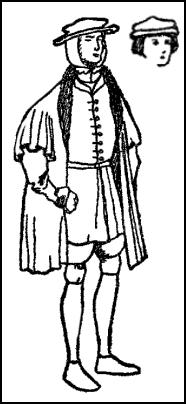
We now see a more general appearance in the streets of the flat cap upon the heads of citizens. The hood, that eminently practical head-gear, took long to die, and, when at last it went out of fashion, except among the labouring classes, there came in the cap that now remains to us in the cap of the Beefeaters at the Tower of London.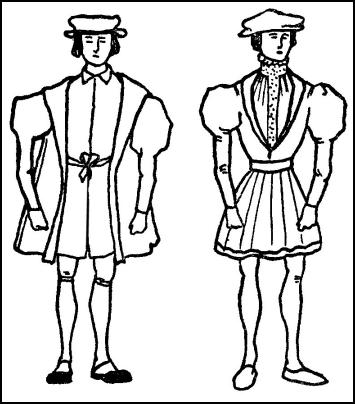
Blueboy Coats
The Bluecoat Boys, and long may they have the sense to keep to their dress, show us exactly the ordinary dress of the citizen, except that the modern knickerbocker has taken the place of the trunks. Also, the long skirts of these blue coats were, in Edward's time, the mark of the grave man, others wore these same skirts cut to the knee. That peculiar fashion of the previous reign - the enormously broad-shouldered appearance - still held in this reign to some extent, though the collars of the jerkins, or, as one may more easily know them, overcoats or jackets, open garments, were not so wide, and allowed more of the puffed shoulder of the sleeve to show. Indeed, the collar became quite small, as in the Windsor Holbein painting of Edward, and the puff in the shoulders not so rotund.The Doublet & The Partlet 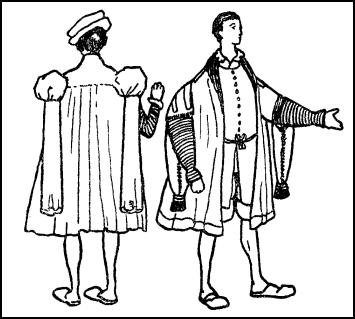
The doublet of this reign shows no change, but the collar of the shirt begins to show signs of the ruff of later years. It is no larger, but is generally left untied with the ornamental strings hanging.
Antiquarian research has, as it often does, muddled us as to the meaning of the word 'partlet.' Fairholt, who is very good in many ways, puts down in his glossary, 'Partlet: A gorget for women.'
Then he goes on to say that a partlet may be goodness knows what else. Minshein says they are 'part of a man's attire, as the loose collar of a doublet, to be set on or taken off by itself, without the bodies, as the picadillies now a daies, or as mens' bands, or womens' neckerchiefs, which are in some, or at least have been within memorie, called partlets.'.
Sir F. Madden says: 'The partlet evidently appears to have been the corset or habit-shirt worn at that period, and which so commonly occurs in the portraits of the time, generally made of velvet and ornamented with precious stones.'
A MAN AND WOMAN OF THE TIME OF EDWARD VI - 1547-1553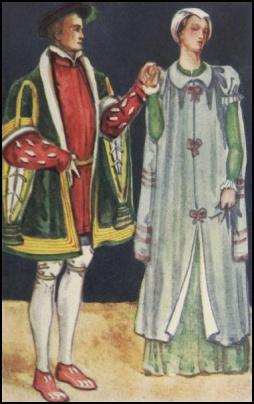
The change from the dress of the previous reign should be easily noticed, especially in the case of the woman. This dress is, of course, of the plainest in this time.
Hall, the author of 'Satires,' 1598, speaks of a man, an effeminate dandy, as wearing a partlet strip. It appears to me, who am unwillingly forced into judging between so many learned persons, that, from all I have been able to gather from contemporary records and papers, the partlet is indeed, as Minshein says, 'the loose collar of a doublet,' in reality the same thing as a shirt band.
Ruff Forerunner
Henry VIII wore a band about his neck, the forerunner of the ruff. Some of his bands were of silver cloth with ruffs to them, others, as I have shown, were wonderfully embroidered. In this case, then, the partlet is head of the family tree to our own collar, 'to be set on or taken off by itself,' and so by way of ruff, valued at threescore pound price apiece, to plain bands, to falling bands, laced neckcloth, stock - to the nine pennyworth of misery we bolt around our necks.Plainer Dress
Dress, on the whole, is much plainer, sleeves are not so full of cuts and slashes, and they fit more closely to the arm. The materials are rich, but the ornament is not so lavish; the portrait of Edward by Gwillim Stretes is a good example of ornament, rich but simple. Shoes are not cut about at the toe quite with the same splendour, but are still broad in the toe.§
Elaborate Headdress Simplified 1550
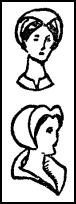 For the women, it may be said that the change towards simplicity is even more marked. The very elaborate head-dress, the folded, diamond-shaped French hood has disappeared almost entirely, and, for the rich, the half hoop, set back from the forehead with a piece of velvet or silk to hang down the back, will best describe the head-gear. From that to the centre-pointed hoop shows the trend of the shape.
The women are also wearing cloth hoods, rather baggy cap-like hoods, with a hanging-piece behind.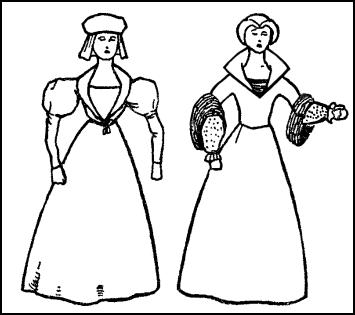
Gown Collars
The most notable change is the collar of the gown, which suddenly springs into existence. It is a high collar and very open in front, showing a piece of the under-dress. On this collar is sewn - what I shall call - the woman's partlet, as the embroidery is often detachable and answers the same purpose as the man's partlet; this later became a separate article, and was under-propped with wires to hold it out stiffly. The same stiff-bodied appearance holds good, but in more simple dresses the skirts were not quite as voluminous as heretofore. With overcoats in general the hanging sleeve is being worn, the arm of the wearer coming out just below the puffed shoulder-piece. With these remarks we may safely go on to the reign of Mary; another reign which does not yield us much in the way of clothes.EDWARD THE SIXTH Reigned six years: 1547-1553. Born, 1537
This costume history information consists of Pages 274-282 of the chapter on the mid 16th century dress in the 6 YEAR REIGN era of boy-king Edward The Sixth 1547-1553 and taken from English Costume by Dion Clayton Calthrop.