By Pauline Weston Thomas for Fashion-Era.com
1714-1800+ Georgian Women's Hair & Headdresses
This costume history page is about hair fashion history. It consists of a selection of women only headdresses and hairstyle illustrations and original from 1714 to 1800+ taken from English Costume History by Dion Clayton Calthrop.
This page is about female headdresses and hairstyles from the Georgian era to 1800+. Later eras of headdresses are shown on other pages.
Georgian Women's Headwear
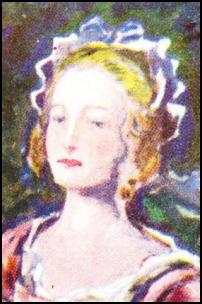
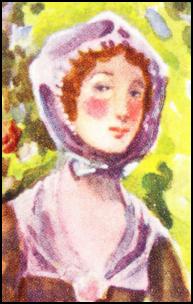
WOMEN OF THE TIME OF GEORGE I - 1714-1727
The ladies wear little lace and linen caps, their hair escaping in a ringlet or so at the side, and flowing down behind, or gathered close up to a small knob on the head.
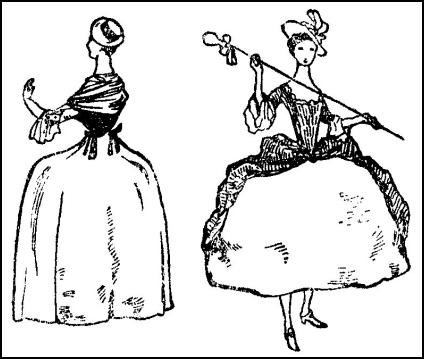
The hair is very tightly gathered up behind, twisted into a small knob on the top of the head, and either drawn straight back from the forehead or parted in the middle, allowing a small fringe to hang on the temples. Nearly every woman wore a small cap or a small round straw hat with a ribbon round it.
Now the lady would puff her hair at the sides and powder it; if she had no hair she wore false, and a little later a full wig. She would now often discard her neat cap and wear a veil behind her back, over her hair, and falling over her shoulders.
George The Third Reigned 60 Years: 1760-1820
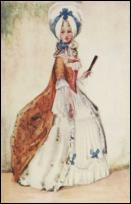
The first color plate above shows the last of the pannier dresses, which gave way in 1794 or 1795 to Empire dresses. The second plate shows the Polonaise skirt.
After the French Revolution, all men's and women's dresses underwent radical changes.
Georgian Women Hairstyles, Georgian Wigs & Headwear
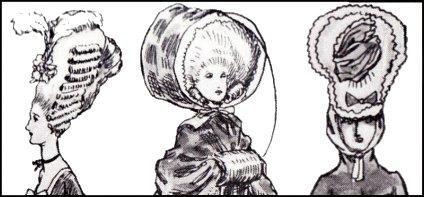
Calthrop wrote:- The drawings of the women's dresses should also speak for themselves. You may watch the growth of the wig and the decline of the hoop - I trust with ease. You may see those towers of hair of which there are so many stories. Those masses of meal and stuffing, powder and pomatum, the dressing of which took many hours.
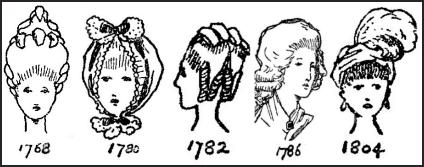
Those piles of decorated, perfumed, reeking mess, by which a lady could show her fancy for the navy by balancing a straw ship on her head, for sport by showing a coach, for gardening by a regular bed of flowers.
Heads which were only dressed, perhaps, once in three weeks, and were then re-scented because it was necessary.
Monstrous germ-gatherers of horse-hair, hemp-wool, and powder, laid on in a paste, the cleaning of which is too awful to give in full detail. 'Three weeks,' says my lady's hairdresser, 'is as long as a head can go well in the summer without being opened.'
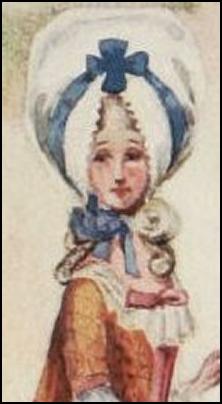
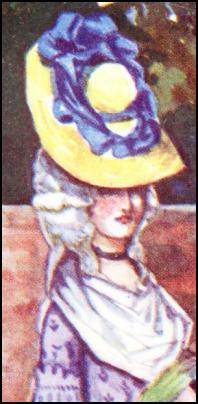
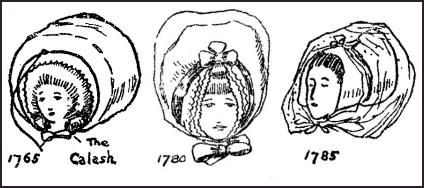
The Ladies Calash
Then we go on to the absurd idea which came over womankind that it was most becoming to look like a pouter pigeon. She took to a buffon, a gauze or fine linen kerchief, which stuck out pigeon-like in front, giving an exaggerated bosom to those who wore it. With this fashion of 1786 came the broad-brimmed hat.
The Mob Cap
Travel a little further and you have the mob cap.
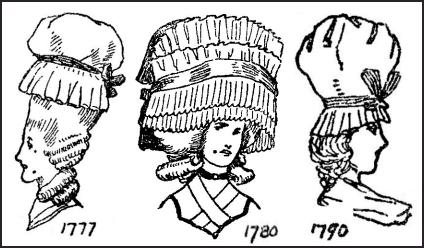
All of a sudden, out go hoops, full skirts, high hair, powder, buffons, broad-brimmed hats, patches, high-heeled shoes, and in some willowy figures and thin, nearly transparent dresses, turbans, low shoes, straight fringes.
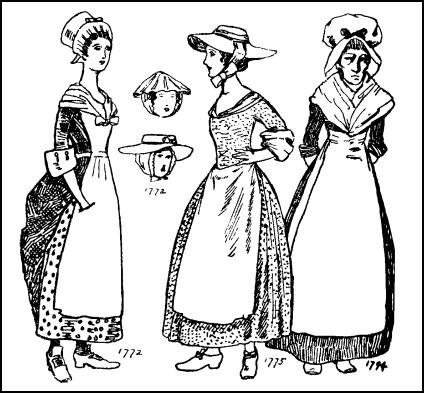
Women's Hairstyles in the Reign of George III
Hairstyle crops are taken from drawings by Calthrop and the Dightons, father & son.
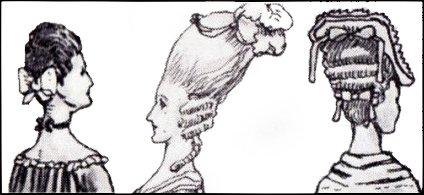
Georgian High Frame Hair Fashion Drawings
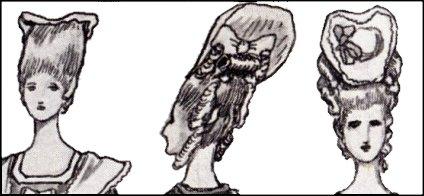
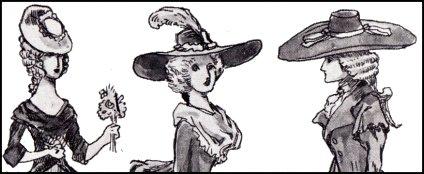
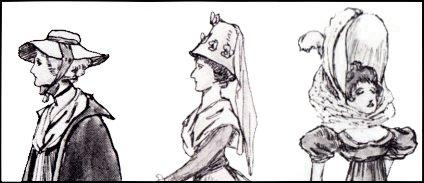
Georgian Turban & Bonnet Hat Fashion Drawings
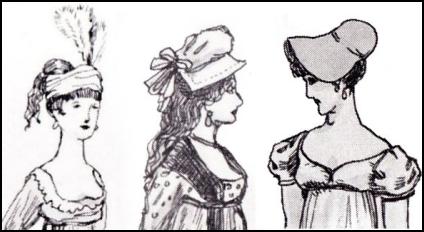
Georgian Turban & Feather Plume Hat Fashion Drawings
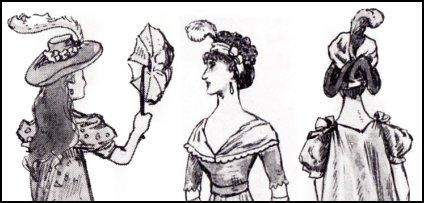
Late Georgian Bonnet & Hat Fashion Drawings
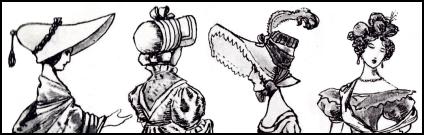
This costume history page is about hair fashion history. It consists of a selection of women only headdresses and hairstyle illustrations and original from 1714 to 1800+ taken from Calthrop's English Costume. See these page English Costume History