By Pauline Weston Thomas for Fashion-Era.com
King George II - 1727-1760
English Costume History by Dion Clayton Calthrop
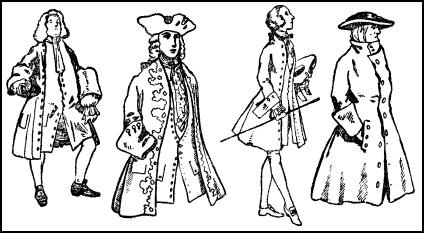
- A MAN OF THE TIME OF GEORGE II -1727-1760
- A WOMAN OF THE TIME OF GEORGE II - 1727-1760
 This costume history information consists of Pages 414-432 of the chapter on C18th dress in the 33 YEAR REIGN era of King George The Second 1727-1760 and taken from English Costume by Dion Clayton Calthrop.
The 36 page section consists of a text copy of the book ENGLISH COSTUME PAINTED & DESCRIBED BY DION CLAYTON CALTHROP. Visuals, drawings and painted fashion plates in the book have a charm of their own and are shown amid the text. The book covers both male and female dress history of over 700 years spanning the era 1066-1830.
This page is about Early Georgian English Costume in the reign of Hanoverian King George II, 1727-1760.
For the Introduction to this book see this introduction written by Dion Clayton Calthrop. I have adjusted the images so they can be used for colouring worksheets where pupils add some costume/society facts.
My comments are in italics.
GEORGE THE SECOND
Reigned thirty-three years: 1727-1760.
Born 1683. Married, 1705, Caroline of Anspach.
Georgian Men's Hair & Hats
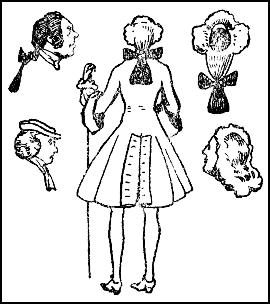
Names of Early Georgian Wigs
Just a few names of wigs, and you will see how the periwig has gone into the background, how the bob-wig has superseded the campaign wig; you will find a veritable confusion of barbers' enthusiasms, half-forgotten designs, names dependent on a twist, a lock, a careful disarrangement - pigeon's-wing wigs with wings of hair at the sides, comets with long, full tails, cauliflowers with a profusion of curls, royal bind-wigs, staircase wigs, ladders, brushes, Count Saxe wigs, cut bobs, long bobs, negligents, chain-buckles, drop-wigs, bags.
Use Hogarth For Dress & Society Reference
Go and look at Hogarth; there's a world of dress for you by the grim humorist who painted Sarah Malcolm, the murderess, in her cell; who painted 'Taste in High Life.'
Wigs & A Wig Lottery
 Wigs! inexhaustible subject - wigs passing from father to son until they arrived at the second-hand dealers in Monmouth Street, and there, after a rough overhauling, began a new life.
There was a wig lottery at sixpence a ticket in Rosemary Lane, and with even ordinary wigs - Grizzle Majors at twenty-five shillings, Great Tyes at a guinea, and Brown Bagwigs at fifteen shillings - quite a considerable saving might be made by the lucky lottery winner.
Georgian Hats For Men
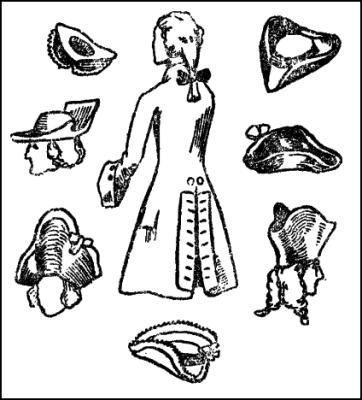
On wigs, hats cocked to suit the passing fashion, broad-brimmed, narrow-brimmed, round, three-cornered, high-brimmed, low-brimmed, turned high off the forehead, turned low in front and high at the back - an endless crowd.
Georgian Tory and Whig Sartorial Meanings
Such a day for clothes, for patches, and politics, Tory side and Whig to your face, Tory or Whig cock to your hat; pockets high, pockets low, stiff cuffs, crushable cuffs, a regular jumble of go-as-you-please.
Let me try to sort the jumble.
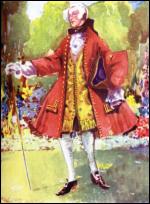
A MAN OF THE TIME OF GEORGE II -1727-1760
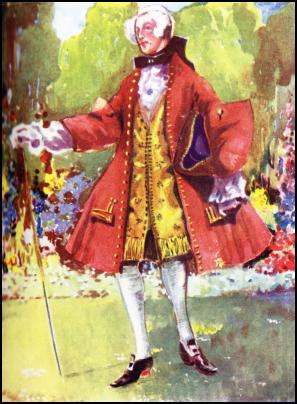
Notice the heavy cuffs, and the very full skirts of the coat. He carries a chapeau bras under his arm - a hat for carrying only, since he will not ruffle his wig. He wears a black satin tie to his wig, the ends of which tie come round his neck, are made into a bow, and brooched with a solitaire.
The Georgian Man's Coat
Foremost, the coat. The coat is growing more full, more spread; it becomes, on the beau, a great spreading, flaunting, skirted affair just buttoned by a button or two at the waist.
Embellishment - Embroidery on the Coat/Waistcoat
It is laced or embroidered all over; it is flowered or plain.
Important Huge Cuffs
The cuffs are huge; they will, of course, suit the fancy of the owner, or the tailor.
About 1745 they will get small - some will get small; then the fashions begin to run riot; by the cut of coat you may not know the date of it, then, when you pass it in the street.
Men's Coat Silhouettes From 1745...
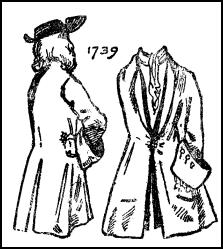
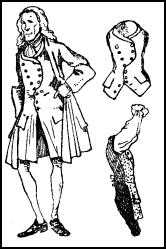 From 1745 there begins the same jumble as to-day, a hopeless thing to unravel; in the next reign, certainly, you may tell yourself here is one of the new Macaronis, but that will be all you will mark out of the crowd of fashions - one more remarkable, newer than the rest, but perhaps you have been in the country for a week, and a new mode has come in and is dying out.
Waistcoats
From coat let us look at waistcoat. Full flaps and long almost to the knees; but again, about 1756, they will be shorter.
They are fringed, flowered, laced, open to show the lace cravat fall so daintily, to show the black velvet bow-tie that comes over from the black velvet, or silk, or satin tie of the queue.
Lace
Ruffles of lace, of all qualities, at the wrists, the beau's hand emerging with his snuff-box from a filmy froth of white lace.
The Importance of the Georgian Man's Changing Coat Silhouette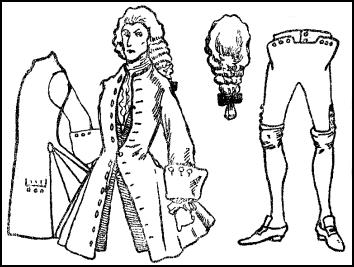
In this era of costume - from George I to George IV - the great thing to remember is that the coat changes more than anything else; from the stiff William and Mary coat with its deep, stiff cuffs, you see the change towards the George I coat, a looser cut of the same design, still simple in embroideries; then the coat skirts are gathered to a button at each side of the coat just behind the pockets.
A George II Coat Freed From The Button
Then, in George II's reign, the skirt hangs in parallel folds free from the button, and shapes to the back more closely, the opening of the coat, from the neck to the waist, being so cut as to hang over the buttons and show the cravat and the waistcoat.
Coats With Fuller Skirts
Then, later in the same reign, we see the coat with the skirts free of buckram and very full all round, and the cuffs also free of stiffening and folding with the crease of the elbow.
Calthrop's George II Coats Silhouette Timeline 1745-1756
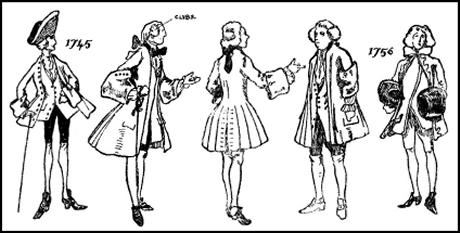
In following out these really complicated changes, I have done my best to make my meaning clear by placing dates against those drawings where dates are valuable, hoping by this means to show the rise and fall of certain fashions more clearly than any description would do.
The Periwig to Tie Wig
It will be noticed that, for ceremony, the periwig gave place to the tie-wig, or, in some few cases, to natural hair curled and powdered.
The older men kept to the periwig no doubt from fondness of the old and, as they thought, more grave fashion; but, as I showed at the beginning of the chapter, the beau and the young man, even the quite middle-class man, wore, or had the choice of wearing, endless varieties of false attires of hair.
The Georgian Sporting Man
The sporting man had his own idea of dress, even as to-day he has a piquant idea in clothes, and who shall say he has not the right?
A black wig, a jockey cap with a bow at the back of it, a very resplendent morning gown richly laced, a morning cap, and very comfortable embroidered slippers, such mixtures of clothes in his wardrobe - his coat, no doubt, a little over-full, but of good cloth, his fine clothes rather over-embroidered, his tie-wig often pushed too far back on his forehead, and so showing his cropped hair underneath.
§
C18th Muffs for Georgian Men
Muffs must be remembered, as every dandy carried a muff in winter, some big, others grotesquely small.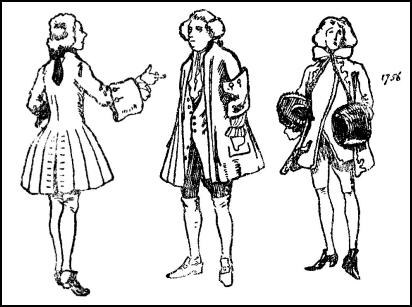
Bath must be remembered, and the great Beau Nash in the famous Pump-Room - as Thackeray says, so say I: 'I should like to have seen the Folly,' he says, meaning Nash.
'It was a splendid embroidered, beruffled, snuff-boxed, red-heeled, impertinent Folly, and knew how to make itself respected. I should like to have seen that noble old madcap Peterborough in his boots (he actually had the audacity to walk about Bath in boots!), with his blue ribbon and stars, and a cabbage under each arm, and a chicken in his hand, which he had been cheapening for his dinner.'
The Queen's Birthday
It was the fashion to wear new clothes on the Queen's birthday, March 1, and then the streets noted the loyal people who indulged their extravagance or pushed a new fashion on that day.
Do not forget that no hard-and-fast rules can be laid down; a man's a man for all his tailor tells him he is a walking fashion plate. Those who liked short cuffs wore them, those who did not care for solitaires did without; the height of a heel, the breadth of a buckle, the sweep of a skirt, all lay at the taste of the owner - merely would I have you remember the essentials.
Fancy Dress For Georgian Masques
There was a deal of dressing up - the King, bless you, in a Turkish array at a masque - the day of the Corydon and Sylvia: mock shepherd, dainty shepherdess was here; my lord in silk loose coat with paste buttons, fringed waistcoat, little three-cornered hat under his arm, and a pastoral staff between his fingers, a crook covered with cherry and blue ribbons; and my lady in such a hoop of sprigged silk or some such stuff, the tiniest of straw hat on her head, high heels tapping the ground, all a-shepherding - what? Cupids, I suppose, little Dresden loves, little comfit-box jokes, little spiteful remarks about the Germans.
Come, let me doff my Kevenhuller hat with the gold fringe, bring my red heels together with a smart tap, bow, with my hand on the third button of my coat from which my stick dangles, and let me introduce the ladies.
THE WOMEN
A WOMAN OF THE TIME OF GEORGE II - 1727-1760
She is wearing a large pinner over her dress. Notice the large panniers, the sleeves without cuffs, the tied cap, and the shortness of the skirts.
I will introduce the fair, painted, powdered, patched, perfumed sex (though this would do for man or woman of the great world then) by some lines from the Bath Guide:
'Bring, O bring thy essence-pot,
Amber, musk, and bergamot;
Eau de chipre, eau de luce,
Sanspareil, and citron juice.
In a band-box is contained
Painted lawns, and chequered shades,
Crape that's worn by love-lorn maids,
Watered tabbies, flowered brocades;
Straw-built hats, and bonnets green,
Catgut, gauzes, tippets, ruffs;
Fans and hoods, and feathered muffs,
Stomachers, and Paris nets,
Earrings, necklaces, aigrets,
Fringes, blouses, and mignionets;
Fine vermillion for the cheek,
Velvet patches à la grecque.
Come, but don't forget the gloves,
Which, with all the smiling loves,
Venus caught young Cupid picking
From the tender breast of chicken.'
Now I think it will be best to describe a lady of quality.
In the first years of the reign she still wears the large hoop skirt, a circular whalebone arrangement started at the waist, and, at intervals, the hoops were placed so that the petticoat stood out all round like a bell; over this the skirt hung stiff and solemn.
The bodice was tight-laced, cut square in front where the neckerchief of linen or lace made the edge soft.
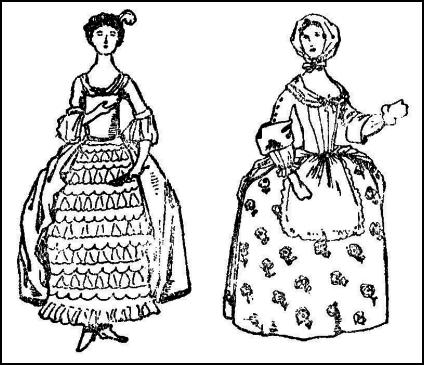
The sleeves still retained the cuff covering the elbow, and the under-sleeve of linen with lace frills came half-way down the forearm, leaving bare arm and wrist to show.
Over the skirt she would wear, as her taste held her, a long, plain apron, or a long, tucked apron, or an apron to her knees.
The bodice generally formed the top of a gown, which gown was very full-skirted, and was divided so as to hang back behind the dress, showing, often, very little in front. This will be seen clearly in the illustrations.
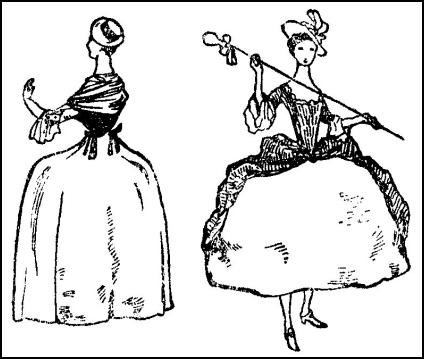
The hair is very tightly gathered up behind, twisted into a small knob on the top of the head, and either drawn straight back from the forehead or parted in the middle, allowing a small fringe to hang on the temples. Nearly every woman wore a small cap or a small round straw hat with a ribbon round it.
The lady's shoes would be high-heeled and pointed-toed, with a little buckle and strap.
The Georgian Sacque Dress
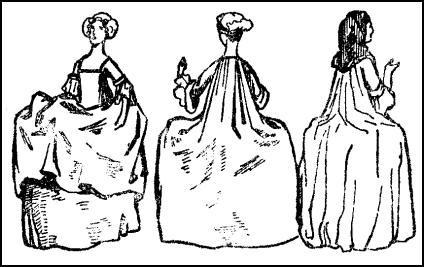
About the middle of the reign the sacque became the general town fashion, the sacque being so named on account of the back, which fell from the shoulders into wide, loose folds over the hooped petticoat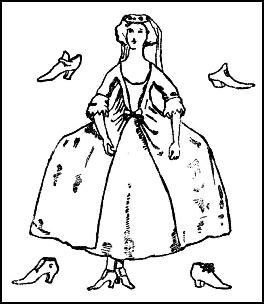 .
.
The sacque was gathered at the back in close pleats, which fell open over the skirt part of this dress. The front of the sacque was sometimes open, sometimes made tight in the bodice.
Now the lady would puff her hair at the sides and powder it; if she had no hair she wore false, and a little later a full wig. She would now often discard her neat cap and wear a veil behind her back, over her hair, and falling over her shoulders.
In 1748, so they say, and so I believe to be true, the King, walking in the Mall, saw the Duchess of Bedford riding in a blue riding-habit with white silk facings—this would be a man's skirted coat, double-breasted, a cravat, a three-corned hat, and a full blue skirt
He admired her dress so much and thought it so neat that he straightway ordered that the officers of the navy, who, until now, had worn scarlet, should take this coat for the model of their new uniform. So did the navy go into blue and white.
Early C18th Poorer Women's Fashions
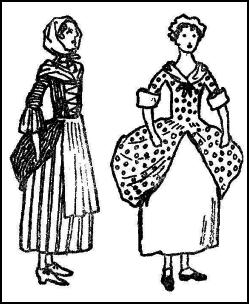
The poorer classes were not, of course, dressed in hooped skirts, but the bodice and gown over the petticoat, the apron, and the turned back cuff to the short sleeve were worn by all.
The orange wench laced her gown neatly, and wore a white cloth tied over her head; about her shoulders she wore a kerchief of white, and often a plain frill of linen at her elbows.
Georgian Fabrics For Gowns
There were blue canvas, striped dimity, flannel, and ticken for the humble; for the rich, lustrings, satins, Padesois, velvets, damasks, fans and Leghorn hats, bands of Valenciennes and Point de Dunquerque - these might be bought of Mrs. Holt, whose card Hogarth engraved, at the Two Olive Posts in the Broad part of the Strand.
One Horse Chairs - Cabriolets
Seventeen hundred and fifty-five saw the one-horse chairs introduced from France, called cabriolets, the first of our own extraordinary wild-looking conveyances contrived for the minimum of comfort and the maximum of danger. This invention captivated the hearts of both men and women.
The men painted cabriolets on their waistcoats, they embroidered them on their stockings, they cut them out in black silk and patched their cheeks with them, horse and all; the women began to take up, a little later, the cabriolet caps with round sides like linen wheels, and later still, at the very end of the reign, there began a craze for such head-dresses - post-chaises, chairs and chairmen, even waggons, and this craze grew and grew, and hair grew - in wigs - to meet the cry for hair and straw men-of-war, for loads of hay, for birds of paradise, for goodness knows what forms of utter absurdity, all of which I put down to the introduction of the cab.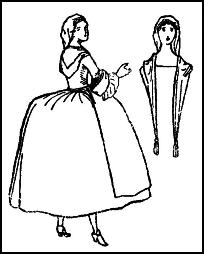
Calthrop's Advice on Copying Early Georgian Costumes
I think that I can best describe the lady of this day as a swollen, skirted figure with a pinched waist, little head of hair, or tiny cap, developing into a loose sacque-backed figure still whaleboned out, with hair puffed at the sides and powdered, getting ready to develop again into a queer figure under a tower of hair, but that waits for the next reign.
One cannot do better than go to Hogarth's prints and pictures—wonderful records of this time - one picture especially, 'Taste in High Life,' being a fine record of the clothes of 1742; here you will see the panier and the sacque, the monstrous muff, the huge hoop, the long-tailed wig, the black boy and the monkey. In the 'Noon' of the 'Four Parts of the Day' there are clothes again satirized.
I am trusting that the drawings will supply what my words have failed to picture, and I again - for the twenty-first time - repeat that, given the cut and the idea of the time, the student has always to realize that there can be no hard-and-fast rule about the fashions; with the shape he can take liberties up to the points shown, with colour he can do anything - patterns of the materials are obtainable, and Hogarth will give anything required in detail.
King George II
Reigned thirty-three years: 1727-1760.
Born 1683. Married, 1705, Caroline of Anspach.
This costume history information consists of Pages 414-432 of the chapter on C18th dress in the 33 YEAR REIGN era of King George The Second 1727-1760 and taken from English Costume by Dion Clayton Calthrop.
The 36 page section consists of a text copy of the book ENGLISH COSTUME PAINTED & DESCRIBED BY DION CLAYTON CALTHROP. Visuals, drawings and painted fashion plates in the book have a charm of their own and are shown amid the text. The book covers both male and female dress history of over 700 years spanning the era 1066-1830.
This page is about Early Georgian dress in the reign of Hanoverian King George II, 1727-1760.
For the Introduction to this book see this introduction written by Dion Clayton Calthrop. I have adjusted the images so they can be used for colouring worksheets where pupils add some costume/society facts.
My comments are in italics.
You have been reading English Costume History at www.fashion-era.com © from the chapter on Hanoverian King George II 1727-1760, from Dion Clayton Calthrop's book English Costume.
Page Added 23 August 2010. Ref:-815.