
Henry VIII Costume 1509-1547
by Dion Clayton Calthrop
By Pauline Weston Thomas for Fashion-Era.com
King Henry VIII Costume 1509-1547
English Costume by Dion Clayton Calthrop
Includes dresses worn by wives of King Henry VIII.
- A Man of the Time of Henry VIII - 1509-1547
- Man of the Time of King Henry VIII - 1509-1547
- A Woman of the Time of Henry VIII - 1509-1547
- The Women
- Woman of the Time of Henry VIII - 1509-1547
 This Tudor costume history information consists of Pages 247-273 of the chapter on early to mid-century 16th century dress in the 38 YEAR REIGN era of Henry The Eighth 1509-1547 and taken from English Costume by Dion Clayton Calthrop.
The 36 page section consists of a text copy of the book ENGLISH COSTUME PAINTED & DESCRIBED BY DION CLAYTON CALTHROP. Visuals, drawings and painted fashion plates in the book have a charm of their own and are shown amid the text. The book covers both male and female dress history of over 700 years spanning the era 1066-1830.
This page is about Tudor dress in the reign of King Henry VIII 1509-1547.
For the Introduction to this book see this introduction written by Dion Clayton Calthrop. I have adjusted the images so they can be used for colouring worksheets where pupils add some costume/society facts.
My comments are in italics.
HENRY THE EIGHTH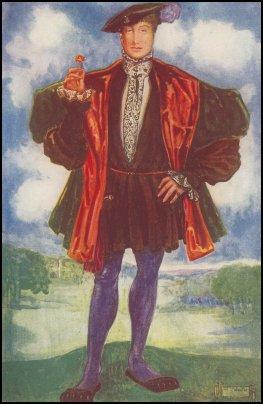
Reigned thirty-eight years: 1509-1547. Born, 1491.
Married:-
1509, Katharine of Aragon; 1532, Anne Boleyn; 1536, Jane Seymour;
1540, Anne of Cleves; 1540, Katharine Howard; 1548, Katherine Parr.
THE MEN
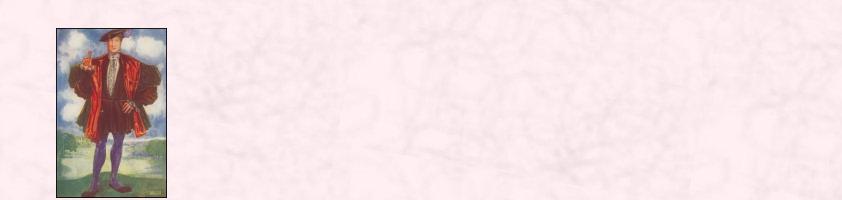
A MAN OF THE TIME OF HENRY VIII - 1509-1547
The costume plate shows a man wearing the club-toed shoes of the era and a white shirt embroidered in black silk - Blackwork. The shoulders are well padded and the flat cap is feature of fashionable dress of the reign of Henry VIII.
VERSES BY HENRY THE EIGHTH IN PRAISE OF CONSTANCY
'As the holy grouth grene with ivie all alone
Whose flowerys cannot be seen and grene wode levys be gone,
Now unto my lady, promyse to her I make
From all other only to her I me betake
Adew myne owne ladye, adew my specyall
Who hath my hart trewly, be sure, and ever shall.'
So, with songs and music of his own composition, comes the richest man in Europe to the throne of England. Gay, brave, tall, full of conceit in his own strength, Henry, a king, a Tudor, a handsome man, abounding in excellence of craft and art, the inheritance from his father and mother, figures in our pageant a veritable symbol of the Renaissance in England.
He had, in common with the marvellous characters of that Springtime of History, the quick intelligence and all the personal charm that the age brought forth in abundance. In his reign the accumulated mass of brain all over the world budded and flowered; the time gave to us a succession of the most remarkable people in any historical period, and it is one of the triumphs of false reasoning to prove this, in England, to have been the result of the separation from the Catholic Church.
For centuries the Church had organized and prepared the ground in which this tree of the world's knowledge was planted, had pruned, cut back, nursed the tree, until gradually it flowered, its branches spread over Christian Europe, and when the flowering branch hanging over England gave forth its first-fruits, those men who ate of the fruit and benefited by the shade were the first to quarrel with the gardeners.
MAN OF THE TIME OF King HENRY VIII COSTUME - 1509-1547
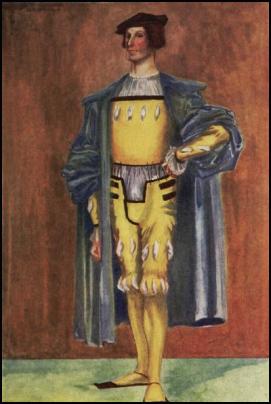 In these days there lived and died Botticelli, Leonardo da Vinci, Raphael, Dürer, Erasmus, Holbein, Copernicus, Luther, Rabelais, and Michael Angelo, to mention a few men of every shade of thought, and in this goodly time came Henry to the English throne, to leave, at his death, instead of the firm progress of order instituted by his father, a bankrupt country with an enormously rich Government.
You may see for the later pictures of his reign a great bloated mass of corpulence, with running ulcers on his legs and the blood of wives and people on his hands, striding in his well-known attitude over the festering slums his rule had produced in London. Harry, Grace à Dieu!
The mental picture from our - costume - point of view is widely different from that of the last reign. No longer do we see hoods and cowls, brown, gray, white, and black in the streets, no longer the throngs of fine craftsmen, of church-carvers, gilders, embroiderers, candle-makers, illuminators, missal-makers; all these served but to swell the ranks of the unemployed, and caused a new problem to England, never since solved, of the skilled poor out of work. The hospitals were closed - that should bring a picture to your eyes - where the streets had been thronged with the doctors of the poor and of the rich in their habits, no monks or lay brothers were to be seen.
The sick, the blind, the insane had no home but the overhung back alleys where the foulest diseases might accumulate and hot-beds of vice spring up, while in the main streets Harry Tudor was carried to his bear-baiting, a quivering mass of jewels shaking on his corrupt body, on his thumb that wonderful diamond the Regale of France, stolen by him from the desecrated shrine of St. Thomas à Becket.
MEN'S FASHIONS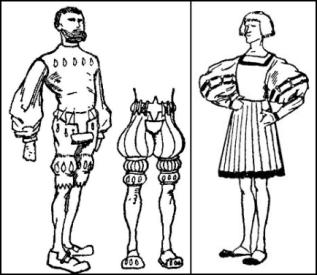
There are two distinct classes of fashion to be seen, the German-Swiss fashion and the English fashion, a natural evolution of the national dress.
The German fashion is that slashed, extravagant-looking creation which we know so well from the drawings of Albert Dürer and the more German designs of Holbein.
The garments which were known as 'blistered' clothes are excessive growths on to the most extravagant designs of the Henry VII date.
The shirt cut low in the neck, and sewn with black embroidery; the little waistcoat ending at the waist and cut straight across from shoulder to shoulder, tied with thongs of leather or coloured laces to the breeches, leaving a gap between which showed the shirt; the universal pouch on the breeches often highly decorated and jewelled.
From the line drawings you will see that the sleeves and the breeches took every form, were of any odd assortment of colours, were cut, puffed, and splashed all over, so that the shirt might be pushed through the holes, looking indeed 'blistered.'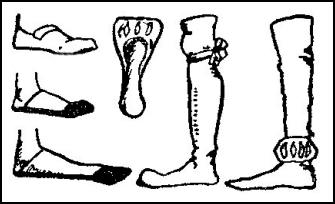
Tudor Footwear - Boots & Shoes
The shoes were of many shapes, as I have shown, agreeing in one point only - that the toes should be cut very broad, often, indeed, quite square.
Short or hanging hair, both were the fashion, and little flat caps with the rim cut at intervals, or the large flat hats of the previous reign, covered with feathers and curiously slashed, were worn with these costumes.
Dressing Gown Like Cloaks 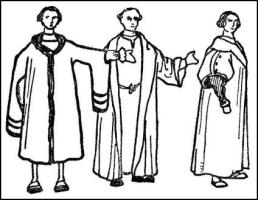
Cloaks, as you may see, were worn over the dress, and also those overcoats shaped much like the modern dressing-gown.
Blistered Padded Breeches
It is from these 'blistered,' padded breeches that we derive the trunks of the next reign, the slashings grown into long ribbon-like slits, the hose puffed at the knee.
Blistered Slashed Sleeves
Separate pairs of sleeves were worn with the waistcoats, or with the petti-cotes, a favourite sleeve trimming being broad velvet bands.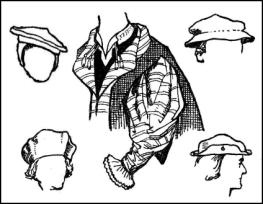
The invention sprang, as usual, from necessity, by vanity to custom. In 1477 the Swiss beat and routed the Duke of Burgundy at Nantes, and the soldiers, whose clothes were in rags, cut and tore up his silk tents, his banners, all material they could find, and made themselves clothes of these odd pieces - clothes still so torn and ragged that their shirts puffed out of every hole and rent.
The arrival of the victorious army caused all the non-fighters to copy this curious freak in clothes, and the courtiers perpetuated the event by proclaiming blistering as the fashion.
The other and more usual fashion springs from the habit of clothes in bygone reigns.
Pulled Shirt Necks Become Tudor Collars
Let us first take the shirt A. It will be seen how, in this reign, the tendency of the shirt was to come close about the neck. 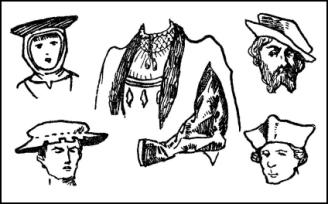
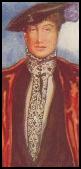
The previous reign showed us, as a rule, a shirt cut very low in the neck, with the hem drawn together with laces; these laces pulled more tightly together, thus rucking the material into closer gathers, caused the cut of the shirt to be altered and made so that the hem frilled out round the neck - a collar, in fact.
That this collar took all forms under certain limitations will be noticed, also that thick necked gentlemen - Henry himself must have invented this - wore the collar of the shirt turned down and tied with strings of linen.
Deep Tudor Cuffs
The cuffs of the shirt, when they showed at the wrist, were often, as was the collar, sewn with elaborate designs in black thread or silk.
Now we take the waistcoat B. As you may see from the drawing showing the German form of dress, this waistcoat was really a petti-cote, a waistcoat with sleeves.
This waistcoat was generally of richly ornamented material (Henry in purple satin, embroidered with his initials and the Tudor rose; Henry in brocade covered with posies made in letters of fine gold bullion).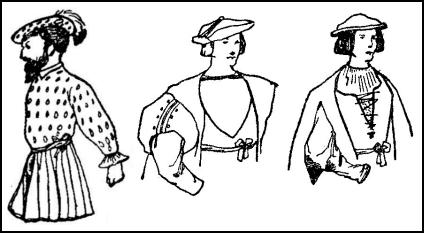
The material was slashed and puffed or plain, and dependent for its effect on the richness of its embroidery or design of the fabric. It was worn with or without sleeves; in most cases the sleeves were detachable.
The coat C. This coat was made with bases like a frock, a skirted coat, in fact; the material used was generally plain, of velvet, fine cloth, silk, or satin.
The varieties of cut were numerous, and are shown in the drawings -
open to the waist,
open all the way in front,
close to the neck - every way;
where the coat was open in front it generally parted to show the bragetto, or jewelled pouch.
It was a matter for choice spirits to decide whether or no they should wear sleeves to their coats, or show the sleeves of their waistcoats. No doubt Madame Fashion saw to it that the changes were rung sufficiently to make hay while the sun shone on extravagant tastes. The coat was held at the waist with a sash of silk tied in a bow with short ends. 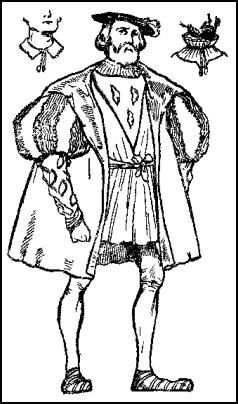
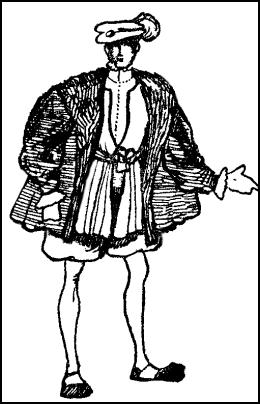
Towards the end of the reign, foreshadowing the Elizabethan jerkin or jacket, the custom grew more universal of the coat with sleeves and the high neck, the bases were cut shorter to show the full trunks, and the waistcoat was almost entirely done away with, the collar grew in proportion, and spread, like the tail of an angry turkey, in ruffle and folded pleat round the man's neck.
Extreme Overcoats
This is the extreme German-English fashion. In Germany and Switzerland this was carried to greater lengths.
The overcoat D is the gown of the previous reign cut, for the dandy, into a shorter affair, reaching not far below the knee; for the grave man it remained long, but, for all, the collar had changed to a wide affair stretching well over the shoulders. It was made, this collar, of such stuff as lined the cloak, maybe it was of fur, or of satin, of silk, or of cloth of gold.
The tremendous folds of these overcoats gave to the persons in them a sense of splendour and dignity; the short sleeves of the fashionable overcoats, puffed and swollen, barred with rich appliqué designs or bars of fur, reaching only to the elbow, there to end in a hem of fur or some rich stuff, the collar as wide as these padded shoulders, all told in effect as garments which gave a great air of well-being and richness to their owner.
Tudor Sleeves
Of course, I suppose one must explain, the sleeves varied in every way: were long, short, full, medium full, according to taste. Sometimes the overcoats were sleeveless.
Trunks - Breeches - Hose Fashions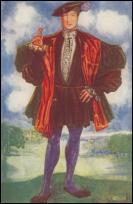
Beneath these garments the trunks were worn - loose little breeches, which, in the German style, were bagged, puffed, rolled, and slashed in infinite varieties. Let it be noticed that the cutting of slashes was hardly ever a straight slit, but in the curve of an elongated S or a double S curve.
Other slashes were squared top and bottom.
Tight Hose
All men wore tight hose, in some cases puffed at the knee; in fact, the bagging, sagging, and slashing of hose suggested the separate breeches or trunks of hose.
The shoes were very broad, and were sometimes stuffed into a mound at the toes, were sewn with precious stones, and, also, were cut and puffed with silk.
The little flat cap will be seen in all its varieties in the drawings.
The Irish were forbidden by law to wear a shirt, smock, kerchor, bendel, neckerchor, mocket (a handkerchor), or linen cap coloured or dyed with saffron; or to wear in shirts or smocks above seven yards of cloth.
§
Tudor Sumptuary Laws
To wear black genet you must be royal; to wear sable you must rank above a viscount; to wear martin (marten) or velvet trimming you must be worth over two hundred marks a year. Short hair came into fashion about 1521.
Sir Philip Calthrop and John Drakes the Shoemaker of Norwich
So well known is the story of Sir Philip Calthrop and John Drakes the shoemaker of Norwich, who tried to ape the fashion, that I must here allude to this ancestor of mine who was the first of the dandies of note, among persons not of the royal blood.
The story itself, retold in every history of costume, is to this effect: Drakes, the shoemaker, seeing that the county talked of Sir Philip's clothes, ordered a gown from the same tailor. This reached the ears of Sir Philip, who then ordered his gown to be cut as full of slashes as the shears could make it. The ruin of cloth so staggered the shoemaker that he vowed to keep to his own humble fashion in future.
 No doubt Sir Philip's slashes were cunningly embroidered round, and the gown made rich and sparkling with the device of seed pearls so much in use. This man's son, also Sir Philip, married Amy, daughter of Sir William Boleyn, of Blickling, Norfolk. She was aunt to Queen Anne Boleyn.
[We now move from King Henry the Eight's costume to ladies Tudor dress.]
THE WOMEN COSTUME
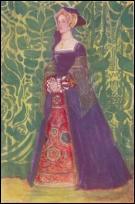
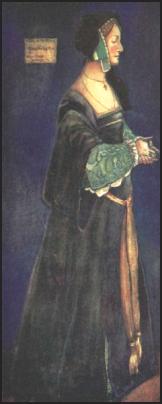
A WOMAN OF THE TIME OF HENRY VIII - 1509-1547
The woman wears a plain but rich looking dress and on her head a peculiar head-dress with a pad support of silk in front to hold it from the forehead. The half-sleeves are clearly visible.
One cannot call to mind pictures of this time without, in the first instance, seeing the form of Henry rise up sharply before us followed by his company of wives. The fat, uxorious giant comes straight to the front of the picture, he dominates the age pictorially; and, as a fitting background, one sees the six women who were sacrificed on the political altar to pander to his vanity.
Katherine of Aragon - the fine and noble lady - a tool of political desires, cast off after Henry had searched his precious conscience, after eighteen years of married life, to find that he had scruples as to the spirituality of the marriage.
Anne Boleyn, tainted with the life of the Court, a pitiful figure in spite of all her odious crimes; how often must a ghost, in a black satin nightdress edged with black velvet, have haunted the royal dreams. And the rest of them, clustered round the vain king, while in the background the great figures of the time loom hugely as they play with the crowned puppets.
The Hood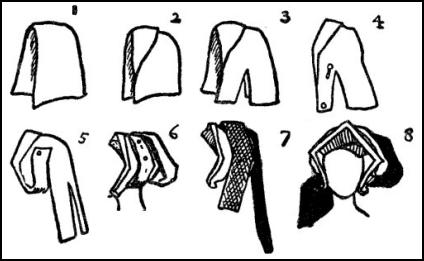
The note of the time, as we look at it with our eyes keen on the picture, is the final evolution of the hood.
Bit by bit, inch by inch, the plain fabric has become enriched, each succeeding step in an elaboration of the simple form; the border next to the face is turned back, then the hood is lined with fine stuff and the turnover shows this to advantage; then the sides are split and the back is made more full; then a tag is sewn on to the sides by which means the cut side may be fastened off the shoulders.
The front is now stiffened and shaped at an angle, this front is sewn with jewels, and, as the angle forms a gap between the forehead and the point of the hood, a pad is added to fill in the vacant space.
Diamond Shaped Tudor Headdress
At last one arrives at the diamond-shaped head-dress worn in this reign, and, in this reign, elaborated in every way, elaborated, in fact, out of existence.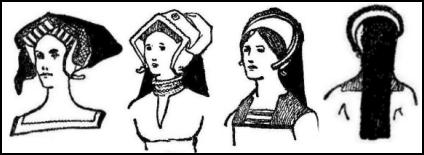
In order to make the head-dress in its 1509 state you must make the white lining with the jewelled turnover as a separate cap. However, I think that the drawings speak for themselves more plainly than I can write.
Every device for crowding jewels together was used, criss-cross, in groups of small numbers, in great masses.
Pendants were worn, hung upon jewelled chains that wound twice round the neck, once close to the neck, the second loop loose and passed, as a rule, under the lawn shift.
Large brooches decorated the bodices, brooches with drop ornaments, the body of the brooch of fine gold workmanship, many of them wrought in Italy.
The shift, delicately embroidered with black silk, had often a band of jewellery upon it, and this shift was square cut, following the shape of the bodice.
The bodice of the gown was square cut and much stiffened to a box-like shape.
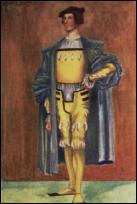
WOMAN OF THE TIME OF HENRY VIII - 1509-1547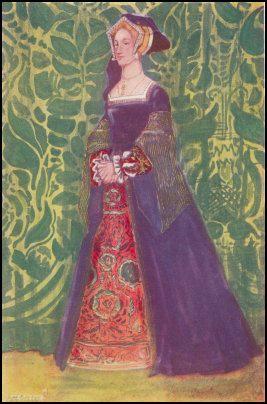
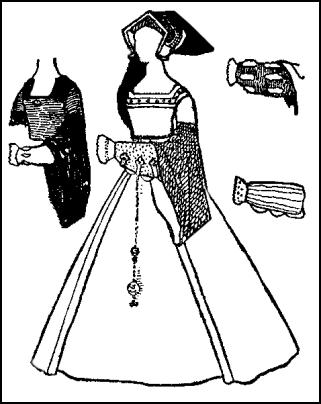
Notice the wide cuffs covered with gold network, and the rich panel of the under-skirt. Classical Henry VIII woman's costume.
Tudor Gown Sleeves
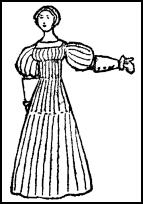
The sleeves of the gown were narrow at the shoulders, and after fitting the arm for about six inches down from the shoulders, they widened gradually until, just below the elbow, they became square and very full; in this way they showed the false under-sleeve.
Tudor Under Sleeves
This under-sleeve was generally made of a fine rich-patterned silk or brocade, the same stuff which formed the under-gown; the sleeve was a binding for the very full lawn or cambric sleeve which showed in a ruffle at the wrist and in great puffs under the forearm.
The under-sleeve was really more like a gauntlet, as it was generally held together by buttoned tags; it was puffed with other coloured silk, slashed to show the shift, or it might be plain.
Tudor Top Sleeves
Now the sleeve of the gown was subject to much alteration.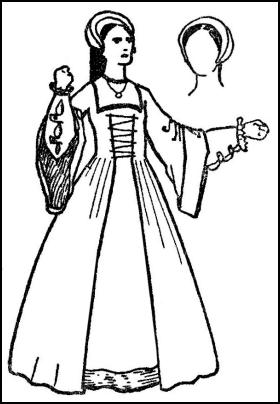
It was, as I have described, made very square and full at the elbow, and over this some ladies wore a false sleeve of gold net - you may imagine the length to which net will go, studied with jewels, crossed in many ways, twisted into patterns, sewn on to the sleeve in sloping lines - but, besides this, the sleeve was turned back to form a deep square cuff which was often made of black or coloured velvet, or of fur.
In all this I am taking no account of the German fashions, which I must describe separately. Look at the drawings I have made of the German fashion. I find that they leave me dumb - mere man has but a limited vocabulary when the talk comes to clothes - and these dresses that look like silk pumpkins, blistered and puffed and slashed, sewn in ribs, swollen, and altogether so queer, are beyond the furious dashes that my pen makes at truth and millinery.
The costumes of the people of this age have grown up in the minds of most artists as being inseparable from the drawings of Holbein and Dürer.
Surely, I say to myself, most people who will read this will know their Holbein and Dürer, between whom there lies a vast difference, but who between them show, the one, the estate of England, and the other, those most German fashions which had so powerful an influence upon our own.
Both these men show the profusion of richness, the extravagant follies of the dress of their time, how, to use the words of Pliny: 'We penetrate into the bowels of the earth, digging veins of gold and silver, and ores of brass and lead; we seek also for gems and certain little pebbles. Driving galleries into the depths, we draw out the bowels of the earth, that the gems we seek may be worn on the finger.
How many hands are wasted in order that a single joint may sparkle! If any hell there were, it had assuredly ere now been disclosed by the borings of avarice and luxury!'
Or in the writings of Tertullian, called by Sigismund Feyerabendt, citizen and printer of Frankfort, a 'most strict censor who most severely blames women:' 'Come now,' says Tertullian, 'if from the first both the Milesians sheared sheep, and the Chinese spun from the tree, and the Tyrians dyed and the Phrygians embroidered, and the Babylonians inwove; and if pearls shone and rubies flashed, if gold itself, too, came up from the earth with the desire for it; and if now, too, no lying but the mirror's were allowed, Eve, I suppose, would have desired these things on her expulsion from Paradise, and when spiritually dead.'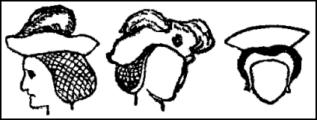
German Coarse Gold-web Nets
One sees by the tortured and twisted German fashion that the hair was plaited, and so, in curves and twists, dropped into coarse gold-web nets, thrust into web nets with velvet pouches to them, so that the hair stuck out behind in a great knob, or at the side in two protuberances; over all a cap like to the man's, but that it was infinitely more feathered and jewelled.
Barbes or Beard-like Linen Cloths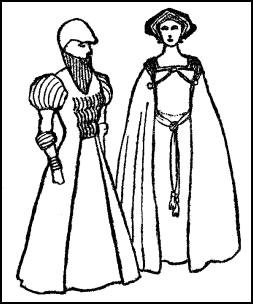
Then, again, they wore those hideous barbes or beard-like linen cloths, over the chin, and an infinite variety of caps of linen upon their heads - caps which showed always the form of the head beneath.
In common with the men, their overcoats and cloaks were voluminous, and needed to be so if those great sleeves had to be stuffed into them; fur collars or silk collars, with facings to match, were rolled over to show little or great expanses of these materials.
Here, to show what dainty creatures were our lady ancestors, to show from what beef and blood and bone we come, I give you (keep your eye meanwhile upon the wonderful dresses) the daily allowance of a Maid of Honour.
Daily Food Allowance of a Tudor Maid of Honour
Every morning at breakfast one chyne of beef from the kitchen, one chete loaf and one maunchet at the pantry bar, and one gallon of ale at the buttery bar.
For dinner a piece of beef, a stroke of roast and a reward from the kitchen. A caste of chete bread from the pantry bar, and a gallon of ale at the buttery bar.
 Afternoon - should they suffer the pangs of hunger - a maunchet of bread from the pantry bar, and a gallon of ale at the buttery bar.
Supper, a messe of pottage, a piece of mutton and a reward from the kitchen. A caste of chete bread from the pantry bar, and a gallon of ale at the buttery bar.
After supper - to insure a good night's rest - a chete loaf and a maunchet from the pantry bar, and half a gallon of ale from the seller bar.
Four and a half gallons of ale! I wonder did they drink it all themselves? All this, and down in the mornings in velvets and silks, with faces as fresh as primroses.
It is the fate of all articles of clothing or adornment, naturally tied or twisted, or folded and pinned by the devotees of fashion, to become, after some little time, made up, ready made, into the shapes which had before some of the owner's mood and personality about them.
These hoods worn by the women, these wide sleeves to the gowns, these hanging sleeves to the overcoats, the velvet slip of under-dress, all, in their time, became falsified into ready-made articles. With the hoods you can see for yourselves how they lend themselves by their shape to personal taste; they were made up, all ready sewn; where pins had been used, the folds of velvet at the back were made steadfast, the crimp of the white linen was determined, the angle of the side-flap ruled by some unwritten law of mode.
Mary Queen of Scots Head-dress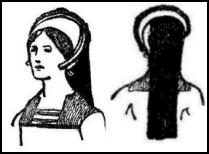
In the end, by a process of evolution, the diamond shape disappeared, and the cap was placed further back on the head, the contour being circular where it had previously been pointed. The velvet hanging-piece remained at the back of the head, but was smaller, in one piece, and was never pinned up, and the entire shape gradually altered towards, and finally into, the well-known Mary Queen of Scots head-dress, with which every reader must be familiar.
It has often occurred to me while writing this book that the absolute history of one such head-dress would be of more help than these isolated remarks, which have to be dropped only to be taken up in another reign, but I have felt that, after all, the arrangement is best as it stands, because we can follow, if we are willing, the complete wardrobe of one reign into the next, without mixing the two up. 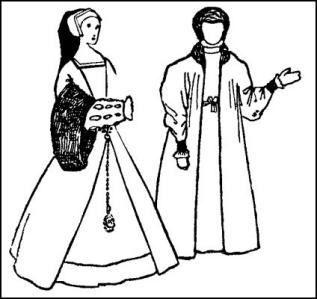
It is difficult to keep two interests running together, but I myself have felt, when reading other works on the subject, that the way in which the various articles of clothing are mixed up is more disturbing than useful.
The wide sleeve to the gown, once part and parcel of the gown, was at last made separate from it - as a cuff more than a sleeve naturally widening - and in the next reign, among the most fashionable, left out altogether.
The upper part of the dress, once cut low and square to show the under-dress, or a vest of other stuff, was now made, towards the end of the reign, with a false top of other stuff, so replacing the under-dress.
Lacing was carried to extremes, so that the body was pinched into the hard roll-like appearance always identified with this time; on the other hand, many, wiser women I should say, were this the place for morals, preferred to lace loose, and show, beneath the lacing, the colour of the under-dress.
Many were the varieties of girdle and belt, from plain silk sashes with tasselled ends to rich jewelled chain girdles ending in heavy ornaments.
 For detail one can do no better than go to Holbein, the master of detail, and to-day, when photographs of pictures are so cheap, and lives of painters, copiously illustrated, are so easily attainable at low prices, it is the finest education, not only in painting, but in Tudor atmosphere and in matters of dress, to go straightway and study the master - that master who touched, without intention, on the moral of his age when he painted a miniature of the Blessed Thomas More on the back of a playing card.
Falstaff will not wear coarse dowlas shirts, dandies call for ostrich feathers, ladies must have Coventry blue gowns and Italian flag-shaped fans; everybody is in the fashion from milkmaids to ladies of the court, each as best as they may manage it. The Jew moves about the streets in his long gaberdine and yellow cap, the lady pads about her garden in tall chopines, and the gentleman sits down as well as he may in his bombasted breeches and smokes Herbe de la Reine in a pipe of clay, and the country woman walks along in her stamell red petticoat guarded or strapped with black, or rides past to market in her over-guard skirts.
Tudor Times Grooming
Let us imagine, by way of a picture of the times, the Queen in her bedchamber under the hands of her tiring-women: She is sitting before a mirror in her embroidered chemise of fine Raynes linen, in her under-linen petticoat and her silk stockings with the gold thread clocks. Over these she wears a rich wrap. Slippers are on her feet.
In front of her, on a table, are rouge and chalk and a pad of cotton-wool - already she has made up her face, and her bright bird-like eyes shine in a painted mask, her strong face, her hawk-like nose and her expressionless mouth reflect back at her from the mirror. Beside the rouge pot is a Nuremberg egg watch, quietly ticking in its crystal case.
The Periwig
One of the women brings forward a number of attires of false hair, golden and red, and from these the Queen chooses one. It is a close periwig of tight red curls, among which pearls and pieces of burnished metal shine. With great care this wig is fastened on to the Queen's head, and she watches the process with her bright eyes and still features in the great mirror.
Then, when this wig is fixed to her mind, she rises, and is helped into the privie coat of bones and buckram, which is laced tightly by the women at her back. Now comes the moment when they are about to fasten on her whalebone hips the great farthingale - over which her voluminous petticoats and skirts will fall. The wheel of bone is tied with ribbons about her waist, and there securely fastened. After some delay in choosing an under-gown, she then puts on several linen petticoats, one over another, to give the required fulness to her figure; and then comes the stiffly-embroidered under-gown - in this case but a petticoat with a linen bodice which has no sleeves.
HENRY THE EIGHTH COSTUME
Reigned thirty-eight years: 1509-1547. Born, 1491.
- A Man of the Time of Henry VIII - 1509-1547
- Man of the Time of Henry VIII - 1509-1547
- A Woman of the Time of Henry VIII - 1509-1547
- The Women
- Woman of the Time of Henry VIII - 1509-1547
Wives of King Henry VIII:-
1509, Katharine of Aragon; 1532, Anne Boleyn; 1536, Jane Seymour;
1540, Anne of Cleves; 1540, Katharine Howard; 1548, Katherine Parr.
This Tudor costume history information above consists of Pages 247-273 of the chapter on early to mid-century 16th century dress in the 38 YEAR REIGN era of Henry The Eighth 1509-1547 and taken from English Costume by Dion Clayton Calthrop.
The 36 page section consists of a text copy of the book ENGLISH COSTUME PAINTED & DESCRIBED BY DION CLAYTON CALTHROP. Visuals, drawings and painted fashion plates in the book have a charm of their own and are shown amid the text. The book covers both male and female dress history of over 700 years spanning the era 1066-1830.
This page is about King Henry VIII costume 1509-1547 - Tudor dynasty.
For the Introduction to this book see this introduction written by Dion Clayton Calthrop. I have adjusted the images so they can be used for colouring worksheets where pupils add some costume/society facts.
My comments are in italics.
You have been reading English Costume History at www.fashion-era.com © from the chapter Henry The Eighth 1509-1547, from Dion Clayton Calthrop's book English Costume.
Page Added 15 August 2010. Ref:-803.
Sitemap
For more information about English Costume By Dion
Clayton Calthrop
see these pages:
- Costume History Home
- Introduction to English Costume by Calthrop
- 1066-1216 Norman
- 1272-1485 Plantagenet
- 1485-1603 Tudor
- 1485-1509 Henry VII
- 1509-1547 Henry VIII Costume
- 1547-1553 Edward VI
- 1553-1558 Mary I
- 1558-1603 Elizabeth I Costume
- 1603-1714 Stuart
- 1603-1830 Hanover
- Chambre Syndicale
- Theories of Fashion
