
King Edward IV - 1461-1483.
English Costume by Dion Clayton Calthrop
By Pauline Weston Thomas for Fashion-Era.com
King Edward IV - 1461-1483
English Costume by Dion Clayton Calthrop
- A MAN OF THE TIME OF EDWARD IV - 1461-1483
- A WOMAN OF THE TIME OF EDWARD IV - 1461-1483
- Calthrop's - How To make a Steeple Headdress - A Hennin
 This costume history information consists of Pages 198-212 of the chapter on the 15th century dress in the 22 YEAR REIGN era of Edward the Fourth 1461-1489 and taken from English Costume by Dion Clayton Calthrop.
The 36 page section consists of a text copy of the book ENGLISH COSTUME PAINTED & DESCRIBED BY DION CLAYTON CALTHROP. Visuals, drawings and painted fashion plates in the book have a charm of their own and are shown amid the text. The book covers both male and female dress history of over 700 years spanning the era 1066-1830.
This page is about dress in the 22 year reign of King Edward the Fourth 1461-1489. The images and details are a good resource for costuming Shakespeare's stage plays of the Plantagenet era.
For the Introduction to this book see this introduction written by Dion Clayton Calthrop. I have adjusted the images so they can be used for colouring worksheets where pupils add some costume/society facts.
My comments are in italics.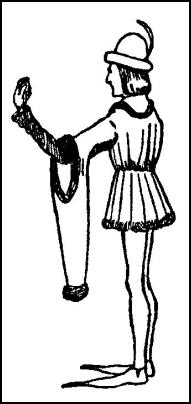
EDWARD THE FOURTH
Reigned twenty-two years: 1461-1483.
Born 1441. Married, 1464, Elizabeth Woodville.
THE MEN
Mr. Caxton
I invite you to call up this reign by a picture of Caxton's shop: you may imagine yourself in the almonry at Westminster, where, in a small enclosure by the west front of the church, there is a chapel and some almshouses. You will be able to see the rich come to look at Mr. Caxton's wares and the poor slinking in to receive alms.
'If it please any man, spiritual or temporal, to buy any pyes of two or three commemorations of Salisbury use emprynted after the form of this present letter, which be well and truly correct, let him come to Westminster into the Almonry at the red pale, and he shall have them good cheap.'
This was Caxton's advertisement.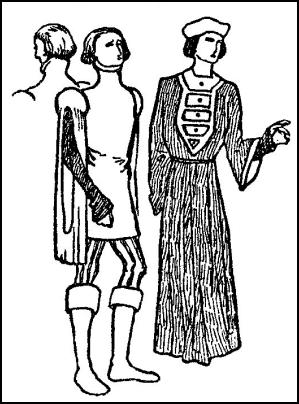
As you watch the people going and coming about the small enclosure, you will notice that the tonsured hair has gone out of fashion, and that whereas the merchants, citizens, and such people wear the roundlet hat, the nobles and fine gentlemen are in black velvet caps, or tall hats with long-peaked brims, or in round high hats with fur brim close to the crown of the hat, or in caps with little rolled brims with a button at the top, over which two laces pass from back to front, and from under the brim there falls the last sign, the dying gasp of the liripipe, now jagged and now with tasselled ends.
We have arrived at the generally accepted vague idea of 'medieval costume,' which means really a hazy notion of the dress of this date: a steeple head-dress for ladies, a short waist, and a train; a tall, sugar-loaf hat with a flat top for the men, long hair, very short and very long tunics, long-pointed shoes, and wide sleeves - this, I think, is the amateur's idea of 'costume in the Middle Ages.'
You will notice that all, or nearly all, the passers-by Caxton's have long hair; that the dandies have extra-long hair brushed out in a cloud at the back; that the older men wear long, very simple gowns, which they belt in at the waist with a stuff or leather belt, on which is hung a bag-purse; that these plain gowns are laced across the front to the waist over a vest of some coloured stuff other than the gown.
You will see that the poor are in very simple tunics - just a loose, stuff shirt with sleeves about 8 inches wide, and with the skirts reaching to the knees, a belt about their middle - rough, shapeless leather shoes, and woollen tights.
You will remember in the early part of the reign, before the heraldic shield with the red pale, Caxton's sign, caught your eye, that the fashionable wore very wide sleeves, great swollen bags fitting only at shoulder and wrist, and you may recall the fact that a tailor was fined twenty shillings in 1463 for making such wide sleeves.
Poulaines, the very long shoes, are now forbidden, except that an esquire and anyone over that rank might wear them 2 inches beyond the toes; but I think the dandies wore the shoes and paid the fine if it were enforced.
§
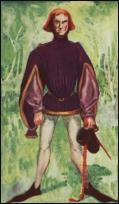
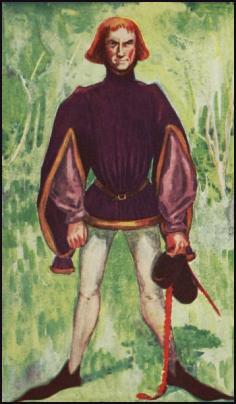 A MAN OF THE TIME OF EDWARD IV - 1461-1483
Notice the jagged ribbon falling from the brim of his hat; this is the last of the liripipe.
See Caxton, in a sober-coloured gown, long, and laced in the front, showing a plain vest under the lacing, talking to some of his great customers. The Duchess of Somerset has just lent him 'Blanchardine and Eglantine'; Earl Rivers, the Queen's brother, talks over his own translation of 'The Sayings of the Philosophers'; and Caxton is extolling that worshipful man Geoffrey Chaucer, and singing praises in reverence 'for that noble poet and great clerke, Vergyl.'
Edward himself has been to the shop and has consented to become patron of an edition of Tully - Edward, with his very subtle face, his tall, handsome appearance, his cold, elegant manners. He is dressed in a velvet gown edged with fur; the neck of the gown is low, and the silk vest shows above it.
Across his chest are gold laces tapering to his waist; these are straight across the front of his gown-opening. His hair is straight, and falls to the nape of his neck; he wears a black velvet cap upon his head.
The skirts of his gown reach to his knees, and are fur-edged; his sleeves are full at the elbows and tight over his wrists; he is wearing red Spanish leather tall boots, turned over at the top.
As he stands talking to Caxton, one or two gentlemen, who have also dismounted, stand about him. Three of them are in the height of the fashion.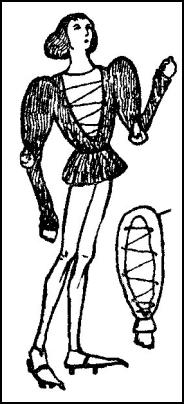
The First Man's Tunic
The first wears a velvet tunic, with fur edges. The tunic is pleated before and behind, and is full and slightly pursed in front; the sleeves are long, and are cut from shoulder to wrist, where they are sewn together again; cuff and border of the cut or opening are both edged with fur.
The neck is high, but there is no collar. The length of the tunic is quite short; it comes well above the knees. His under-sleeves are full, and are of rich silk; his shoes are certainly over the allowed length; his tights are well cut. His peaked hat has gold bands round the crown.
The Second Man's Tunic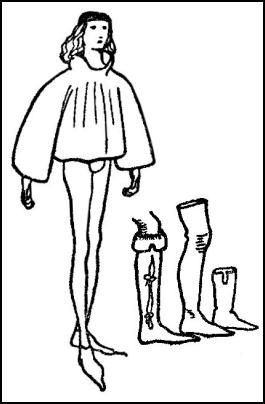
The second gentleman is also in a very short tunic, with very wide sleeves; this tunic is pleated into large even folds, and has a belt of its own material.
His hair is long, and bushed behind; his tights are in two colours, and he wears an eighteen-penny pair of black leather slops or shoes. His hat is black, tall, but without a peak; a long feather is brooched into one side of it.
The Third Man's Tunic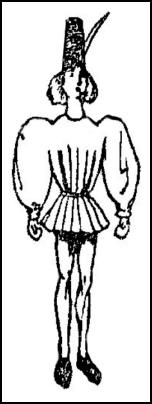
The third man is wearing a low black cap, with a little close brim; a jagged piece of stuff, about 3 feet long, hangs from under the brim of his hat. He is wearing long, straight hair.
This man is wearing a little short tunic, which is loose at the waist, and comes but an inch or two below it; the sleeves are very loose and wide, and are not fastened at the wrist; the tunic has a little collar. The shortness of his tunic shows the whole of his tights, and also the ribbon-fastened cod-piece in front. His shoes are split at the sides, and come into a peak before and behind.
Now, our gentlemen of this time, having cut open their baggy sleeves, and made them to hang down and expose all the under-sleeve, must now needs lace them up again very loosely. Then, by way of change, the tight sleeve was split at the elbow to show a white shirt.
Then came the broad shoulders, when the sleeves were swelled out at the top to give an air of great breadth to the shoulders and a more elegant taper to the waist. Some men had patterns sewn on one leg of their tights. The gown, or whatever top garment was being worn, was sometimes cut into a low, shape behind at the neck to show the undergarment, above which showed a piece of white shirt. A long gown, in shape like a monk's habit, wide sleeves, the same width all the way down, a loose neck - a garment indeed to put on over the head, to slip on for comfort and warmth - was quite a marked fashion in the streets - as marked as the little tunic.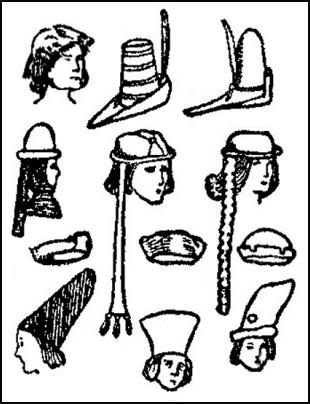
If you are remembering Caxton's shop and a crowd of gentlemen, notice one in a big fur hat, which comes over his eyes; and see also a man who has wound a strip of cloth about his neck and over his head, then, letting one end hang down, has clapped his round, steeple-crowned hat over it.
You will see high collars, low collars, and absence of collar, long gown open to the waist, long gown without opening, short-skirted tunic, tunic without any skirt, long, short, and medium shoes, and, at the end of the reign, one or two broad-toed shoes. Many of these men would be carrying sticks; most of them would have their fingers covered with rings.
Among the group of gentlemen about Edward some merchants have pressed closer to see the King, and a girl or two has stolen into the front row. The King, turning to make a laughing remark to one of his courtiers, will see a roguish, pretty face behind him - the face of a merchant's wife; he will smile at her in a meaning way.
§
THE WOMEN
France, at this date, shows us a sartorial Savonarola, by name Thomas Conecte, a preaching friar, who held an Anti-Hennin Crusade, which ended in a bonfire of these steeple head-dresses.
The flames of these peculiar hats lit up the inspired devotees, and showed their heads wrapped in plain linen wimples or some little unaffected caps. But the ashes were hardly cold before the gray light of the next day showed the figure of the dreaded preacher small upon the horizon, and lit upon the sewing-maids as they sat making fresh steeples for the adornment of their ladies' heads.
Jane Shore - Mistress of Edward IV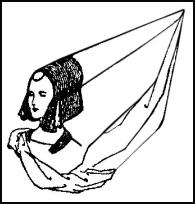
Joan of Arc is dead, and another very different apparition of womankind looms out of the mists of history. Whilst Joan of Arc is hymned and numbered among the happy company of saints triumphant, Jane Shore is roared in drinking-songs and ballads of a disreputable order, and is held up as an awful example. She has for years been represented upon the boards of West End and Surrey-side theatres - in her prime as the mistress of Edward IV, in her penance before the church door, and in her poverty and starvation, hounded from house to house in a Christian country where bread was denied to her.
I myself have seen her through the person of a stout, melancholy, and h-less lady, who, dressed in a sort of burlesque fish-wife costume, has lain dying on the prompt-side of the stage, in a whirl of paper snow, while, to the edification of the twopenny gallery, she has bewailed her evil life, and has been allowed, by a munificent management, to die in the arms of white-clad angels.
There is a gleam of truth in the representation, and you may see the real Jane Shore in a high steeple head-dress, with a thin veil thrown over it, with a frontlet or little loop of black velvet over her forehead; in a high-waisted dress, open in a V shape from shoulder to waist, the opening laced over the square-cut under-gown, the upper gown having a collar of fur or silk, a long train, broad cuffs, perhaps 7 inches long from the base of her fingers, with a broad, coloured band about her waist, a broader trimming of the same colour round the hem of her shirt, and in long peaked shoes. In person of mean stature, her hair dark yellow, her face round and full, her eyes gray, and her countenance as cheerful as herself.
The second real picture of her shows you a haggard woman, with her hair unbound and falling about her shoulders, shivering in a shift, which she clutches about her with one hand, while the other holds a dripping candle; and the third picture shows an old woman in dirty wimple and untidy rags.
Hennin - The Steeple Headdress
Calthrop's - How To Make A Steeple Headdress - A Hennin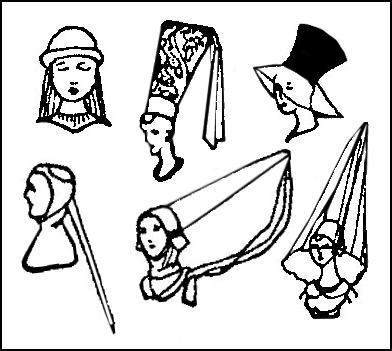
There are many ways of making the steeple head-dress. For the most part they are long, black-covered steeples, resting at an angle of forty-five degrees to the head, the broad end having a deep velvet band round it, with hanging sides, which come to the level of the chin; the point end has a long veil attached to it, which floats lightly down, or is carried on to one shoulder.
Sometimes this steeple hat is worn over a hood, the cape of which is tucked into the dress. Some of these hats have a jutting, upturned piece in front, and they are also covered with all manner of coloured stuffs, but not commonly so.
All persons having an income of £10 a year and over will have that black velvet loop, the frontlet, sewn into their hats.
Cylinder Hat
There is another new shape for hats, varying in height from 8 to 18 inches. It is a cylinder, broader at the top than the bottom, the crown sometimes flat and sometimes rounded into the hat itself; this hat is generally jewelled, and covered with rich material.
The veils are attached to these hats in several ways; either they float down behind from the centre of the crown of the hat, or they are sewn on to the base of the hat, and are supported on wires, so as to shade the face, making a roof over it, pointed in front and behind, or flat across the front and bent into a point behind, or circular.
Take two circles of wire, one the size of the base of your hat and the other larger, and dress your linen or thin silk upon them; then you may pinch the wire into any variations of squares and circles you please.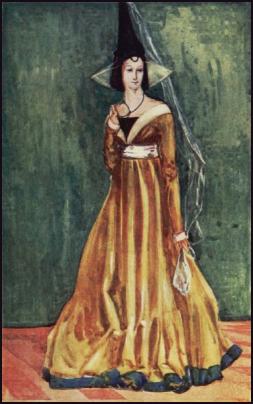
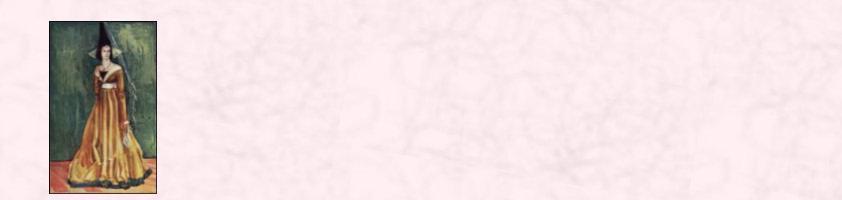
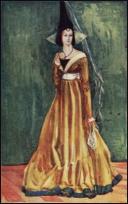
A WOMAN OF THE TIME OF EDWARD IV - 1461-1483
The costume plate shows a lady wearing a steeple headdress - the high hennin from which hangs a wisp of linen. On her forehead is the velvet frontlet a veil stretched on wires across her forehead.
The veil was sometimes worn all over the steeple hat, coming down over the face, but stiff enough to stand away from it. Towards the end of the reign the hats were not so high or so erect.
Remember, also, that the horned head-dress of the previous reign is not by any means extinct.
There remain two more forms of making the human face hideous: one is the head-dress closely resembling an enormous sponge bag, which for some unknown reason lasted well into the reign of Henry VII as a variety to the fashionable head-gear of that time, and the other is very simple, being a wimple kept on the head by a circular stuffed hoop of material, which showed, plain and severe across the forehead. The simple folk wore a hood of linen, with a liripipe and wide ear-flaps.
The dresses are plain in cut; they are all short-waisted if at all fashionable. The most of them have a broad waist-belt, and very deep borders to their skirts; they have broad, turned-back cuffs, often of black. These cuffs, on being turned down over the hand, show the same colour as the dress; they are, in fact, the old long cuff over the fingers turned back for comfort.
Gown Openings
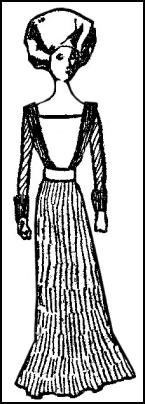
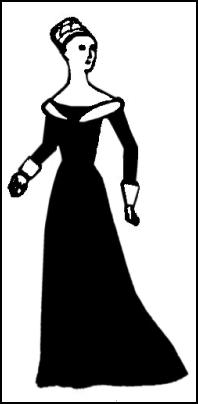 It is by the variety of openings at the necks of the gowns that you may get change. First, let me take the most ordinary - that is, an opening of a V shape from shoulders to waist, the foot of the V at the waist, the points on the top of the shoulders at the join of the arm.
Across this opening is seen, cut square and coming up to the base of the bosom, the under-gown.
You may now proceed to vary this by lacing the V across, but not drawing it together, by having the V fur-edged, or made to turn over in a collar of black upon light material, or its opposite, by showing a vest of stuff other than that of the under-gown, which will then make a variety of colour when the skirt is held up over the arm.
Or you may have your dress so cut that it is high in front and square cut, and over this you may sew a false V collar wither to or above the waist. I have said that the whole neck-opening may be covered by a gorget of cloth, which was pinned up to the steeple hat, or by a hood of thin stuff or silk, the cape of which was tucked into the dress.
The lady, I think, is now complete down to her long-pointed shoes, her necklet of stones or gold chain, with cross or heraldic pendant, and it remains to show that the countrywoman dressed very plainly, in a decent-fitting dress, with her waist in its proper place, her skirt full, the sleeves of her dress turned back like my ldy's, her head wrapped in a wimple or warmed in a hood, her feet in plain, foot-shaped shoes, and wooden clogs strapped on to them for outdoor use or kitchen work; in fact, she looked much like any old body to-day who has lived in a village, except that the wimple and the hood then worn are out of place to-day, more's the pity!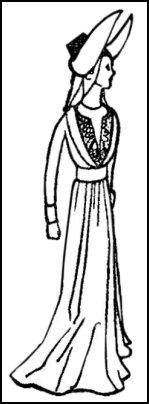
No doubt ladies were just human in those days, and fussed and frittered over an inch or so of hennin, or a yard or two of train. One cut her dress too low to please the others, and another wore her horned head-dress despite the dictates of Fashion, which said, 'Away with horns, and into steeples.'
No doubt the tall hennins, with their floating veils, looked like black masts with silken sails, and the ladies like a crowd of shipping, with velvet trains for waves about their feet; no doubt the steeples swayed and the silks rustled when the heads turned to look at the fine men in the days when hump-shouldered Richard was a dandy.
EDWARD THE FOURTH
Reigned twenty-two years: 1461-1483.
Born 1441. Married, 1464, Elizabeth Woodville.
This costume history information consists of Pages 198-212 of the chapter on the 15th century dress in the 22 YEAR REIGN era of Edward the Fourth 1461-1489 and taken from English Costume by Dion Clayton Calthrop.
The 36 page section consists of a text copy of the book ENGLISH COSTUME PAINTED & DESCRIBED BY DION CLAYTON CALTHROP. Visuals, drawings and painted fashion plates in the book have a charm of their own and are shown amid the text. The book covers both male and female dress history of over 700 years spanning the era 1066-1830.
This page is about dress in the 22 year reign of King Edward the Fourth 1461-1489. The images and details are a good resource for costuming Shakespeare's stage plays of the Plantagenet era.
For the Introduction to this book see this introduction written by Dion Clayton Calthrop. I have adjusted the images so they can be used for colouring worksheets where pupils add some costume/society facts.
You have been reading English Costume History at www.fashion-era.com © from the chapter Edward the Fourth 1461-1489, from Dion Clayton Calthrop's book English Costume.
Page Added 11 August 2010. Ref:-P800.
Sitemap
For more information about English Costume By Dion Clayton Calthrop
see these pages:
- Costume History Home
- Introduction to English Costume by Calthrop
- 1066-1216 Norman
- 1272-1485 Plantagenet
- 1216-1272 Henry III
- 1066-1272 Peasants' Costume - End of the Fourteenth Century
- 1272-1307 Edward I
- 1307-1327 Edward II
- 1327-1377 Edward III
- 1377-1399 Richard II
- 1399-1413 Henry IV
- 1400 Chaucer's Medieval Dress
- 1413-1422 Henry V
- 1422-1461 Henry VI
- 1461-1483 Edward IV
- 1483-1485 Richard III
- 1485-1603 Tudor
- 1603-1714 Stuart
- 1603-1830 Hanover
- Chambre Syndicale
- Theories of Fashion