
King Richard III 1483-1485
English Costume by Dion Clayton Calthrop
By Pauline Weston Thomas for Fashion-Era.com
King Richard III 1483-1485
English Costume by Dion Clayton Calthrop
 This costume history information consists of Pages 213-223 of the chapter on the 15th century dress in the 2 YEAR REIGN era of Richard the Third 1483-1485 and taken from English Costume by Dion Clayton Calthrop.
The 36 page section consists of a text copy of the book ENGLISH COSTUME PAINTED & DESCRIBED BY DION CLAYTON CALTHROP. Visuals, drawings and painted fashion plates in the book have a charm of their own and are shown amid the text. The book covers both male and female dress history of over 700 years spanning the era 1066-1830.
This page is about dress in the 2 year reign of King Richard the Third 1483-1485. The images and details are a good resource for costuming Shakespeare's stage plays of the Plantagenet era.
For the Introduction to this book see this introduction written by Dion Clayton Calthrop. I have adjusted the images so they can be used for colouring worksheets where pupils add some costume/society facts.
My comments are in italics.
RICHARD THE THIRD
Reigned two years: 1483-1485.
Born 1450. Married, 1473, Anne Neville.
EDWARD THE FIFTH
Reigned two months: April and June, 1487.
THE MEN
Fashion's pulse beat very weak in the spring of 1483. More attune to the pipes of Fate were the black cloaks of conspirators and a measured tread of soft-shoed feet than lute and dance of airy millinery. The axe of the executioner soiled many white shirts, and dreadful forebodings fluttered the dovecots of high-hennined ladies.
The old order was dying; Medievalism, which made a last spluttering flame in the next reign, was now burnt low, and was saving for that last effort. When Richard married Anne Neville, in the same year was Raphael born in Italy; literature was beginning, thought was beginning; many of the great spirits of the Renaissance were alive and working in Italy; the very trend of clothes showed something vaguely different, something which shows, however, that the foundations of the world were being shaken - so shaken that men and women, coming out of the gloom of the fourteenth century through the half-light of the fifteenth, saw the first signs of a new day, the first show of spring, and, with a perversity or an eagerness to meet the coming day, they began to change their clothes.
It is in this reign of Richard III that we get, for the men, a hint of the peculiar magnificence of the first years of the sixteenth century; we get the first flush of those wonderful patterns which are used by Memline and Holbein, those variations of the pine-apple pattern, and of that peculiar convention which is traceable in the outline of the Tudor rose.
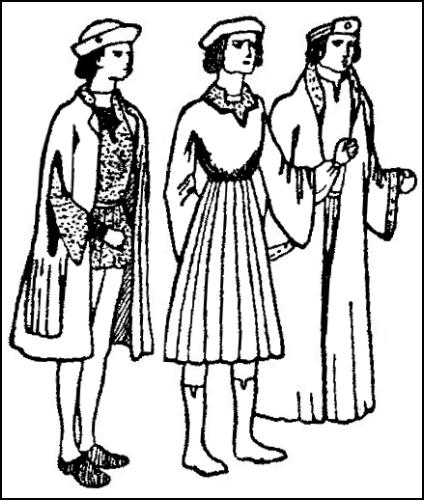
The men, at first sight, do not appear very different to the men of Edward IV's time; they have the long hair, the general clean-shaven faces, open-breasted tunics, and full-pleated skirts.
But, as a rule, the man, peculiar to his time, the clothes-post of his age, has discarded the tall peaked hat, and is almost always dressed in the black velvet, stiff-brimmed hat. The pleated skirt to his tunic has grown longer, and his purse has grown larger; the sleeves are tighter, and the old tunic with the split, hanging sleeves has grown fuller, longer, and has become an overcoat, being now open all the way down.
You will see that the neck of the tunic is cut very low, and that you may see above it, above the black velvet with which it is so often bound, the rich colour or fine material of an undergarment, a sort of waistcoat, and yet again above that the straight top of a finely-pleated white shirt.
Sometimes the sleeves of the tunic will be wide, and when the arm is flung up in gesticulation, the baggy white shirt, tight-buttoned at the wrist, will show. Instead of the overcoat with the hanging sleeves, you will find a very plain-cut overcoat, with sleeves comfortably wide, and with little plain lapels to the collar. It is cut wide enough in the back to allow for the spread of the tunic.
Black velvet is becoming a very fashionable trimming, and will be seen as a border or as under-vest to show between the shirt and the tunic. No clothes of the last reign will be incongruous in this; the very short tunics which expose the cod-piece, the split-sleeve tunic, all the variations, I have described. 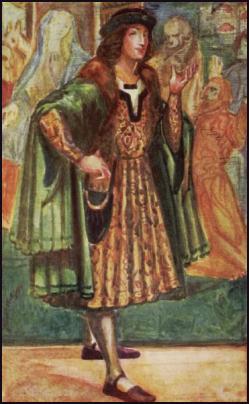
Judges walk about, looking like gentlemen of the time of Richard II: a judge wears a long loose gown, with wide sleeves, from out of which appear the sleeves of his under-tunic, buttoned from elbow to wrist; he wears a cloak with a hood, the cloak split up the right side, and fastened by three buttons upon the right shoulder.
A doctor is in very plain, ample gown, with a cape over his shoulders and a small round cap on his head. His gown is not bound at the waist.
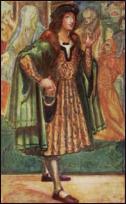
A MAN OF THE TIME OF RICHARD III - 1483-1485
This costume plate shows a gentleman wearing a new fashion trend of the first of the broad-toed shoes and the birth of the Tudor costume. Note the early components of Tudor dress - the full pleated skirts and the prominent white shirt.
The blunt shoes have come into fashion, and with this the old long-peaked shoe dies for ever.
Common-sense will show you that the gentlemen who had leisure to hunt in these times did not wear their most foppish garments, that the tunics were plain, the boots high, the cloaks of strong material. They wore a hunting-hat, with a long peak over the eyes and a little peak over the neck at the back; a broad band passed under the chin, and, buttoning on to either side of the hat, kept it in place.
The Peasant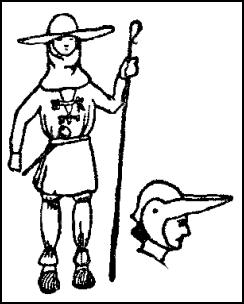
The peasant wore a loose tunic, often open-breasted and laced across; he had a belt about his waist, a hood over his head, and often a broad-brimmed Noah's Ark hat over the hood; his slops, or loose trousers, were tied below the knee and at the ankles. A shepherd would stick his pipe in his belt, so that he might march before his flock, piping them into the fold.
To sum up, you must picture a man in a dress of Edward IV's time, modified, or, rather, expanded or expanding into the costume of Henry VII's time - a reign, in fact, which hardly has a distinct costume to itself - that is, for the men - but has a hand stretched out to two centuries, the fifteenth and the sixteenth; yet, if I have shown the man to you as I myself can see him, he is different from his father in 1461, and will change a great deal before 1500.
THE WOMEN
Here we are at the end of an epoch, at the close of a costume period, at one of those curious final dates in a history of clothes which says that within a year or so the women of one time will look hopelessly old-fashioned and queer to the modern woman. Except for the peculiar sponge-bag turban, which had a few years of life in it, the woman in Henry VII's reign would look back at this time and smile, and the young woman would laugh at the old ideas of beauty.
The River of Time runs under many bridges, and it would seem that the arches were low to the Bridge of Fashion in 1483, and the steeple hat was lowered to prevent contact with them. 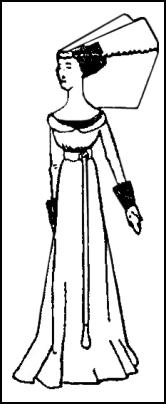
The correct angle of forty-five degrees changed into a right angle, the steeple hat, the hennin, came toppling down, and an embroidered bonnet, perched right on the back of the head, came into vogue. It is this bonnet which gives, from our point of view, distinction to the reign. It was a definite fashion, a distinct halt.
It had travelled along the years of the fourteenth century, from the wimple and the horns, and the stiff turbans, and the boxes of stiffened cloth of gold; it had languished in the caul and blossomed in the huge wimple-covered horns; it had shot up in the hennin; and now it gave, as its last transformation, this bonnet at the back of the head, with the stiff wimple stretched upon wires. Soon was to come the diamond-shaped head-dress, and after that the birth of hair as a beauty.
In this case the hair was drawn as tightly as possible away from the forehead, and at the forehead the smaller hairs were plucked away; even eyebrows were a little out of fashion. Then this cylindrical bonnet was placed at the back of the head, with its wings of thin linen stiffly sewn or propped on wires. These wires were generally of a shape, the point at the forehead.
On some occasions two straight wires came out on either side of the face in addition to the , and so made two wings on either side of the face and two wings over the back of the head. It is more easy to describe through means of the drawings, and the reader will soon see what bend to give to the wires in order that the wings may be properly held out.
Beyond this head-dress there was very little alteration in the lady's dress since the previous reign. The skirts were full; the waist was high, but not absurdly so; the band round the dress was broad; the sleeves were tight; and the cuffs, often of fur, were folded back to a good depth.
The neck opening of the dress varied, as did that of the previous reign, but whereas the most fashionable opening was then from neck to waist, this reign gave more liking to a higher corsage, over the top of which a narrow piece of stuff showed, often of black velvet.
We may safely assume that the ladies followed the men in the matter of broad shoes. For a time the old fashion of the long-tongued belt came in, and we see instances of such belts being worn with the tongue reaching nearly to the feet, tipped with a metal ornament.
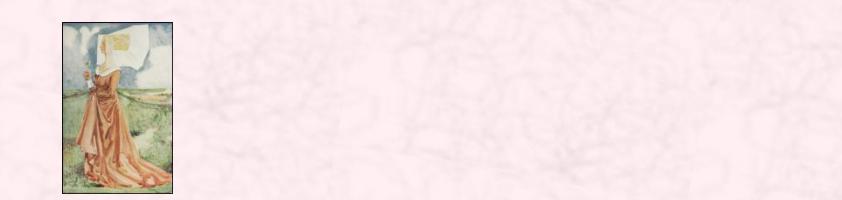
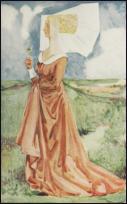
A WOMAN OF THE TIME OF RICHARD III - 1483-1485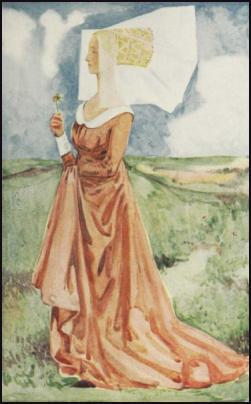
The costume plate shows the lower steeple headdress which is made of thin linen stretched upon wires; through this her jewelled cap and the embellishment is visible.
Not until night did these ladies discard their winged head erections; not until the streets were dark, and the brass basins swinging from the barbers' poles shone but dimly, and the tailors no longer sat, cross-legged, on the benches in their shop-fronts - then might my lady uncover her head and talk, in company with my lord, over the strange new stories of Prester John and of the Wandering Jew; then, at her proper time, she will go to her rest and sleep soundly beneath her embroidered quilt, under the protection of the saints whose pictures she has sewn into the corners of it. Matthew, Mark, Luke, and John, bless the bed that she lies on.
So we come to an end of a second series of dates, from the First Edward to the Third Richard, and we leave them to come to the Tudors and their follies and fantastics; we leave an age that is quaint, rich, and yet fairly simple, to come to an age of padded hips and farthingales, monstrous ruffs, knee-breeks, rag-stuffed trunks, and high-heeled shoes.
With the drawings and text you should be able to people a vast world of figures, dating from the middle of the thirteenth century, 1272, to nearly the end of the fifteenth, 1485, and if you allow ordinary horse-sense to have play, you will be able to people your world with correctly-dressed figures in the true inspiration of their time.
You cannot disassociate the man from his tailor; his clothes must appeal to you, historically and soulfully, as an outward and visible sign to the graces and vices of his age and times.
RICHARD THE THIRD
Reigned two years: 1483-1485.
Born 1450. Married, 1473, Anne Neville.
EDWARD THE FIFTH
Reigned two months: April and June, 1487.
This costume history information consists of Pages 213-223 of the chapter on the 15th century dress in the 2 YEAR REIGN era of Richard the Third 1483-1485 and taken from English Costume by Dion Clayton Calthrop.
The 36 page section consists of a text copy of the book ENGLISH COSTUME PAINTED & DESCRIBED BY DION CLAYTON CALTHROP. Visuals, drawings and painted fashion plates in the book have a charm of their own and are shown amid the text. The book covers both male and female dress history of over 700 years spanning the era 1066-1830.
This page is about dress in the 2 year reign of King Richard the Third 1483-1485. The images and details are a good resource for costuming Shakespeare's stage plays of the Plantagenet era.
For the Introduction to this book see this introduction written by Dion Clayton Calthrop. I have adjusted the images so they can be used for colouring worksheets where pupils add some costume/society facts.
My comments are in italics.
You have been reading English Costume History at www.fashion-era.com © from the chapter Richard the Third 1483-1485, from Dion Clayton Calthrop's book English Costume.
Page Added 11 August 2010. Ref:-P801.
Sitemap
For more information about English Costume By Dion Clayton Calthrop
see these pages:
- Costume History Home
- Introduction to English Costume by Calthrop
- 1066-1216 Norman
- 1272-1485 Plantagenet
- 1216-1272 Henry III
- 1066-1272 Peasants' Costume - End of the Fourteenth Century
- 1272-1307 Edward I
- 1307-1327 Edward II
- 1327-1377 Edward III
- 1377-1399 Richard II
- 1399-1413 Henry IV
- 1400 Chaucer's Medieval Dress
- 1413-1422 Henry V
- 1422-1461 Henry VI
- 1461-1483 Edward IV
- 1483-1485 Richard III
- 1485-1603 Tudor
- 1603-1714 Stuart
- 1603-1830 Hanover
- Chambre Syndicale
- Theories of Fashion